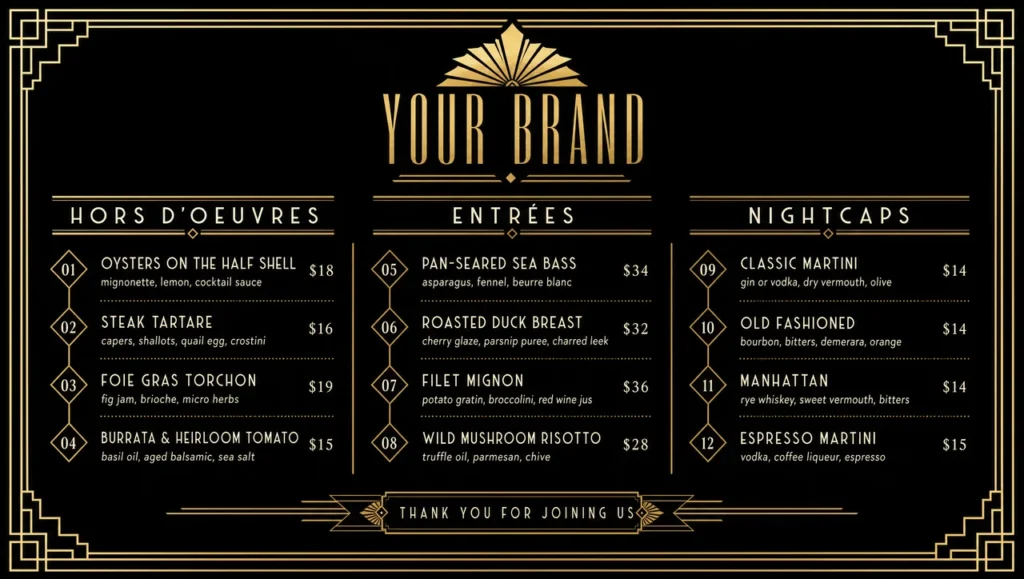
Local Food Menu Template
Characteristics
- Screen formatLandscape 16:9
- Template resolution1280 × 724 px
- Color paletteKraft, deep green, and soft black
- Screen formatLandscape 16:9
- Template resolution1280 × 724 px
- Color paletteBone, ink, and rust brown
- Screen formatPortrait 9:16
- Template resolution1280 × 2264 px
- Color paletteSlate, wheat, and copper
- Screen formatLandscape 16:9
- Template resolution1280 × 724 px
- Color palettePale clay, olive, and cream
- Screen formatPortrait 9:16
- Template resolution1280 × 2264 px
- Color paletteCharcoal, chalk white, and mustard
- Built forRestaurant
- AI customization
- POS price syncSyncs with Toast, Square, Clover
- Paper or screenAvailable as a print-ready download or an automated digital display.
- Automated managementAuto-switches this Local Food Menu by daypart and pushes price updates — no manual republishing.
- Template priceFree
A local food menu has one job an ordinary menu does not: it has to say where the food came from without turning every line into a paragraph. Name the farm inside the dish and the line runs to three rows. Leave it out and the reason the menu exists disappears.
So the source gets a slot of its own. Three sections, twelve lines — From The Garden, From The Farm, Drinks — and beneath each dish one short line in lighter type for the grower, the dairy or the mill. That line is a field, not a sentence: a local menu, food listed by where it grew, changes when the harvest changes, and rewriting prose every fortnight is what kills these boards. A farm to table menu template is only useful if the supplier name is as easy to swap as the price.
In a seated dining room the kraft and deep green build, new for 2026, does the work. Supplier lines sit indented under each dish, close enough to read as part of it, small enough to skip. 1280×724, three sections of nothing but food and provenance, which is the plainest farm to table menu in the set.
Move the growers up into the section heads and the whole thing reads differently. The bone and ink build, also 1280×724, does that — one farm per section, a hand-drawn rule down the edge, dishes left to stand on their own. It suits a local foods menu built around three or four partners rather than twelve, and it is the version guests tend to photograph.
Vertical, for a panel rather than a wall: slate and wheat at 1280×2264, courses numbered, fewer lines, one set price at the foot. This is the farm to table dinner menu — a single sitting, a fixed sequence, no à la carte decisions to make at the table.
Cut the course structure entirely and you get the pale clay and olive build, sized 1280×724 for a counter. Pastries, soup, two coffees — a local cafe menu rather than a restaurant one, short enough to read while queueing.
When the list changes daily, nothing beats a board that looks like it was written that morning. The charcoal and chalk build, 1280×2264, leaves room for a hand-written date at the top and drops the ruled layout for chalk spacing. Run it for a month to find out which growers your room actually asks about before committing to a printed version.
Sections, dishes, supplier lines and prices all change. If you are collecting farm to table menu ideas for a seasonal local menu, the chalkboard is the cheapest place to test them. The rest of the restaurant menu templates cover other formats for a neighborhood restaurant menu, more food menu template sit in the wider library, and pricing flows from the point of sale — the same connection behind the menu boards for restaurants that keep local restaurant menus in step across two or three sites.
Setup Complexity
| Complexity level | Level 3 of 5 |
|---|---|
| Difficulty | Moderate |
| Sections | 3 |
| Menu items | 12 |
| Estimated time | ~3 min |
Want a Local Food Menu in a different format?
Want a different local build?
Tell us how many growers you name and whether the room reads standing or seated, and get a custom local food menu ready to edit.