What Is a QSR? QSR Meaning in Plain English, With Types, Examples and Industry Data


The QSR meaning is simple: QSR stands for quick service restaurant, where guests order and pay at a counter, drive-thru, kiosk or app, choose from a short standardized menu, and get food in minutes with no table service. It's the industry's name for fast food, from McDonald's to a one-location taco counter. What is QSR beyond the acronym? Next, you'll find what the term means, the six traits every QSR shares, the main types with real examples, how QSRs differ from full-service restaurants, and what the QSR industry looks like in 2026.
What Does QSR Stand For? The QSR Meaning in One Line
QSR stands for quick service restaurant, the trade term for a restaurant where guests order without a server and receive their meal within minutes. Guests call it fast food, but in trade language QSR means the same thing. Operators, franchisors, analysts and job listings say QSR, because the acronym describes a business model rather than a type of food. That’s the whole QSR meaning in the restaurant world, and the short answer to what does QSR stand for.
What’s a QSR, then, in plain terms? It’s any restaurant where the guest orders and pays first and gets food in minutes. So when a franchise brochure mentions “QSR brands” or a marketing report tracks “QSR traffic,” it means burger, chicken, sandwich, pizza and coffee chains built on speed. The plural is QSRs, and QSRs run on counter service whatever they sell.
Quick Service Restaurant Definition
The US government’s industry classification gives the clearest quick service restaurant definition. NAICS code 722513, Limited-Service Restaurants, covers establishments “where patrons generally order or select items and pay before eating.” The same class lists fast-food restaurants, carryout shops, sandwich shops, pizza delivery shops and drive-ins as examples. Restaurants with table service fall under a separate code, 722511, Full-Service Restaurants.
That one phrase, pay before eating, is the most reliable test, and it’s also the most useful QSR definition. To define QSR in one line: a restaurant where you pay before you eat and nobody serves you at the table. What is quick service, then? The quick service definition, and the quick service meaning in everyday use, come down to who does the serving: in quick service, the guest orders, picks up and clears the tray, and the staff focuses on making food fast. That’s the quick service restaurant meaning behind every label below.
Not to be confused with casual dining. Some guides call quick service a “casual-dining” format. In industry terms, casual dining means a full-service restaurant with servers, like a family grill. Quick service is limited-service by definition.
Quick Serve Restaurant, Quickservice, Limited-Service: Other Names for QSRs
You’ll see several labels for the same format:
- Quick serve restaurant, quick-serve or quickservice. These are spelling variants of quick service. What is a quick serve restaurant? Exactly the same thing as a QSR, and quick serve restaurants appear in the same rankings.
- Fast service restaurant. An informal version, common in menus and local listings.
- Fast food restaurant. The consumer term, and the answer to “what is the fast food industry called?” In trade language, it is the QSR industry or QSR segment. So if you’re looking for the fast food acronym, it’s QSR, and the QSR meaning is identical.
- Limited-service restaurant (LSR). A wider government and research category. It includes QSRs plus fast casual chains, coffee shops and snack bars, which is why industry figures for “limited-service” run higher than figures for QSRs alone.
QSR Meaning Outside Restaurants
Outside restaurants, QSR has three common meanings:
- Finance. QSR is the stock ticker of Restaurant Brands International, the parent company of Burger King, Tim Hortons, Popeyes and Firehouse Subs.
- Manufacturing and quality. In medical devices, QSR meant the FDA’s Quality System Regulation (21 CFR Part 820). It was replaced by the Quality Management System Regulation (QMSR) on February 2, 2026.
- Software. QSR International is the company that originally developed NVivo, a qualitative research tool.
The rest of this guide covers the restaurant meaning. Next, here’s what every quick service restaurant has in common.
What Is a QSR Restaurant? 6 Traits of a Quick Service Restaurant
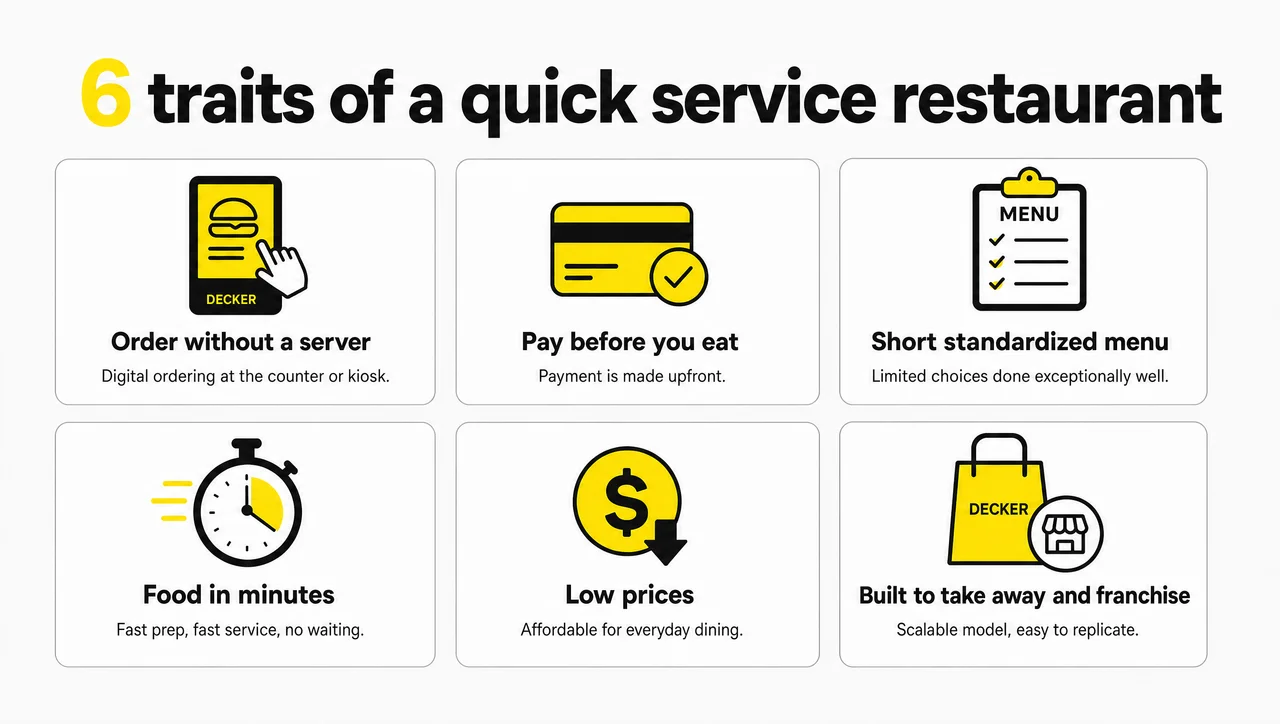
A quick service restaurant is a limited-service eatery where you order and pay first, pick from a short standardized menu, and get your food in minutes, with no server at the table. No single brand or cuisine makes a restaurant a QSR. The service model does, and that’s the QSR restaurant meaning in practice. These six traits define every QSR restaurant:
- Ordering without a server. Guests order at a counter, a drive-thru speaker, a self-order kiosk or a mobile app.
- Payment before the meal. The check comes first, as the NAICS definition states.
- A short, standardized menu. Every location serves the same items, prepared the same way. This keeps training short and mistakes rare.
- Speed measured in minutes. The kitchen is built for a steady flow of orders and lunch-hour peaks.
- Low prices. A combo or value meal costs a fraction of a full-service dinner, because the model runs on volume rather than service.
- Built to take away and to copy. Takeout, drive-thru and delivery carry most orders, and strict standards let the format grow through franchising.
| Trait | What it looks like in a QSR | Why it matters |
|---|---|---|
| No server | counter, drive-thru, kiosk or app | lower labor cost per order |
| Pay first | payment at order | faster table turnover, no check wait |
| Standard menu | same recipes in every location | predictable taste, fast training |
| Speed | meals ready in minutes | more orders per hour |
| Low prices | value meals and combos | wide audience, frequent visits |
| Replicable | written procedures and brand standards | growth through franchising |
If a restaurant checks most of these boxes, it’s a quick service restaurant, whatever the sign above the door says. Next, here’s how QSRs run those six traits day to day.
How the Quick Service Model Works
The fast service model works like an assembly line: every ordering channel feeds one kitchen, the menu is short enough to prepare ahead, and each person on the team owns one station. That’s the QSR concept in one sentence, and QSR food service everywhere runs on it. The parts below explain how it plays out in practice.
Ordering Channels: Counter, Drive-Thru, Kiosk, App and Delivery
Modern QSRs take orders through five channels at once:
- Front counter. The classic order point, still the default for dine-in guests.
- Drive-thru. The signature quick service channel. It only works when food is ready almost instantly.
- Self-order kiosk. It takes pressure off the counter and lets guests customize orders without holding up the line.
- Mobile order-ahead. The guest pays in the app and picks up at a shelf or curbside.
- Delivery. Orders from delivery apps and the brand’s own site go to the same kitchen.
Most of that traffic leaves the building. According to an April 2025 National Restaurant Association report, nearly 75% of all restaurant traffic now happens off-premises, and 58% of limited-service operators say off-premises orders make up a bigger share of sales than in 2019.
Speed at the window is measured in seconds. In Intouch Insight’s 2025 drive-thru study, classic fast-food brands averaged 5 minutes 9 seconds of total time per visit, and the fastest brand, Taco Bell, averaged 4 minutes 16 seconds.
Kitchen and Menu Built for Speed
QSRs cook in batches, hold finished components in warming cabinets, and assemble each order at a make line. A kitchen display system (KDS) sends every ticket to the right station, so the grill, the fryer and the drinks work in parallel.
The menu is designed around that line. A short menu means fewer ingredients, less waste and predictable bulk purchasing. Limited-time offers (LTOs) bring variety without new equipment: a seasonal sandwich usually reuses buns, sauces and proteins that are already in stock.
What Are Quick Service Servers?
Traditional quick service restaurants have no servers in the restaurant sense, so the quick service servers meaning depends on the employer. “Quick service server” is a job title some employers use, especially theme parks, stadiums, campuses and hospital cafés, for a counter team member who takes the order, assembles it and hands it off. Some also run food to tables.
| Role | What they do |
|---|---|
| Cashier or quick service server | takes orders and payments, hands off food |
| Crew member | cooks, assembles and packs orders |
| Drive-thru operator | takes orders at the speaker, runs the window |
| Food runner | brings orders to tables or curbside |
| Shift leader | runs the floor during one shift |
Theme parks use the same vocabulary: at Disney parks, for example, “quick-service” restaurants are the counter-order spots, as opposed to table-service dining.
A Short History of Quick Service
The format is about a century old. White Castle, founded in Wichita, Kansas, in 1921, is widely credited as the first fast-food chain. In 1948, the McDonald brothers turned their drive-in into a limited-menu, assembly-line kitchen they called the Speedee Service System. That kitchen became the template the whole industry still follows. As a result, quick service kitchens look alike behind the counter, with a make line and a KDS, even when their menus have nothing in common.
Types of QSR Restaurants, With Quick Service Restaurant Examples
Quick service restaurants range from burger and chicken chains to coffee counters, pizza delivery and delivery-only kitchens, and what unites them is order-and-go service, not the food. What are QSR restaurants in practice? Here are the main types of QSR fast food and beyond, with real chains:
| Type | Examples | How it serves |
|---|---|---|
| Burgers | McDonald’s, Burger King, Wendy’s, Jack in the Box | counter, drive-thru, kiosk, app |
| Chicken | Chick-fil-A, KFC, Popeyes | counter, drive-thru, often double lanes |
| Sandwiches and subs | Subway, Firehouse Subs | assembly line in front of the guest |
| Pizza | Domino’s, Pizza Hut | delivery and carryout first |
| Mexican-inspired | Taco Bell | drive-thru and late-night |
| Coffee and bakery | Starbucks, Dunkin’, Tim Hortons | counter, drive-thru, mobile order |
| Fast casual | Chipotle, Panera Bread | made to order in front of the guest |
| Delivery-only and ghost kitchens | virtual brands | app orders only, no dining room |
| Kiosks and concessions | stadium, airport and mall counters | counter only, short menu |
Examples of quick-service (fast food) restaurants are McDonald’s, Burger King, Wendy’s, Taco Bell, KFC and Subway, the chains most textbooks use. Most quick service restaurants serve food that’s easy to prepare ahead or assemble fast: burgers, fried chicken, subs, burritos, pizza, fries and coffee drinks.
Is McDonald’s a Quick Service Restaurant?
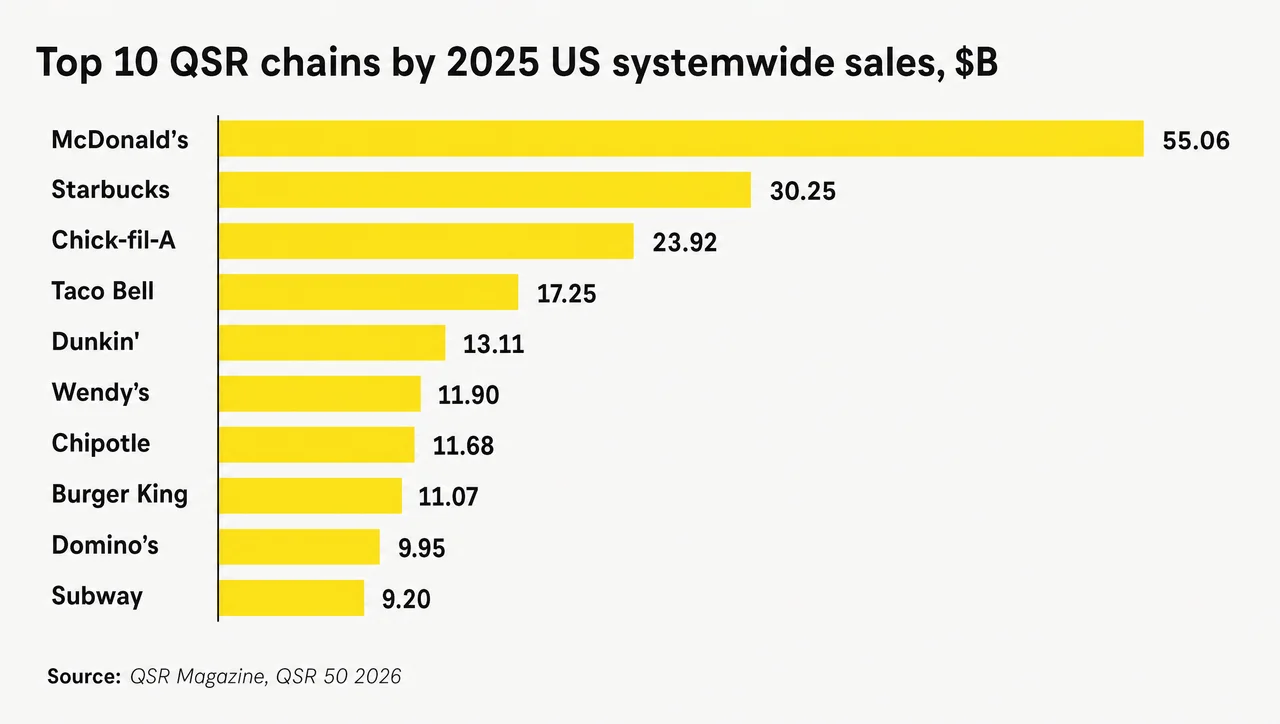
Yes. McDonald’s is the textbook quick service restaurant example, and it meets all six traits: counter, kiosk, app and drive-thru ordering; payment first; a standardized menu; service in minutes; value pricing; and a franchise system. It is also the largest quick service chain in the US. In QSR Magazine’s 2026 QSR 50 ranking, McDonald’s reported $55.06 billion in 2025 US systemwide sales across 13,706 restaurants, ahead of Starbucks ($30.25 billion) and Chick-fil-A ($23.92 billion).
Independent QSRs: Not All Quick Service Restaurants Are Chains
Chains dominate headlines, but independents make up a large part of the category. One market research estimate puts independent outlets at about 57% of the US quick service market in 2025. Many small quick service restaurants grow the same way: a juice cart becomes a storefront, a food truck opens a brick-and-mortar location, and a single counter adds a second and third site before selling its first franchise. However, speed isn’t unique to this format, so it helps to compare it with full-service and fine dining.
QSR vs Fast Food vs FSR: How Restaurant Formats Differ
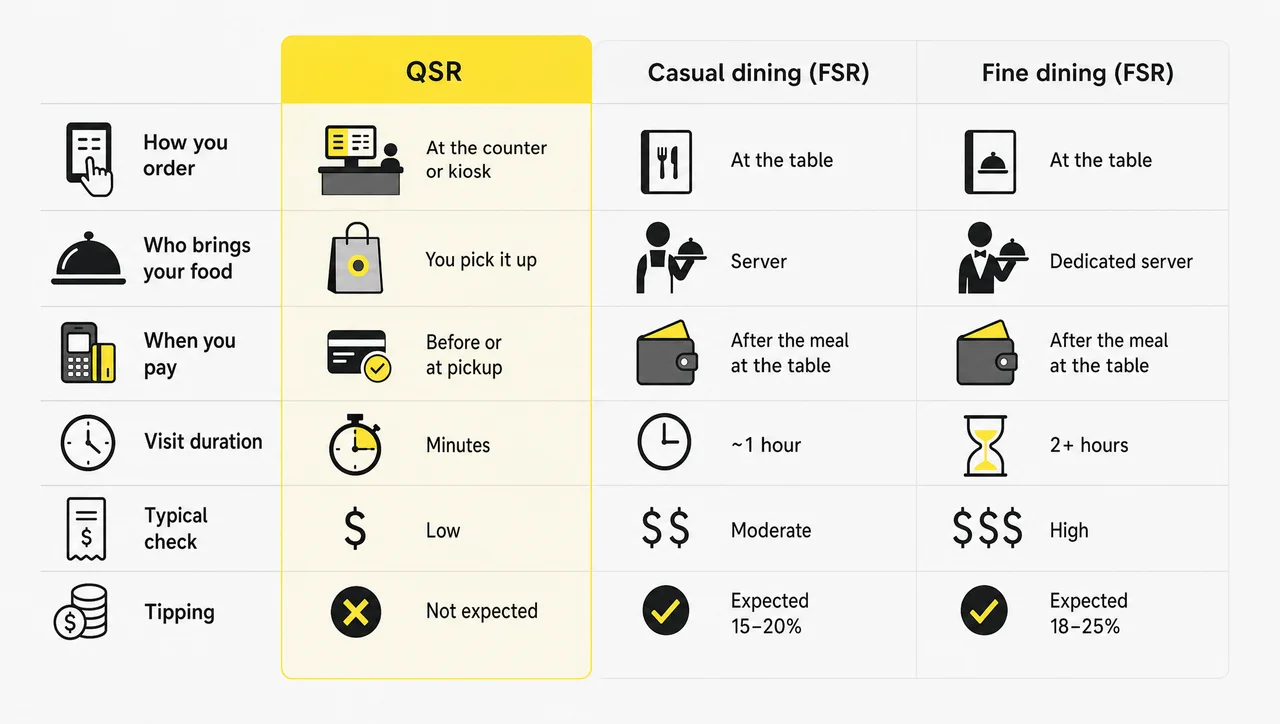
A QSR and a fast food restaurant are the same format under two names, while an FSR, or full-service restaurant, seats guests, takes orders at the table and brings the check after the meal. The table compares a quick service restaurant with the two main kinds of full-service restaurants:
| QSR | Casual dining (FSR) | Fine dining (FSR) | |
|---|---|---|---|
| How guests order | counter, drive-thru, kiosk, app | server at the table | server, often with a sommelier |
| Who brings the food | guest picks it up | server | server team |
| When guests pay | before eating | after the meal | after the meal |
| Typical visit | a few minutes, or takeout | about an hour | two hours or more |
| Menu | short and standardized | broad, with specials | seasonal, often chef-driven |
| Check per person | lowest | mid-range | highest |
| Tipping | optional | expected | expected |
| Example | McDonald’s | Applebee’s | a chef-owned tasting-menu restaurant |
Is QSR the Same as Fast Food?
In practice, yes, and the QSR meaning doesn’t change. In the quick service restaurant vs fast food question, fast food describes the food, and QSR describes the business model. Fast food vs quick service is a difference of vocabulary, not of format. The difference shows up in trade usage: the QSR 50 ranking includes coffee chains like Starbucks and fast casual brands like Chipotle, which most guests wouldn’t call fast food. So in the restaurant vs fast food debate, “restaurant” is the wider category, and a QSR is the restaurant type that serves fast food.
QSR vs FSR (Full-Service Restaurants)
FSR vs QSR comes down to service. An FSR restaurant is built around table service. A host seats the guest, a server takes the order and delivers the food, and the table is cleared after the meal. Many FSRs also run a bar. The range is wide, from family grills to fine dining.
For an operator, the gap is mostly about labor and space. Quick service restaurants need fewer staff per order, less floor space and cheaper equipment, and a stable menu allows bulk purchasing. An FSR earns more per guest but carries higher payroll and longer table turns. Both are under pressure in 2026: in the National Restaurant Association’s 2026 outlook, 29% of limited-service operators expected higher sales this year, compared with 32% of full-service operators. Beyond the dining room, those differences shape the whole QSR industry, from market size to hiring.
What Is the QSR Industry? Size, Business Model and Trends
The QSR industry is the quick service segment of the US restaurant business, which the National Restaurant Association expects to reach $1.55 trillion in total restaurant and foodservice sales and 15.8 million jobs in 2026. The QSR industry meaning is narrower than restaurants overall: it covers counter-service brands only, and the segment’s own size depends on who does the counting.
| Metric | Figure | Source |
|---|---|---|
| US restaurant and foodservice sales, 2026 | $1.55 trillion (forecast) | National Restaurant Association |
| Restaurant industry jobs, 2026 | 15.8 million (forecast) | National Restaurant Association |
| US quick service restaurants market, 2025 | about $294–$453 billion | market research estimates |
| Adults eating fast food on a given day | 36.6% (2013–2016) | CDC, NCHS Data Brief 322 |
| Fast food and counter workers | 3.85 million, median $15.00 an hour (May 2025) | Bureau of Labor Statistics |
The gap in quick service restaurants market estimates comes from definitions. Some firms count only traditional fast food, while others add coffee chains, pizza delivery and fast casual. QSR Magazine describes the quick service restaurant industry it covers as a $350 billion market.
“More than a third of Americans eat fast food every day” isn’t what the data says. The CDC found that 36.6% of adults ate fast food on a given day in 2013–2016. That’s a different group of people each day, not the same people daily. Adults aged 20–39 had the highest rate, at 44.9%.
What Is QSR in Business? How the QSR Business Model Works
What does QSR mean in business? It means a restaurant model that gives up table service in exchange for volume. In marketing, the term covers this model and the brands built on it. Five levers make QSRs work as a business:
- High guest turnover. Takeout, drive-thru and short dine-in visits let one location serve hundreds of orders a day.
- Lower operating costs. Smaller dining rooms, fewer staff per order and simpler equipment keep overhead down compared with full-service restaurants.
- Predictable inventory. A focused menu means fewer ingredients, less waste and bulk purchasing.
- Franchising. QSRs replicate easily because written standards travel well, and franchisees get a known brand, suppliers and a proven playbook. Market research estimates put franchised outlets at roughly two-thirds of global quick service sales.
- Dual-brand locations. Two brands under one roof, such as Taco Bell and KFC, share rent, labor and equipment.
When the QSR Model Isn’t the Right Fit
Quick service is a strong format, but not for every concept:
- Dishes take longer to cook than a drive-thru visit. If a signature dish needs 10–15 minutes on the line, it can’t meet a service window of about 5 minutes. Cook-to-order concepts fit fast casual or full service better.
- The concept depends on long stays. If revenue relies on guests ordering a second round over an hour, counter service cuts that spending short.
- The location has little traffic. The model needs hundreds of low-check orders a day. A quiet street with a few dozen guests can’t cover the rent at fast food prices.
- The menu changes daily. Chef-driven menus that change every day break the standardized recipes and training that make the format fast.
QSR Retail: Convenience Stores and Grocery Food Service
The quick service model now works outside restaurants too. Convenience stores and gas stations sell made-to-order food at a counter. Supermarkets run food-to-go stations, and airports, malls and stadiums host kiosk-style counters. In commercial real estate, “QSR retail” also refers to the buildings themselves: freestanding pads with drive-thru lanes that landlords lease to quick service brands. The format is the same everywhere: order without a server, a short menu and food in minutes.
QSR Trends to Watch
- Automation to offset labor costs. Kiosks, mobile ordering, voice AI in the drive-thru and digital signage built for QSRs handle more orders with smaller teams. The results are mixed so far: Intouch Insight’s 2025 study found that AI-taken drive-thru orders were 83% accurate on their own and 95% accurate with staff support.
- Off-premises by design. QSRs now serve most orders off-premises, so new stores put pickup shelves, double drive-thru lanes and delivery handoff areas ahead of dining room seats.
- Digital loyalty and personalization. Apps reward repeat visits and suggest add-ons based on order history.
- Value pressure. QSRs trim menus to core items and lean on value bundles as food and packaging costs rise.
- Healthier and clearer menus. Guests expect lighter options, ingredient transparency and less packaging, without losing speed.
In other words, the format keeps changing, and so does what it means to work a drive-thru shift or order at a kiosk.
What Is QSR Experience?
QSR experience has two meanings: work experience in a quick service restaurant, listed on a resume, and the guest experience a quick service restaurant delivers from order to pickup. The QSR experience meaning depends on who’s asking: job listings use the first meaning, and operators and marketers use the second.
QSR Experience on a Resume
When a job posting asks for QSR experience, it means time working in a fast food or quick service restaurant. Common roles are crew member, cashier, drive-thru operator, cook, shift leader, assistant manager and general manager. It’s a big workforce: the Bureau of Labor Statistics counted 3.85 million fast food and counter workers in May 2025, with a median wage of $15.00 an hour.
Employers value QSR experience because it proves skills that carry over to retail, logistics and customer service:
- working fast and accurately under peak-hour pressure
- running a POS and handling cash
- following food safety rules, often backed by a food handler card or ServSafe certificate
- staying calm with a line of guests
- following standard procedures without shortcuts
The QSR Guest Experience
For guests, a good QSR experience comes down to five things: speed, order accuracy, the same taste in every location, a menu they can read at a glance, and a clean restaurant. Screens shape that impression too: restaurant digital signage covers order status, promos and wait times, not just the menu. Friendliness matters more than many operators assume. In Intouch Insight’s 2025 study, satisfaction with the service level reached 97% when staff were friendly and dropped to 22% when they weren’t. Food safety sits under all of it: one incident, especially one that goes viral, can damage a brand overnight. Next, here’s how operators keep that experience fast at peak hours.
Quick Service Restaurant Management: What Keeps a QSR Fast
Quick service restaurant management comes down to shaving seconds from every order without losing accuracy, through a tight menu, a smart kitchen layout, trained staff, clear data and a menu board guests can read at a glance. Fast QSRs run on six practices:
- Keep the menu short and executed well. Fewer items mean faster prep, easier training and steady quality at peak hours.
- Design the kitchen for flow. A layout that saves a few seconds per order adds up fast at a hundred orders an hour.
- Train for clear roles. Every team member should own a station. Better benefits, structured training and flexible schedules help keep staff turnover under control.
- Decide with data. Sales data shows which items move, which slow the line and which dayparts need more staff.
- Build food safety into the routine. Checklists, temperature logs and digital compliance tracking make safety habits consistent across shifts.
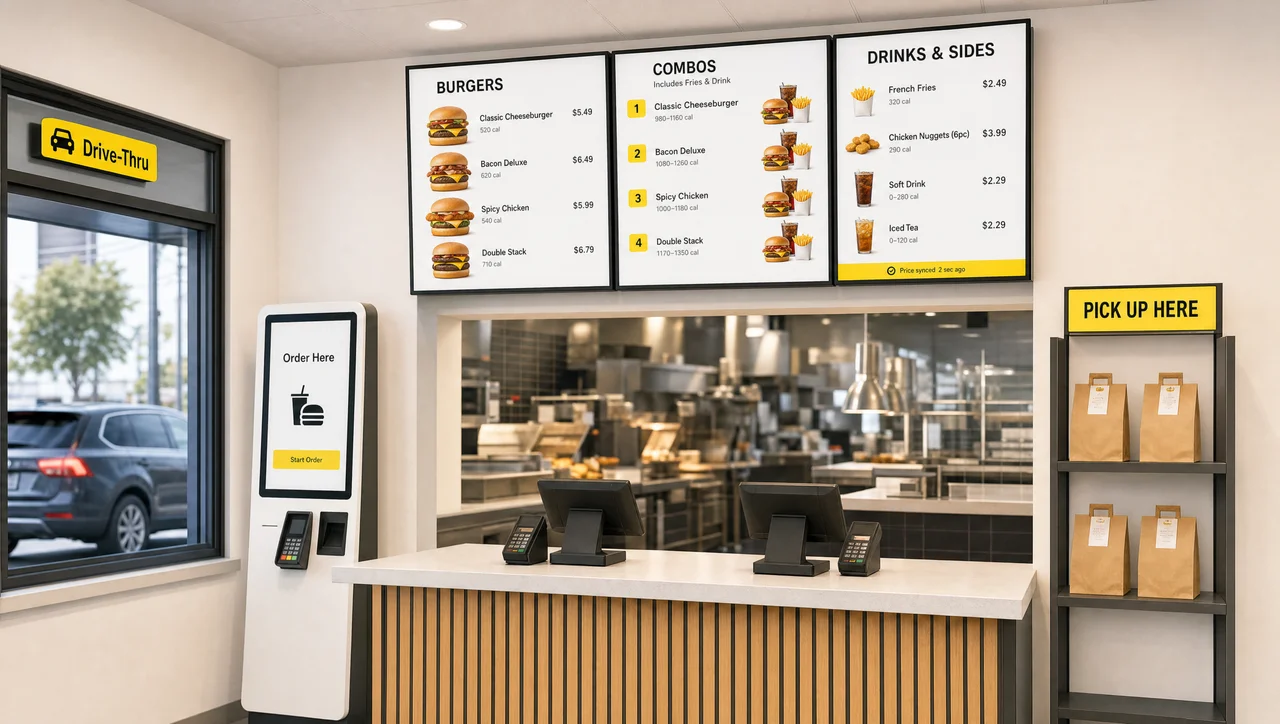
- Make the menu readable in seconds. The line starts at the menu board, which is why many chains have switched from print to digital menu boards. A guest who can’t find a price or asks about a sold-out item holds up everyone behind them.
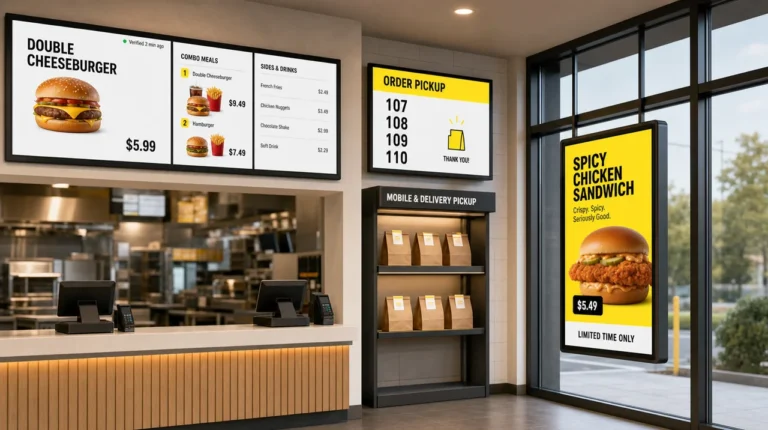
That last point is where many quick service restaurants lose time without noticing it. Printed boards go out of date with every price change and limited-time offer, so staff end up explaining the menu at the register. Digital menu boards for restaurants fix this by showing current prices, combos and dayparts on screen, and by hiding items the kitchen has run out of.
Decker is a digital menu board system built for quick service chains. It pulls prices and item availability from POS systems such as Toast, Square and Clover, so a price changed in the POS appears on every screen in 1–5 seconds through the Decker Player, and items marked unavailable disappear from the board. Breakfast switches to lunch on a schedule, and every location is managed from one dashboard. In the Burger Shop case in Downtown Los Angeles, four menu screens were connected to the POS, and menu updates went from days or weeks to minutes. As a result, the menu board stops being the bottleneck at the counter. Beyond the screens, speed comes from the back of house, where the same station routines that run a restaurant kitchen through a lunch rush keep every ticket moving from the KDS to the make line.
Questions and Answers
1 What does QSR mean in a restaurant?
The QSR meaning in restaurant language is quick service restaurant, so if you wonder what is QSR in restaurant terms, it’s a place where you order and pay at a counter, drive-thru, kiosk or app, pick from a short menu and get your food in minutes without a server. Fast food chains like McDonald’s, Taco Bell and Subway are the best-known QSRs.
2 What is the difference between QSR and fast casual?
A QSR prepares most of its food ahead and serves it almost instantly, often through a drive-thru. A fast casual restaurant cooks or assembles each order fresh in front of the guest, costs a few dollars more per meal and has a more relaxed dining room. Both skip table service.
3 Is fast casual part of the QSR industry?
Often, yes. Trade publications and rankings such as the QSR 50 cover fast casual chains alongside traditional fast food, and the government’s limited-service category includes both. Chipotle, a fast casual chain, ranks among the top 10 QSR 50 brands by US sales.
4 Is Starbucks a QSR?
Yes. Starbucks is a coffee chain usually classified as a quick service restaurant: guests order at a counter, drive-thru or app, pay first and pick up their drinks. It ranked second in the 2026 QSR 50, with $30.25 billion in 2025 US systemwide sales.
5 Is a food truck a quick service restaurant?
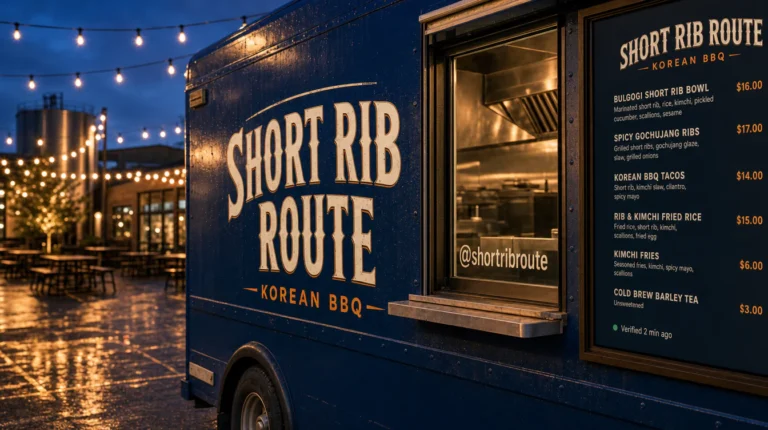
A food truck uses the quick service model: order at the window, pay first and choose from a short menu. Officially, food trucks have their own industry code, NAICS 722330, Mobile Food Services. Many food trucks later open brick-and-mortar restaurants.
6 Can you tip at a quick service restaurant?
You can, but it’s optional. Many QSRs now offer a digital tip prompt at the register or in the app. Tipping is standard at full-service restaurants, where a server handles the whole meal.
7 Are all QSRs chains?
No. A national chain is the most visible kind of quick service restaurant, but independent operators hold a large share of the US quick service market, about 57% by one 2025 estimate. Many independents start as a cart, a food truck or a single counter.
Sources
- National Restaurant Association — From Trend to Transformation: Off-Premises Dining Now Essential
- CDC, National Center for Health Statistics — Fast Food Consumption Among Adults in the United States
- U.S. Bureau of Labor Statistics — Occupational Employment and Wages
- QSR Magazine — QSR 50 2026: Top 50 Fast-Food Chains, Ranked by Sales