How to Run a Restaurant Kitchen Efficiently, Shift by Shift



Running a restaurant kitchen comes down to five systems: a station map and prep lists, a ticket flow from POS to the pass, food safety temperatures and logs, cost targets for food and labor, and a daily 86 routine that keeps the dining room in sync with the line.
What It Takes to Run a Restaurant Kitchen: Five Systems
A restaurant kitchen does not fall apart because one cook has a bad night. It falls apart when one of five systems has no owner and no paperwork behind it. To run a restaurant kitchen well, each system needs a named owner and a document behind it. Each system produces a physical artifact that someone checks every day, and that artifact is what makes the system real instead of a good intention.
| System | What it controls | Daily artifact |
|---|---|---|
| Station map | Who stands where and who owns which items | One-page station description per position |
| Prep and par levels | What gets made today for tomorrow | Prep list with build-to amounts |
| Ticket flow | How an order moves from POS to the pass | Ticket times by station |
| Food safety | Temperatures, labels, and rotation | Temperature and cooling logs |
| Cost control | Food cost, labor cost, and waste | Weekly inventory and waste log |
The 86 routine sits on top of all five, because every sold-out item touches prep, service, and what the guest is still being offered.
Design the Line Before You Design the Menu
You run a restaurant kitchen from the layout out, not from the menu in: most problems in a commercial kitchen are layout problems wearing a costume. If a cook has to cross the room for a pan mid-service, that trip happens a hundred times a night.
One Direction of Travel
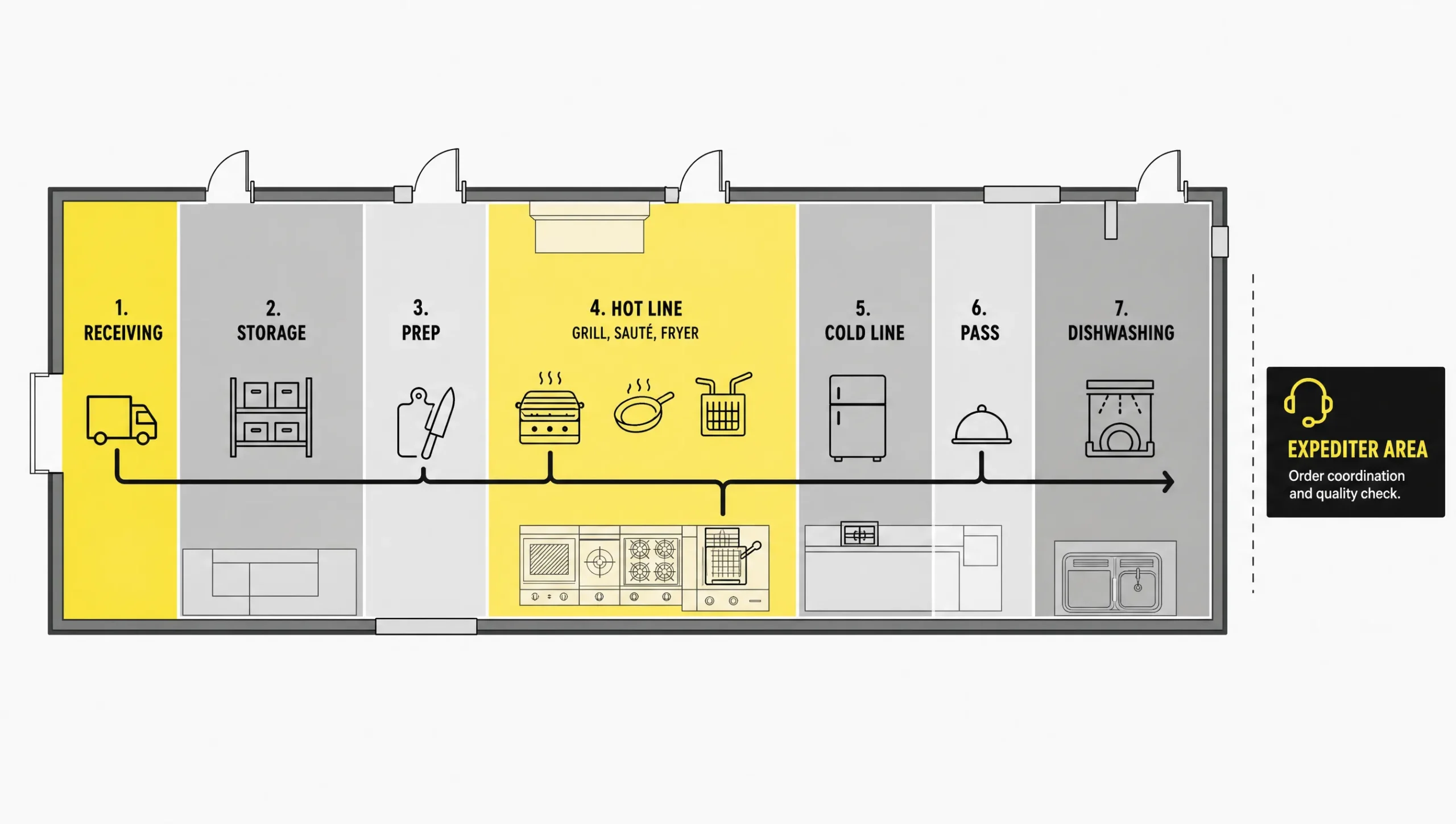
Set the room up as an assembly line that moves one way: receiving, storage, prep, cooking, plating, pass, then dish. Ingredients should travel in a logical sequence from delivery to plate without doubling back, and staff paths should not cross in the narrow spots. Each station (prep, grill, sauté, fryer, cold station, pass) owns specific components of every ticket and keeps its own tools and mise en place within arm’s reach.
Write a Station Description for Every Position
Give each station a one-page duty list: setup, service responsibilities, closing tasks, and quality standards. A written station, a clear chain of command, and at least one backup skill per person are what keep a line running when someone calls out. This single document also cuts training time, because a new cook reads the station instead of shadowing someone for a week.
Build a Menu the Line Can Execute
A veteran chef’s rule: put the complexity into prep and keep execution simple. A dish that takes four pans during service will never be made well when 30 tickets are up. Standardize sides and vary the mains instead, so a handful of components support many plates. A simplified menu also lowers the number of stations a small kitchen needs.
Clean and Organized Is a Financial System
Dirty, chaotic kitchens lose money: product goes missing, cooks slow down, and inspections turn expensive. It is also far easier to keep a kitchen clean when each shift starts clean, which is why closing standards belong in the station descriptions rather than in someone’s memory.
Stay a Day Ahead: Prep Lists, Par Levels, and Mise en Place
Prep is what decides whether service is calm or frantic, and the rule behind it is simple: today’s shift is built yesterday. That takes three things — a prep list driven by par levels rather than guesswork, a prep area that produces shared components in batches, and labeling that keeps rotation honest.
The Day-Ahead Rule
The clearest operating principle in a kitchen comes from career chefs: when you walk in the door in the morning, you are planning for tomorrow, because today should have been set up yesterday. A kitchen that is not a day ahead is permanently behind, and every rush arrives as a surprise.
Set Pars From Data, Not Feel
For each prep item, record how much you should have on hand to get through a set period, and treat that number as the par or build-to amount. The prep list then writes itself: current count versus par. Pull the numbers from actual sales history rather than from what last Friday felt like.
What the Prep Area Handles
Prep is where portioning, sauces, stocks, and shared components get made, labeled, and dated. It also enforces rotation: newer product behind older, covered containers, and consistent container standards so counts stay honest. For a new kitchen, over-prepare in the first week. Opening volume is unpredictable, and running out on day three costs more than the waste.
See what your guests see when the kitchen 86s an item
Decker connects your menu screens to your POS, so a sold-out item disappears from the board and a new price lands in about 1–5 seconds. In a 30-minute session we map your screens, your POS, and what needs to sync, then show how the platform publishes, verifies, and recovers your displays.
How to Run a Restaurant Kitchen Efficiently During Service
You run a restaurant kitchen efficiently during service by giving every cook a written station, one clear voice at the pass, and a clock on every ticket. Service is where the systems either hold or collapse. Three things decide the outcome: how tickets reach the stations, who owns the pass, and whether anyone is watching the clock.
Ticket Flow From POS to Station
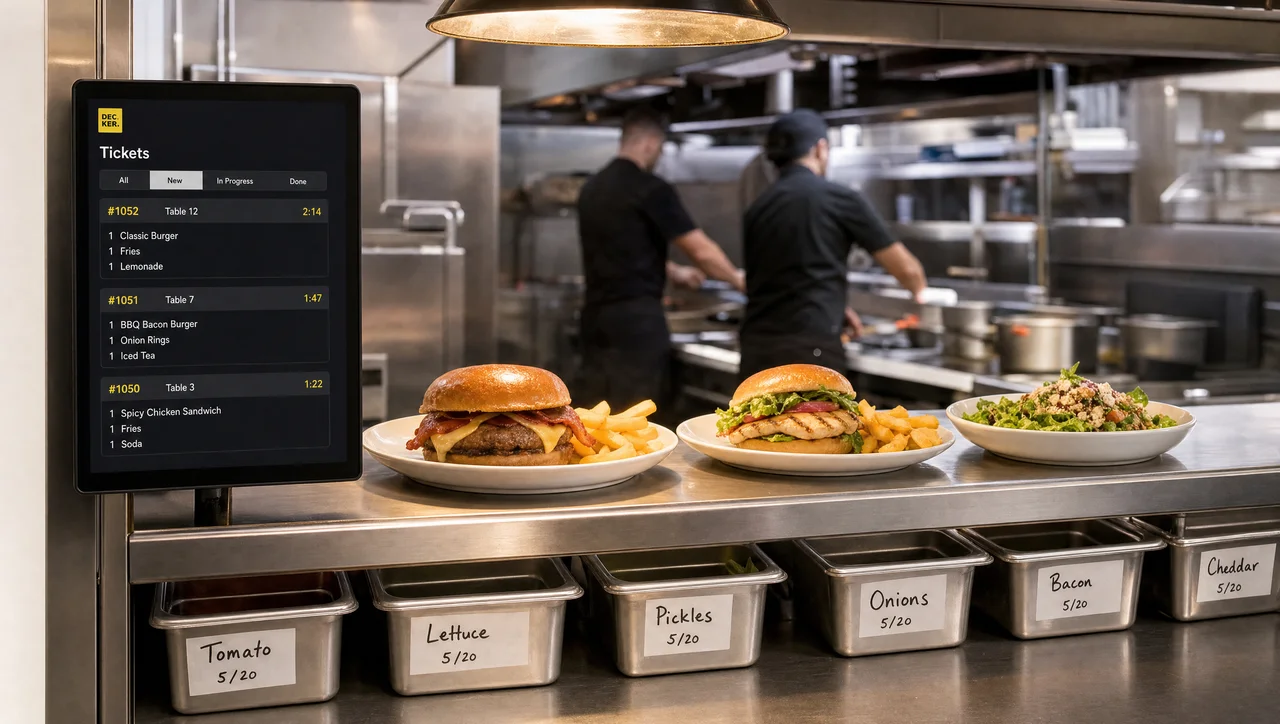
An order rung in at the POS routes to the kitchen and splits by station, so grill, sauté, and cold each see their part of the same ticket. On a kitchen display system, timers start when the ticket lands, cooks mark components complete, and the ticket changes color as it ages. Paper tickets can work in a small room, but they carry no timer and no record.
The Expediter at the Pass
The expediter is the air traffic controller. The job is three things: read the board and spot which tickets are oldest and which stations are dragging, check every plate against the standard before it leaves, and keep the dining room’s timing matched to what the kitchen is actually producing. The station with the longest cook time starts first so components arrive at the pass together instead of sitting under a heat lamp. In a small kitchen, the head cook or chef holds this role along with a station.
Ticket Times and Bottlenecks
A kitchen display system records how long each ticket and each item takes, from the moment it appears to the moment it is marked done. Use that to find your own baseline by daypart, then look for the station that consistently runs long. Published benchmarks from other concepts are close to useless here, because ticket time depends on menu complexity, station count, and staffing.
⚠️ A fast kitchen is not a kitchen where everyone hurries. It is one where the slowest component on the ticket starts first.
Food Safety Systems That Keep the Kitchen Compliant
Food safety is the one system in a restaurant kitchen where someone else sets the standard for you, and where failing it closes the doors.
Holding, Cooking, and Cooling Temperatures
The FDA Food Code sets the numbers a US kitchen runs on. Cold TCS food is held at 41°F or below and hot TCS food at 135°F or above, with the range between them treated as the danger zone.
| Process | Requirement |
|---|---|
| Cold holding | 41°F or below |
| Hot holding | 135°F or above |
| Poultry, stuffed items | 165°F |
| Ground meat | 155°F for 17 seconds |
| Fish and intact cuts | 145°F for 15 seconds |
| Reheating for hot holding | 165°F for 15 seconds |
| Cooling, stage one | 135°F to 70°F within 2 hours |
| Cooling, full process | 135°F to 41°F within 6 hours total |
Check cooling food at least every half hour and hot-held items every two to four hours, and write it down. If the first cooling stage is missed, split the batch into smaller portions or use an ice bath immediately.
⚠️ Food that misses the cooling window cannot be rescued by reheating it. Bacteria may already have produced heat-stable toxins, so the batch is discarded.
Logs, Labels, and Line Checks
Inspectors cite the same handful of failures over and over: TCS food above 41°F in a cooler, hot line below 135°F, cooling that took too long, and no temperature records at all. A pre-service line check that covers cooler temps, holding temps, labels, and dates catches most of these before a guest or an inspector does.
Kitchen Numbers: Food Cost, Labor, and Prime Cost
A restaurant kitchen can run smoothly and still lose money. Two percentages tell you whether the way you are running it is affordable: food cost, usually 28–35% of revenue, and labor cost, usually 25–36%. Together they form prime cost, which most operators keep under 65%.
| Metric | Typical range | Notes |
|---|---|---|
| Food cost | 28–35% of revenue | Varies by format, cuisine, and menu pricing |
| Labor cost | 25–36% of revenue | Full service around 36.5%, quick service around 25% |
| Prime cost (food + labor) | Under 65% is the common target | Quick service often 55–60%, fine dining can reach 65–72% |
Back-of-house labor (cooks, prep, dish) usually accounts for 12–18% of revenue on its own, and it is the part of kitchen management a chef controls directly. Track prime cost weekly rather than monthly, because by the time a monthly P&L arrives, four weeks of bad purchasing are already spent. Pair it with a waste log: a sheet by the trash where anyone writes down what got thrown out and why turns invisible losses into a list you can act on.
How to Run a Small Restaurant Kitchen With a Small Team
The systems that run a restaurant kitchen of twenty also run one of four. A small restaurant kitchen has the same five systems and fewer people to carry them, so each one has to be simpler and written down.
- Cut the menu before you cut corners. Fewer items with shared components mean fewer stations, less prep, and tighter inventory.
- Cross-train everyone. Each person should cover at least one station besides their own.
- Fix what is broken and buy the tools. Equipment and tools are what the staff earns money with, so a dull knife or a dead fridge is an operating expense, not a purchase to postpone.
- Promote from within. Dishwashers become prep cooks, prep cooks become line cooks, line cooks become sous chefs. If every hire comes from outside, your best people find their growth somewhere else.
Keeping the Crew
Turnover in the restaurant industry averages around 73%, which means the kitchen that depends on one person’s memory is one resignation away from chaos. Written stations, prep lists, and recipe cards are what let a new cook produce the same plate in week one.
The Pre-Shift Line-Up
Run a short line-up before every service and cover four things: the 86 list, the specials, large parties and VIPs expected, and any menu or prep changes. Five minutes here prevents most of the shouting that happens later.
Keep the Menu Honest: 86 Lists and What Guests See
Every other system in a restaurant kitchen is internal. The 86 list is the one that reaches the guest, and it is the day’s running record of what the kitchen has run out of. It breaks down in a predictable way: the line knows, the expediter knows, the servers mostly know, and the guest is still reading a menu that offers the dish. The result is an order that has to be walked back at the table, which costs a server trip, a remake, and a bit of trust.
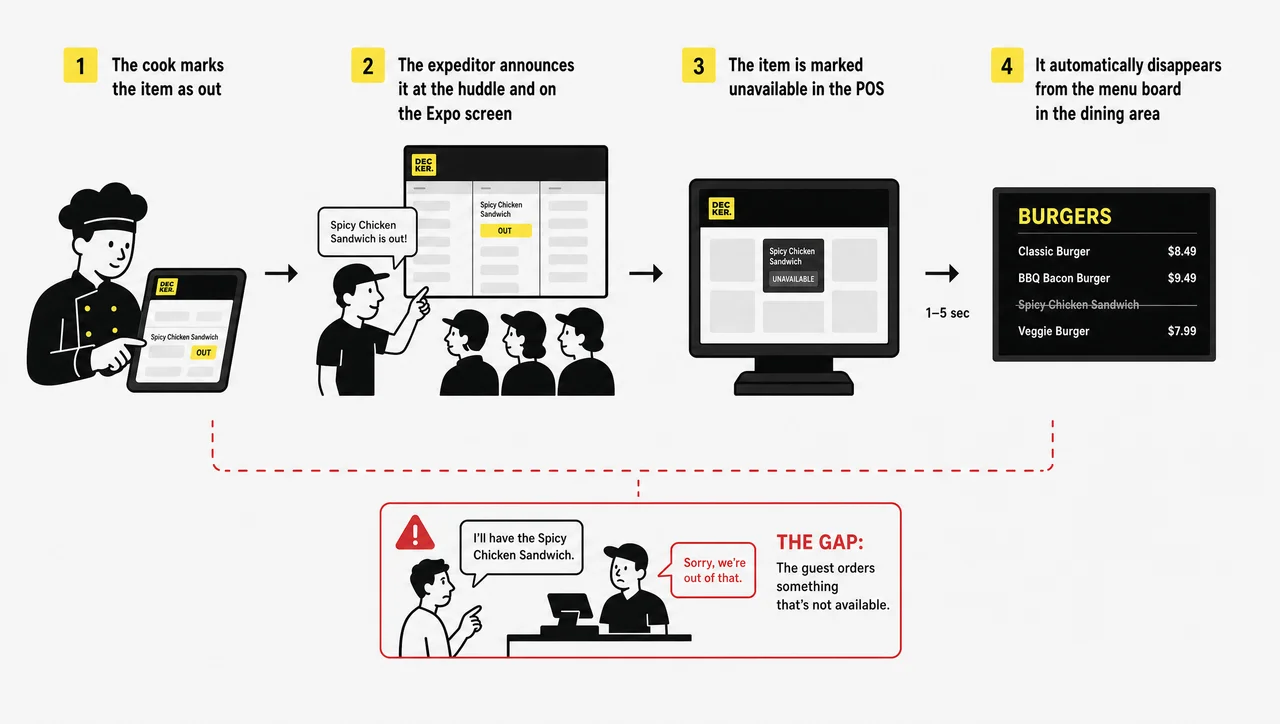
The fix is making one source the truth. When the item is marked unavailable at the POS, every surface that shows the menu should follow, including the board above the counter. That is where a POS-connected menu screen helps: with Decker, an item marked unavailable in the POS is hidden from the screen automatically, and a price change reaches the display in about 1–5 seconds without anyone redesigning a board. The same rules can swap the breakfast layout for lunch on schedule.
The limits are worth knowing too. If your menu and prices stay the same all year and the 86 list is two items on a chalkboard, a screen system solves a problem you do not have. And screens need power and a connection to receive updates, though the last published menu keeps showing when the signal drops.
Questions and Answers
1 How do you run a kitchen in a restaurant with no experience?
You learn to run a restaurant kitchen from written systems, not instinct: a station description for each position, a prep list with par levels, a temperature log, and a pre-shift line-up. Then hire or promote one experienced cook who can hold the pass while you learn the room.
2 How do you run an efficient restaurant kitchen during a rush?
You run an efficient restaurant kitchen in a rush by starting the longest-cooking component of each ticket first, keep one person at the pass calling tickets, and hold the line to its mise en place instead of letting cooks improvise. Watch the oldest ticket on the board, not the newest.
3 How many stations does a small restaurant kitchen need?
That depends on the menu, not the square footage. A tight menu can run on prep, one hot station, and a cold station, with the chef covering the pass. Every additional cooking method you put on the menu usually adds a station and a set of hands.
4 What food cost percentage should a restaurant kitchen target?
Most operations run between 28% and 35% of revenue, depending on format and pricing. The more useful number is prime cost, food plus labor, which is commonly kept under 65%.
5 What is an 86 list?
It is the list of menu items the kitchen has run out of or pulled for the shift. It is reviewed at the pre-shift line-up and updated during service so servers, the POS, and any menu screens all reflect what is actually available.
6 How long should ticket times be?
There is no universal number. Pull your own baseline from your kitchen display data by daypart, then work on the station that consistently runs longest instead of pushing the whole line to move faster.
7 How much should a new kitchen prep for its first week?
More than the projection suggests. Opening demand is hard to forecast, and running out of a signature item in the first days does more damage than the cost of the extra prep.
8 Who runs the kitchen when the chef is off?
A named second, usually the sous chef or lead line cook, with the same authority over the pass and the 86 list. Written station descriptions and prep lists are what make that handoff work without a phone call every hour.