Starting a Food Truck, From First Idea to First Service Window


To start a food truck business, test a concept in your city, get a truck or trailer, register the company, book a commissary, pass the health plan review and fire inspection, insure the vehicle, build a short menu, and launch at a few proven spots. Expect to spend $50,000 to $250,000 and three to eight months.
Most people who ask how to start a food truck picture the cooking. The cooking is the easy part. Paperwork, parking and the daily run to the commissary decide whether a food truck business survives its first season. Whether you want to know how to start your own food truck business or add a second truck, this guide walks through every step in the order the permits actually require. It then covers what it takes to run and own a truck once it is on the road, what the money looks like, and when a truck is the wrong first move.
The U.S. food truck industry took in about $2.8 billion in 2025, according to IBISWorld estimates, and counts of active trucks range from about 47,000 to more than 58,000 depending on the source. That is tens of thousands of competitors, each with the same questions you have right now.
What You Need to Start a Food Truck Business in 2026?
To start a food truck business you need a business license and LLC or other registration, a health permit, a fire inspection, a mobile vendor permit, a commissary agreement, insurance and a vehicle built to your county’s health code. Behind them sit a tested concept, an EIN, a sales tax permit and a certified food protection manager. Each item unlocks the next one. A health department will not approve a truck without a commissary letter in most counties, many fire departments must sign off before the health permit is issued, and event organizers will not book you without proof of insurance.
The table below is the short answer to what do you need to start a food truck. Typical costs are industry ranges and vary by city.
| What you need | What it is | Who issues it | Typical cost |
|---|---|---|---|
| Concept and market check | Cuisine, price point, list of legal spots with foot traffic | You | Your time |
| Business plan | Costs, sales forecast, funding plan | You | Your time |
| Vehicle | Truck, trailer, cart or tent built to health code | Dealer, builder or lessor | See the budget section |
| Business registration | LLC or sole proprietorship, plus a local business license | Secretary of State, city or county | $50–$500 a year for the license |
| EIN | Federal tax ID | IRS | Free |
| Sales tax permit | Right to collect sales tax | State revenue department | Often free |
| Commissary agreement | Licensed kitchen for prep, water, waste and storage | Commissary operator | $500–$2,500 a month |
| Health permit | Plan review, inspection and an operating permit | County, city or state health agency | $100–$1,500, more in some counties |
| Fire inspection | Check of propane, suppression and extinguishers | Fire marshal | $100–$1,000 |
| Mobile food vendor permit | Where and when you may sell | City | $100–$1,000 a year |
| Vehicle registration and inspection | Road safety check for a commercial vehicle | DMV | $50–$500 |
| Insurance | Commercial auto, general liability, workers’ comp | Insurer | See Step 8 |
| Food safety certification | A certified food protection manager on the team | Accredited exam provider | Exam fee |
Requirements to open a food truck differ by county and city, so treat the table as the minimum. Some cities add parking or zoning permits, signage permits, or noise permits for generators and speakers. A few cap the number of vendor permits they issue each year, which means a waiting list before you can sell.
Before You Spend Anything: Work a Line and Call the Health Department
The two steps that save the most money when starting a food truck are free: work a season on someone else’s truck, and talk to your health department before you buy a vehicle. Owners who have been through it repeat both points more often than any other advice.
A truck is a restaurant, a vehicle and a traveling event company at once. Anyone can learn a recipe, yet few new owners already know how to manage inventory, pass an inspection, run a line during a rush and drive a vehicle that weighs around 15,000 pounds and has blind spots on every side. A part-time job or a few unpaid shifts (“stages”) on a busy truck show you whether you like the work before you borrow money for it.
The health department call comes next. Ask for the mobile food unit plan review packet. It lists the photos, drawings and documents the department needs, the number of sinks, the tank sizes and the commissary rules. In practice, that packet is the specification for your truck. Also ask whether your city has food truck rules at all. A city without them is a risk, because rules written after you launch may not favor the way you operate.
“Buy the truck first, sort out the permits later” is the most expensive mistake in this business. A truck that fails local plan review needs new sinks, tanks or a hood before it can sell a single meal, and a used truck approved in another county is no guarantee of approval in yours.
Three calls before you buy anything:
- Health department: plan review packet, commissary rules, fees and timelines.
- Fire marshal: suppression, propane and extinguisher requirements.
- City and county licensing offices: the business license, vendor permits, parking zones, permit caps and hours in every place you plan to sell.
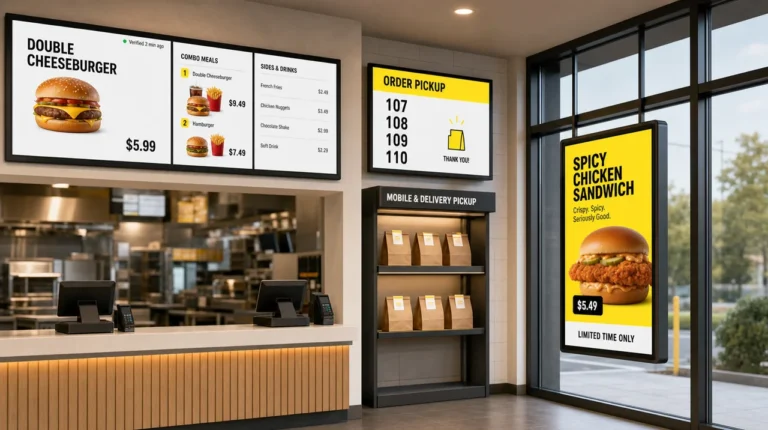
Before you order a build, check which digital menu boards, screens and POS setups new trucks launch with, so the service window, wiring and power plan fit them from day one.
How to Start a Food Truck Business in 12 Steps
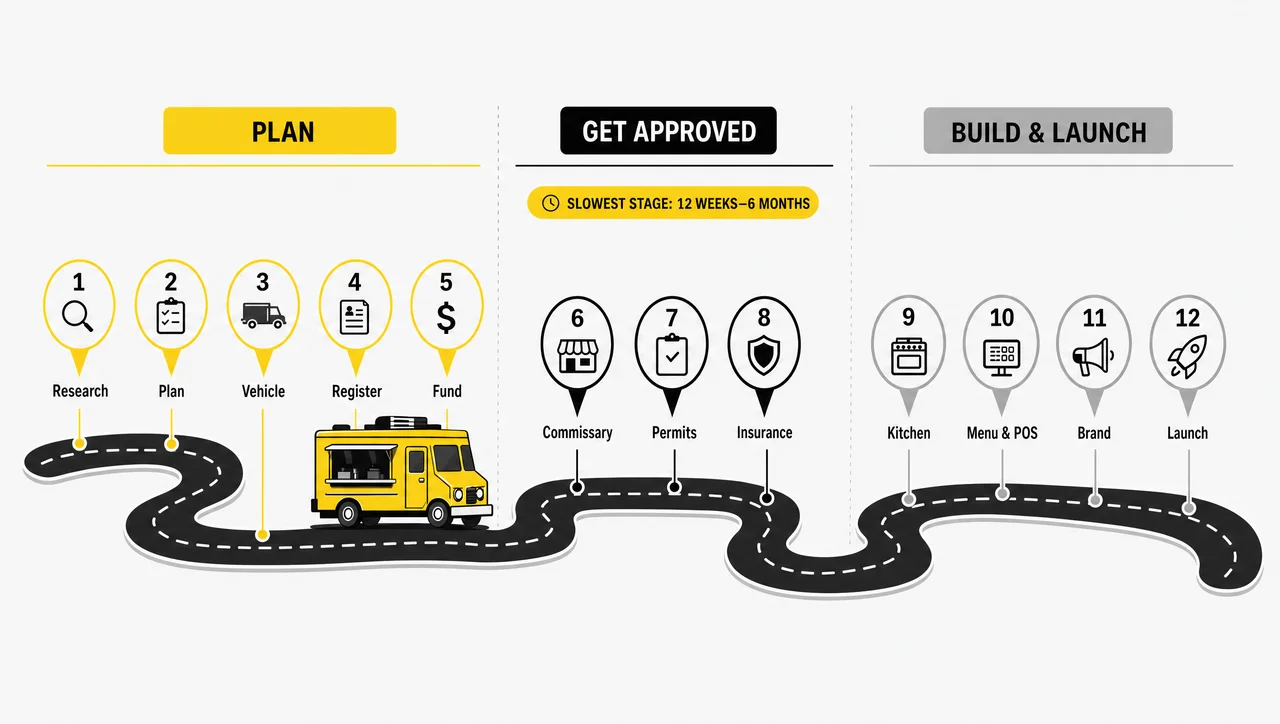
The steps to starting a food truck run in a fixed order: research the market, write the plan, choose the vehicle, register the company, secure funding, book a commissary, get permits and inspections, insure the truck, build the kitchen, plan the menu and payments, build the brand, and launch at tested spots. Skipping ahead costs money, because each step depends on a document from the step before it.
- Research your local food truck scene and pick a concept
- Write the business plan
- Choose and get the vehicle
- Register the business, get an EIN and a sales tax permit
- Fund the truck
- Book a commissary kitchen
- Get licenses and permits and pass inspections
- Insure the truck and the business
- Build out the kitchen around the menu
- Plan the menu, the menu board and payments
- Build the brand and market before launch
- Choose locations and soft-launch
1. Research Your Local Food Truck Scene and Pick a Concept
Pick your food truck concept after you know the local scene, not before. Spend two or three weeks eating at the trucks you would compete with. Note what they sell, what they charge, where they park and how long their lines are at noon and at 7 p.m. Then look at demand: office parks without cafeterias, breweries without kitchens, hospitals, college campuses, weekend markets and youth sports fields.
Answer five questions before you settle on a concept:
- What does the food truck scene in your region look like, and where is it saturated?
- Who are your competitors, and what do they do well and badly?
- Who will buy from you, what do they like to eat, and how much will they spend?
- What food do you want to cook every day for years?
- How will you be different from what already sells here? A taco truck in Los Angeles needs exceptional tacos.
Industry surveys put French fries, burgers and BBQ at the top of food truck menus, followed by fried chicken, tacos, mac and cheese and coffee. Classics sell, but they also meet the most competition. Less common concepts such as waffles, pierogies, paninis, smoothies or a cuisine you grew up with can stand out faster. Write the concept as one sentence: cuisine, price and promise, for example “Korean fried chicken sandwiches under $14, handed over in five minutes.”
Sales also move with the weather, so read up on how seasons affect food truck sales before you build a first-year forecast.
2. Write the Business Plan
The business plan turns the concept into numbers, and every lender and investor will ask for it. The U.S. Small Business Administration lists writing a plan as the second of its 10 steps to start a business, right after market research. A standard plan has nine parts:
- Executive summary: what the truck sells, the mission and the team.
- Company description: what sets the business apart.
- Market analysis: competitors and your edge over them.
- Organization and management: legal structure and who runs what.
- Product description: the menu and the guests it serves.
- Marketing and sales: how you will find and keep customers.
- Funding request: how much you need and what it pays for.
- Financial projections: startup costs, monthly fixed costs, a sales forecast by location and day, food cost per item and the break-even point.
- Appendix: credit history, licenses, permits and legal documents.
Add a staffing plan and a pricing strategy. Write the plan in chunks and revisit it every few months, because a plan that stays in a drawer stops being useful the day you launch.
3. Choose and Get the Vehicle: Truck, Trailer, Cart or Tent
There are four ways to get a food truck, and each has to end with a fully working mobile kitchen that meets local code: buy a used one, have a new one custom-built, lease one, or rent-to-own. Buying a food truck costs from about $30,000 for a used unit that needs work to $200,000 and up for a new custom build. A used truck is fastest and cheapest to acquire, but you inherit its layout, wiring and repairs. A custom build costs more, yet it is designed around your menu and your county’s code and usually passes inspection more easily.
| Option | Typical upfront cost | Best for | Watch out for |
|---|---|---|---|
| Used truck, ready to go | $40,000–$80,000 | A fast start on a proven layout | Engine and equipment repairs |
| Used truck needing a refit | $30,000–$60,000 plus $10,000–$30,000 | Buyers who can manage a build | A layout that fails local code |
| New custom truck | $100,000–$200,000+ | A long-term concept with a fixed menu | Build waits of several months |
| Lease | $2,000–$5,000 a month | Testing a market or concept | No equity, limited changes |
| Rent-to-own | Monthly payments | Owners without a large down payment | Total cost over the term |
Before you buy a food truck, compare it against the plan review packet: the number and type of sinks (a handwashing sink and a three-compartment sink), the hood and suppression system, the refrigeration and hot holding, the fresh and gray water tank sizes, the lighting and the ventilation. Some cities also limit truck size. Check that the equipment works, that the water pressure is adequate and that there is enough storage.
Used trucks sell through online marketplaces, dealers and builders, and a seller may be halfway across the country. Plan for the truck to cost more than you expect: even a truck with most of the equipment usually needs a few parts replaced before it passes inspection. A trailer is a cheaper route. New trailers start around $30,000 plus a tow vehicle, and owners report finding well-built used trailers for about $10,000.
4. Register the Business, Get an EIN and a Sales Tax Permit
Choose a business structure first, then register the business name with your state. A sole proprietorship needs no filing, but the owner is personally liable for business debts, and loans are harder to get. An LLC protects personal assets and offers pass-through taxation, but it needs a registered agent and annual reports, and some states charge a franchise tax. Many food truck owners form an LLC.
Then register with your Secretary of State, get a free Employer Identification Number from the IRS, apply for a sales tax permit with your state revenue department, and open a business bank account. The SBA’s checklist puts registration, federal and state tax IDs, licenses and permits, and a business bank account at steps 7 through 10. Register the name you will paint on the truck before the wrap is printed.
Older guides say every new LLC must file a beneficial ownership (BOI) report with FinCEN. That is out of date. In March 2025, FinCEN issued an interim final rule that exempts companies created in the United States from BOI reporting.
5. Fund the Truck
Most first-time owners combine several sources of funding and financing options, because one loan rarely covers the whole build. The most common options:
- Secured vehicle or equipment loan: easier to get and cheaper than unsecured credit, because the truck is the collateral.
- SBA-backed loans: longer terms through participating banks.
- SBA microloans: up to $50,000 through nonprofit intermediary lenders, a fit for a used trailer or working capital.
- Unsecured loan or line of credit: faster, but at higher rates.
- Rent-to-own or lease: lower upfront cost in exchange for higher monthly payments.
- Partners and private investors: cash or equipment in exchange for a share of the business.
Food truck grants exist, but they are rare, small and usually local, so do not build the plan around one. Lenders will ask for the business plan, your credit history and how much of your own money is in the deal. Keep a reserve after launch: industry guides suggest $5,000 to $20,000, and operators recommend at least $10,000 to $20,000 saved before opening day, or three months of fixed costs, whichever is higher.
6. Book a Commissary Kitchen
A commissary is a licensed commercial kitchen where you prep food in bulk, store supplies, wash dishes, fill fresh water, dump gray water and grease, and often park the truck overnight. Most health departments require one. Snohomish County in Washington, for example, requires a commissary for all mobile food units, with limited exemptions, and asks operators to keep a log of visits on board for one year.
Commissary rent usually runs $500 to $2,500 a month, often with a deposit of one or two months. You typically need the signed agreement before the health department will approve the truck. Visit two or three commissaries and compare hours, cold storage, parking and distance from your best selling spots, because you will drive that route every day. The commissary also decides how much storage the truck itself needs.
A few states exempt self-sufficient trucks. Florida, for example, requires a commissary only when a truck lacks a three-compartment sink, a handwashing sink, refrigeration, a power source, a potable water tank or a wastewater tank, and the exemption is confirmed at plan review.
A home kitchen is not a commissary. Cottage food laws cover low-risk foods such as bread, cookies and jam sold directly to customers. They do not cover the hot, perishable meals a truck serves, so prep for a truck happens in a licensed facility.
7. Get the Licenses and Permits and Pass the Inspections
Most food trucks need a business license plus four approvals from the city and county offices where they plan to sell: a health permit, a fire inspection, a mobile vendor permit and a vehicle inspection. The health permit usually comes in two stages. First, plan review: you submit drawings of the truck, the equipment list, the menu and the commissary agreement. Then an inspection of the finished truck and an annual operating permit.
- Health permit. Snohomish County charges $1,100 for a new plan review, quotes about 12 weeks for the first review, and sets annual permits from $500 for low-risk menus to $1,025 for high-risk ones. Operators in other areas report three to six months from application to approval, often with requests for extra documents. After that, expect a routine inspection at least once a year.
- Fire inspection. NFPA 1 (Section 50.7) and NFPA 96 (Annex B) set the rules most fire marshals use for mobile cooking: an approved suppression system over cooking equipment, a Class K extinguisher for grease fires plus an ABC extinguisher, and a propane leak detector listed for vehicles. The detector is tested monthly and each time a cylinder is changed, and staff take annual training on shutting off fuel and using extinguishers. Many event organizers will not let a truck without suppression on site.
- Mobile food vendor permit. Sets where and when you may sell. Some cities limit how many they issue.
- Vehicle registration and safety inspection. Brakes, lights and emissions for a commercial vehicle.
- Food safety certification. The FDA Food Code, which most states adopt in some version, requires a certified food protection manager in the operation, and many counties also require food handler cards for every employee.
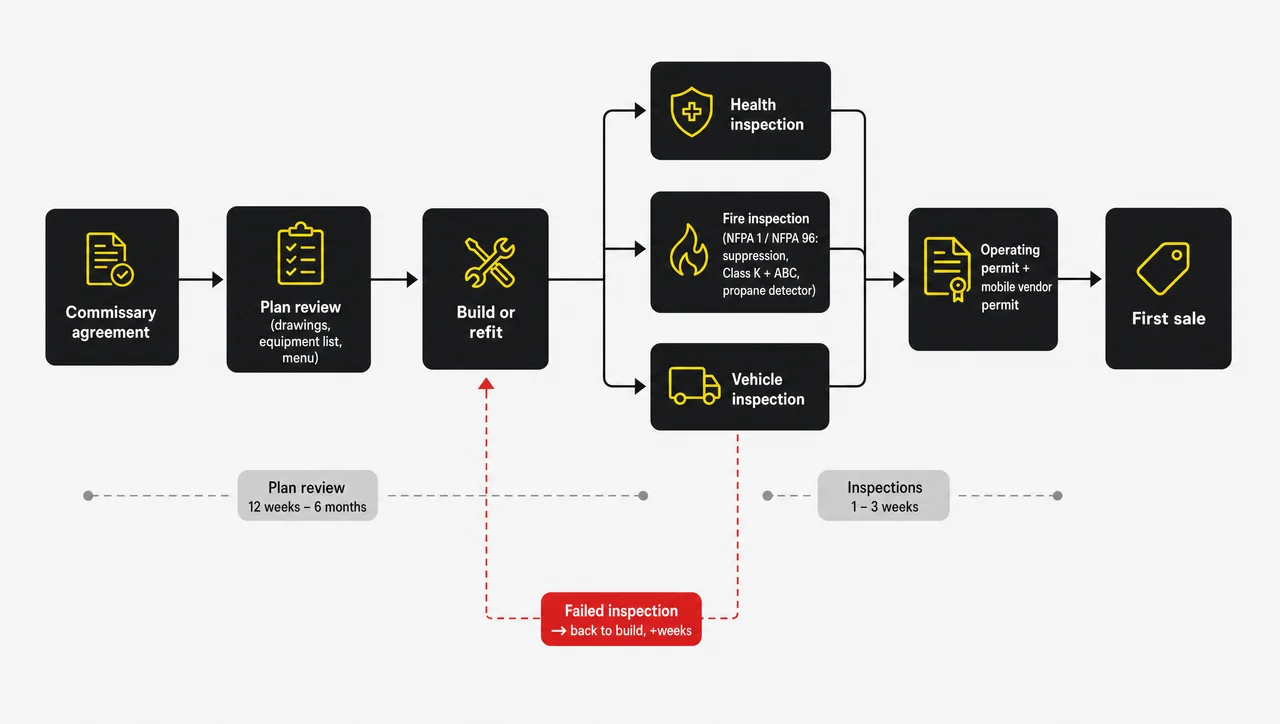
Each city on your route may need its own license. A U.S. Chamber of Commerce Foundation study of 20 cities found that opening a truck took from 10 procedures in Denver to 32 in Boston and San Francisco, from 8 to 23 trips to government offices, and around 37 business days of paperwork in the least friendly cities. Annual fees ranged from $590 in Indianapolis to $17,066 in Boston. Operating without permits risks fines of thousands of dollars, a shutdown on the spot and a voided insurance policy.
A permit from one city does not let you sell in the next one. Operators in the U.S. Chamber study named working across several jurisdictions as the heaviest regulatory burden. Check each city’s rules before you add it to the route.
Food safety rules the inspector checks
Inspectors look at the same basics on every truck, at the commissary and at events:
- Cold food held at 41°F (5°C) or below, hot food at 135°F (57°C) or above.
- A separate handwashing sink with hot and cold water, soap, paper towels and a sign.
- Raw meat stored below ready-to-eat food, and color-coded cutting boards to prevent cross-contamination.
- Food in sealed, food-grade containers labeled with contents and date.
- A plan for gray water, trash and daily sanitizing of food contact surfaces.
- Pest control: tight-fitting doors and screens on vents.
- Temperature and propane detector logs kept on board.
8. Insure the Truck and the Business
Commercial auto insurance is required by law for a business vehicle, and workers’ compensation is required in most states once you hire the first employee. General liability covers customer injuries and foodborne illness claims. Most event organizers and venues ask for general liability limits of $1 million per occurrence and $2 million aggregate, so check that figure before you apply to festivals.
Industry guides put commercial vehicle insurance at $1,000 to $4,000 a year and general liability at $300 to $2,000 a year. Also consider equipment breakdown, food spoilage and inland marine coverage: one failed refrigerator on a hot day can cost a full load of inventory. Get licensed and insured before you sell food anywhere, including orders taken through social media.
9. Build Out the Kitchen Around the Menu
Build the kitchen around the menu, not the other way around. If only one item on the menu is fried, drop that item and skip the fryer; you save money, space, heat and a cleaning job. A taco truck needs a flat-top and a steam table. A pizza truck needs an oven that fits the chassis weight limit. A coffee truck needs espresso equipment, a water system and a generator sized for both.
| Equipment group | Typical items | Typical cost |
|---|---|---|
| Cooking | Griddles, fryers, ranges, ovens, steam tables | $5,000–$15,000 |
| Cold storage | Under-counter fridges, prep table refrigeration, freezers | $2,000–$8,000 |
| Ventilation and fire | Hood, suppression system, Class K extinguisher | $3,000–$10,000 |
| Sinks and plumbing | Handwashing sink, three-compartment sink, fresh and gray tanks | $1,000–$5,000 |
| Prep and storage | Stainless tables, shelving, food-grade bins | $500–$2,000 |
| Power | Generator or shore power, propane system | Varies with load |
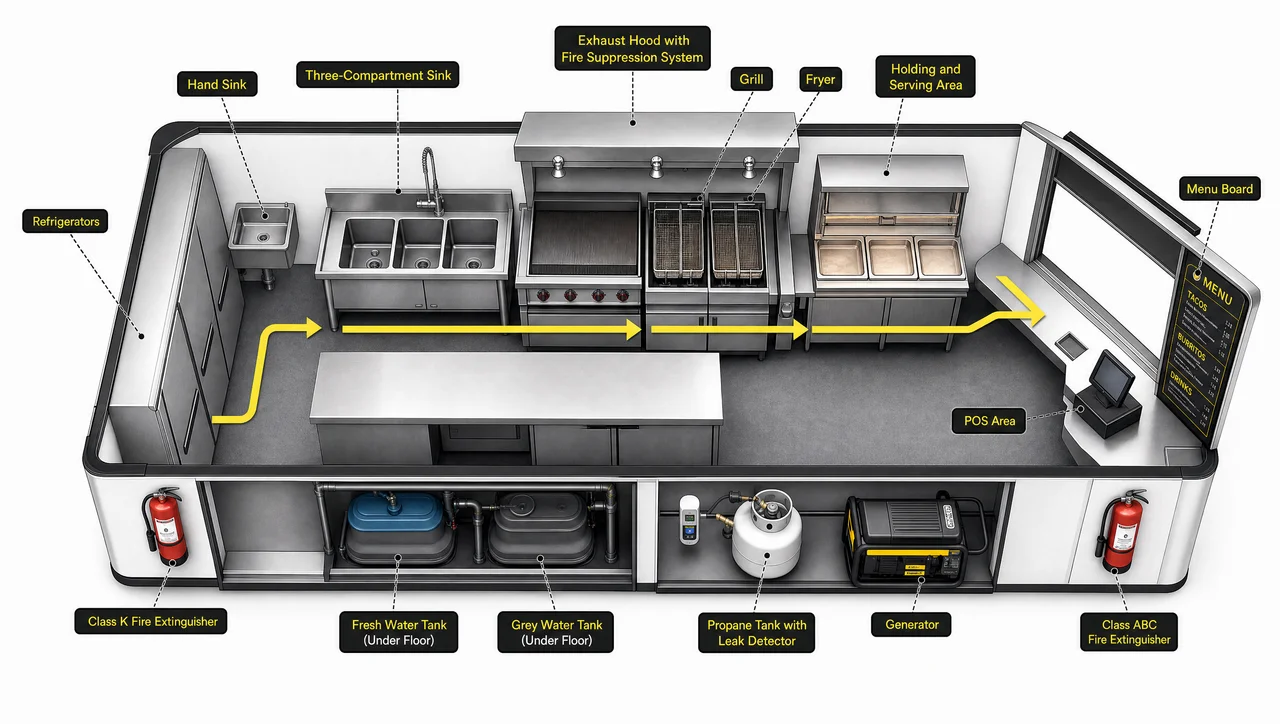
Lay the line out the way you would run a restaurant kitchen, in the order food moves: cold storage, prep, cooking, holding, the service window. Keep high-use items within reach, install anti-slip flooring, use vertical shelving, and leave a clear path for staff. Many builders offer CAD layouts before you commit.
Size the generator or battery system for peak load, when every burner, fryer and fridge runs at once. Generators give you independence from event power but are noisy and need maintenance, and some cities require a noise permit. To price equipment, check a large restaurant supply catalog as the worst-case new price, then look at local restaurant supply stores, classifieds and auctions of restaurants that are closing.
10. Plan a Short Menu, a Readable Menu Board and Payments
A food truck menu is short on purpose. Guests read it from the street, often in a line, and your kitchen is a few feet long. A common guideline is 5 to 7 core items plus a few seasonal ones, built around shared ingredients so one cooler of proteins and sauces covers the whole menu. One operator who started with a hot dog cart served just three items and outpaced the trucks parked next to him. Price each item from its food cost, labor and competitor prices, highlight a signature dish, and consider vegan or gluten-free options.
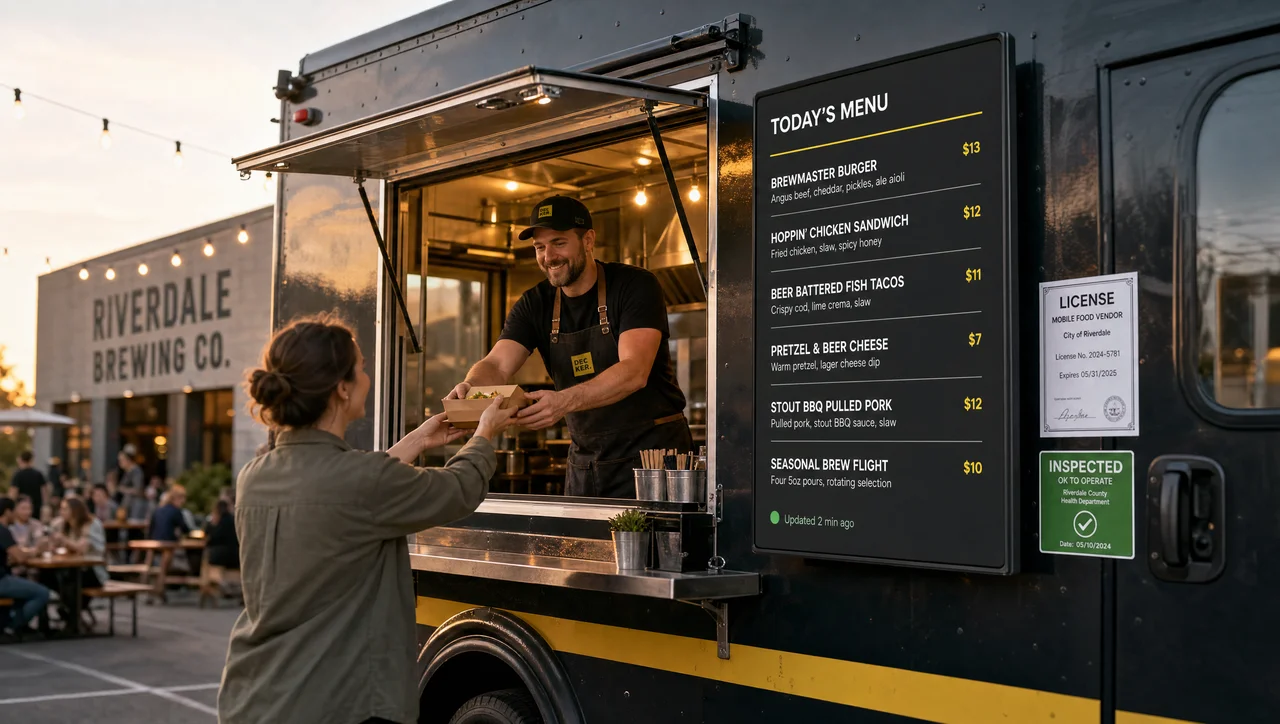
The menu board is part of the kitchen’s speed. Guests who can read the board decide before they reach the window. Sign makers use a rule of thumb of about 1 inch of letter height for every 10 feet of viewing distance, so a board read from 20 feet needs item names about 2 inches tall. A screen at the service window lets you change prices, hide items that sold out and switch from lunch to dinner without reprinting. Food truck menu boards that pull prices from the POS also keep the board and the register from showing different numbers.
Choose a point-of-sale system that works offline, takes cards and mobile wallets, supports tips and tracks inventory. Offline mode matters on a truck: a festival lot with thousands of phones on one cell tower is where connections drop. A POS terminal and software typically cost $500 to $2,500, card readers $100 to $300 and receipt printers $150 to $500. Track three numbers from day one: average ticket, orders per hour at peak, and sales by location.
11. Build the Brand and Market Before Launch
Your truck is a rolling billboard, so the wrap is marketing money well spent. A custom wrap typically costs $2,500 to $10,000 and a logo and branding package $500 to $5,000. Stick to one to three main colors and use them everywhere: the truck, the menu, the website, social media, even the napkins. A good design catches attention, tells people what you sell and is easy to remember.
Set up the marketing before the first service:
- Social media: Instagram, TikTok and Facebook, posting a few times a week, with the week’s schedule every Monday.
- Google Business Profile: so local searches show your truck, hours and location.
- Reviews: reply to reviews on Google Maps and Yelp.
- Loyalty: a simple punch card that gives a free item on the 5th or 10th order.
- SMS updates: text regulars when and where you park.
- Associations and directories: join local food truck associations and event directories to get booked for busy events.
- Merchandise: shirts and hats turn fans into walking ads.
12. Choose Locations and Soft-Launch
Build the route from three kinds of spots: recurring lunch stops (business districts, office parks, hospitals, college campuses), evening and weekend spots (breweries, apartment complexes, parks, youth sports, dedicated truck lots), and booked events and catering menus. Partnerships with breweries and coffee shops that do not serve food bring steady customers to both businesses. Match the schedule to the crowd: an office park wants lunch at noon, a concert crowd wants food at 10 p.m.
Most good spots charge a fee, so run the numbers first: how many orders do you need to cover the fee, and how many does a truck there usually sell? Ask other owners. Operators report event fees such as $500 for a 10×10 space and $750 for a 10×20, with sales rising from about $2,500 to $4,000 on the larger footprint. Events also need a temporary food permit in many places. Many experienced owners stop hopping between spots and fill weekdays with catering and weekends with events and catering, because booked income is steadier than street traffic.
Before the grand opening, run a soft launch. Serve friends, then a small private event, then one public spot on a weekday. Time the orders, watch where the line stalls and cut any item that slows the window. Check zoning, waste disposal and parking limits for every spot, because many cities limit how long food trucks can stay or how close they can park to a restaurant.
“A food truck can park anywhere with a meter” is not true. Chicago bans trucks within 200 feet of any fixed business that sells food, with fines of up to $2,000, and requires GPS tracking. The Illinois Supreme Court upheld the rule in 2019.
What Licenses Are Needed to Start a Food Truck, by State
Licenses for a food truck come from three places: a business license from the city or county, a health permit from a county, city or state health agency, and a mobile vendor license from the city, and a few states now issue one statewide food truck license. The mix decides how many applications you file, so check your state first. Recent changes in three large markets show how different the rules can be:
| Market | Who licenses the truck | What to know |
|---|---|---|
| Florida | The state (DBPR) issues a Mobile Food Dispensing Vehicle license | Since July 1, 2020, state law preempts local food truck licenses, permits and fees; counties still control zoning, property use and event permits. Self-sufficient trucks may skip the commissary. |
| Texas | The Department of State Health Services (DSHS) issues a statewide permit | Since July 1, 2026, every mobile food vendor needs a DSHS license instead of a separate local health license in each city. Application fees run $309 to $876 by vendor type. Local fire inspections still apply. |
| New York City | The Department of Health issues a license to each worker and a permit to each unit | Unit permits are capped, with waiting lists. From July 1, 2026, the city issues 2,200 supervisory licenses a year for five years, and a supervisory license holder must be on the unit whenever it operates. |
Most other states still license trucks county by county, which is why the same truck can need a new health permit when it crosses a county line. If your state is not listed, start with the county health department where your commissary sits.
Where the Startup Money Goes
A food truck startup budget usually lands between $50,000 and $250,000, with the vehicle taking the largest share, and a self-built trailer can open for around $20,000. Estimates of average startup costs differ by source: one national business group puts the average near $55,000, restaurant supply and POS companies quote $50,000 to $100,000 for a used truck with a light refit and $120,000 to $250,000 for a new custom build. The full cost breakdown deserves its own guide, but the table shows where the money goes.
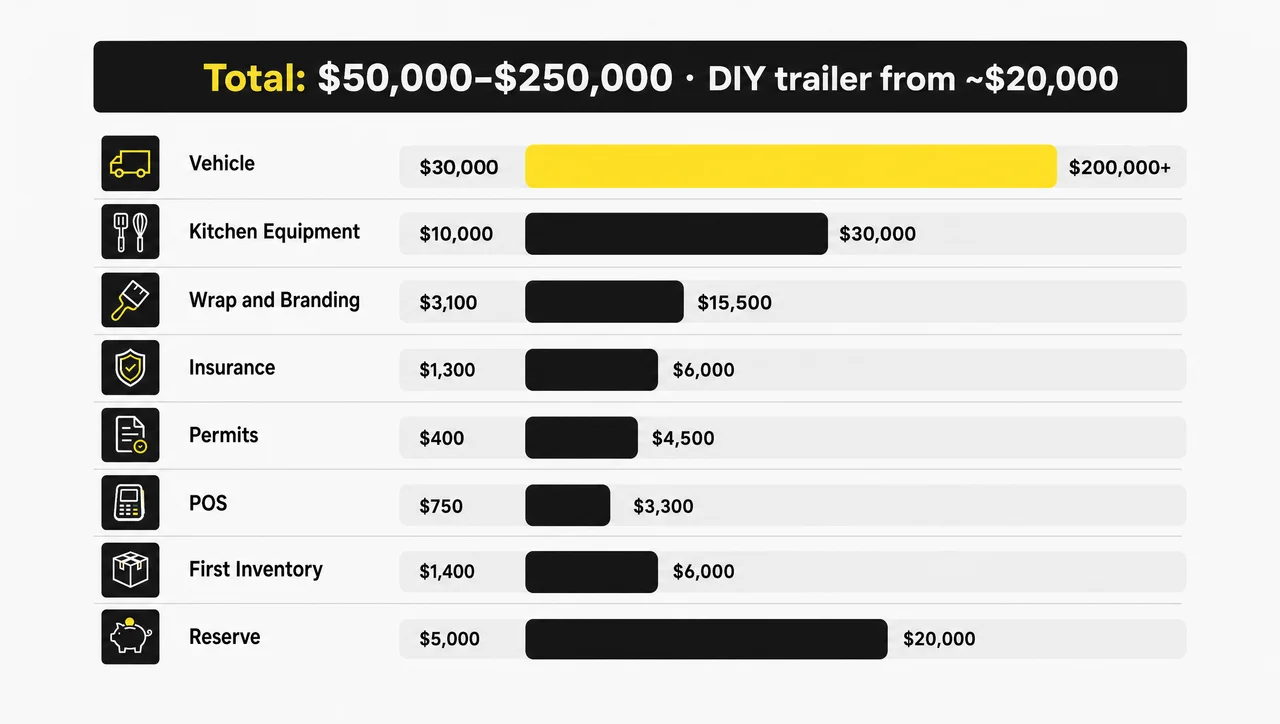
| Budget item | Typical range |
|---|---|
| Vehicle (used, refit or new custom) | $30,000–$200,000+ |
| Kitchen equipment | $10,000–$30,000 |
| Licenses and permits (first year) | $400–$4,500, far more in some cities |
| Wrap, logo and menu board design | $3,100–$15,500 |
| POS hardware and software | $750–$3,300 |
| First inventory, paper goods, utensils | $1,400–$6,000 |
| Insurance (first year) | $1,300–$6,000 |
| Working capital reserve | $5,000–$20,000 |
Monthly costs to run a food truck start before the first sale: commissary rent ($500–$2,500), insurance, loan or lease payments ($2,000–$5,000 for a lease), fuel, propane, maintenance, software, food and labor.
Three budget lessons repeat across operators. A used truck saves money up front but often costs more in repairs. Licenses and commissary fees in large cities are larger than first-time owners expect. And the whole project costs more than the first estimate, so the reserve is not optional.
How Long It Takes to Open a Food Truck
Opening a food truck usually takes three to eight months, and health department approval is the slowest part. Buying a used truck can take a week. Getting it approved can take a season. One operator who started with no experience took eight months and about $20,000 to build a trailer and reach state inspection.
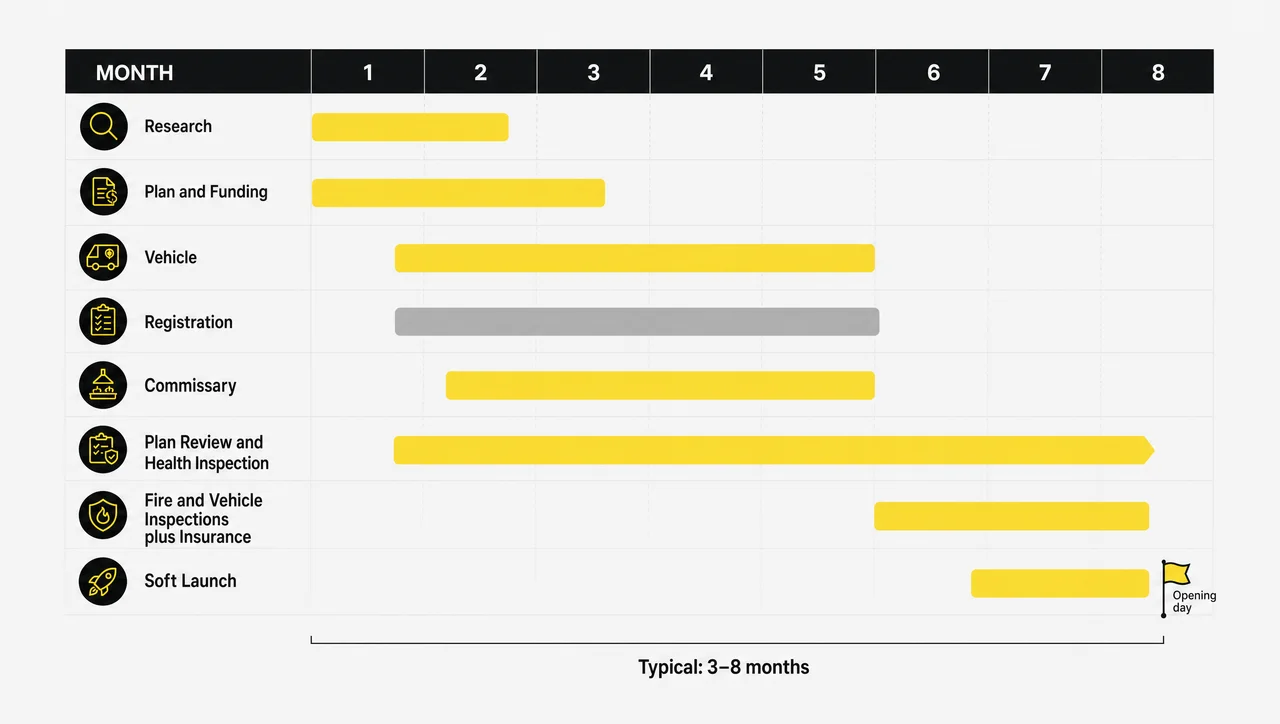
| Stage | Typical time | What slows it down |
|---|---|---|
| Market research and concept | 2–4 weeks | Testing too many ideas at once |
| Business plan and funding | 3–8 weeks | Loan paperwork, missing tax returns |
| Buying, leasing or building the vehicle | 1 week–4 months | Custom builds take the longest |
| Registration, EIN, sales tax permit | 1–3 weeks | State processing times |
| Commissary agreement | 1–2 weeks | Waitlists in busy cities |
| Plan review and health inspection | 12 weeks–6 months | Resubmitting drawings after corrections |
| Fire and vehicle inspections, insurance | 1–3 weeks | Missing propane detector or suppression tags |
| Soft launch | 1–2 weeks | Menu changes after the first services |
Steps overlap. You can register the company while a builder finishes the truck and train staff while plan review is pending. If you are working out how to open a food truck business on a deadline, submit plan review as early as the health department allows, because it sets the launch date. A failed inspection can push the opening back by weeks or months.
Food Truck, Trailer, Cart or Tent: Which to Start With
Starting a food trailer business costs less than a truck, but you need a tow vehicle and more space to park and turn. A trailer has no engine to break down, so when the tow vehicle fails you hitch another one. A truck is easier to drive in a city and faster to set up at several stops a day. Carts and tents cost the least and let you test a menu before you commit to a vehicle.
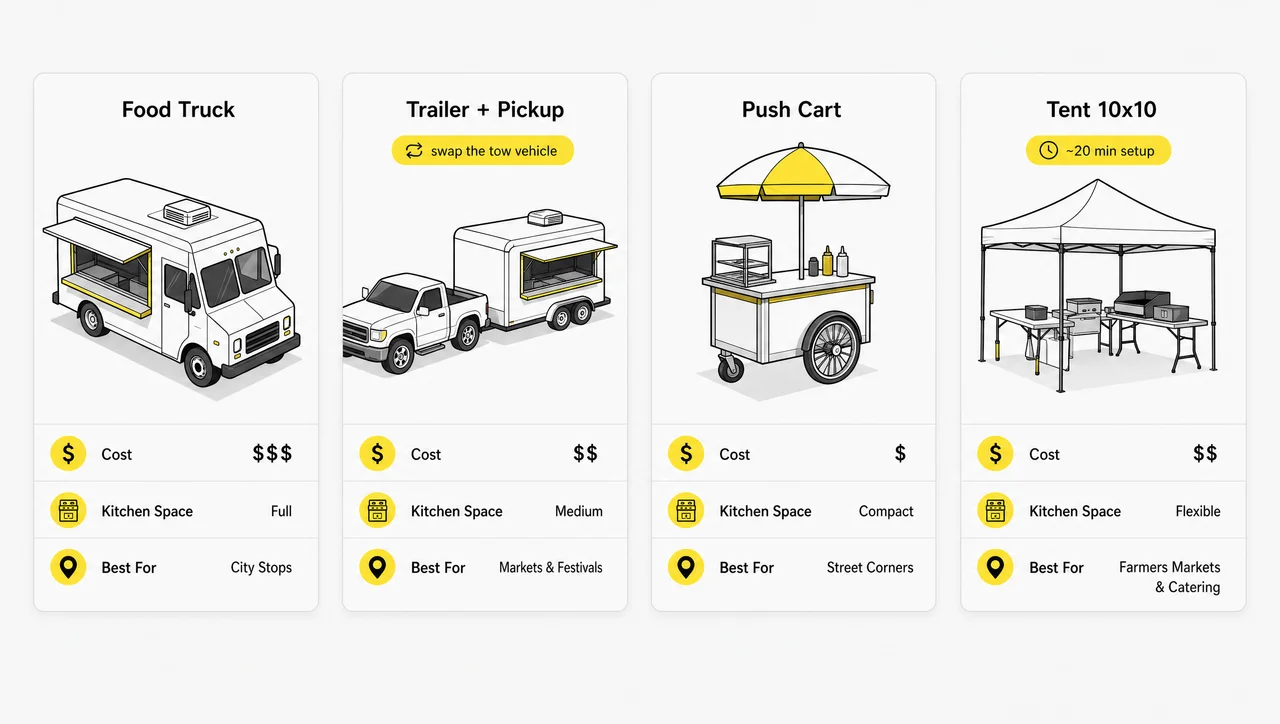
| Factor | Food truck | Food trailer | Cart | Tent |
|---|---|---|---|---|
| Upfront cost | Highest | Lower, plus a tow vehicle | Low | $5,000–$15,000 in total |
| Engine breakdown | Stops the business | Swap the tow vehicle | None | None |
| Kitchen space | Limited by the chassis | Often larger for the price | Very small | Depends on setup |
| Setup at a spot | Minutes | Hitching and leveling | Minutes | About 20 minutes with practice |
| Menu range | Full | Full | 2–5 items | Short menu |
| Best for | Several stops a day, city streets | Long stays at markets, breweries, festivals | Street corners, events | Farmers markets, festivals, catering |
If you are figuring out how to start a food trailer business, the permit path is almost the same as for a truck: plan review, commissary, fire inspection and insurance, plus trailer registration. Tents and carts also need a health permit and a commissary in most areas, and inspectors check the same things at events: a handwashing station with hot water, cold food kept cold and hot food kept hot. One pair of operators runs two tents for $20,000 to $30,000 where two trucks would cost $100,000 or more, and a hot dog vendor bought his truck from cart profits without a loan.
Show Your Menu on a Board That Follows Your POS.
Change a price in Toast, Square or Clover and the menu screen on your truck updates in seconds. Sold-out items disappear, and the Decker Player keeps the last menu on screen if the signal drops. One screen stays free. Start for free
How to Run a Food Truck Day to Day
Running a food truck means a fixed daily loop: commissary prep, drive, set up, serve, break down, clean, restock and return. A single lunch service often fills a 10- to 12-hour day, because prep starts hours before the window opens and cleaning, restocking and logs continue after it closes.
What do you need to run a food truck besides a kitchen? A routine that covers the checks inspectors look for:
- Fill fresh water and empty gray water and grease at the commissary.
- Check fridge temperatures and record them in the log.
- Test the propane detector when a cylinder is changed, and log the test.
- Load prepped food in covered, labeled containers.
- Confirm the day’s spot, parking rules and event contact.
- Post the location online before you leave.
- Close the day with sales by item, waste by item and tomorrow’s prep list.
Staff for a truck need food safety certification, speed under pressure, good service, and reliable cash and POS handling. Cross-train everyone so any person can cook, take orders or run the window. Two people cover a slow lunch spot; festivals take three or four.
Pick suppliers by distance from the commissary, delivery options, consistency, price and minimum order size. Local farms and wholesalers can lower costs and improve freshness. Maintain the truck on a schedule, because a breakdown costs the day’s sales plus the repair. For bad-weather days, line up indoor partners and catering.
How to run a food truck business profitably comes down to food cost and labor. Keep food cost near the plan with portioning tools and a short menu, negotiate with vendors, adjust prices when costs rise, and use POS data to see which items sell and which come back to the commissary every night.
Owning a Food Truck: Money, Hours and Profit
Owning a food truck business means running a restaurant, a vehicle and a traveling event company at once, usually on thin margins. Industry estimates put average food truck revenue at $250,000 to $500,000 a year, and one 2024 estimate gives $346,000. Typical profit margins run about 3 to 6 percent, which on the 2024 average leaves roughly $21,500 a year after salaries.
| Metric | Typical figure |
|---|---|
| Annual revenue | $250,000–$500,000 |
| Profit margin | About 3–6% (some trucks near 0%, the best near 15%) |
| Time to profit | Within a year for the strongest trucks, 2–3 years for most |
| Weekly hours in season | 60 or more for owner-operators |
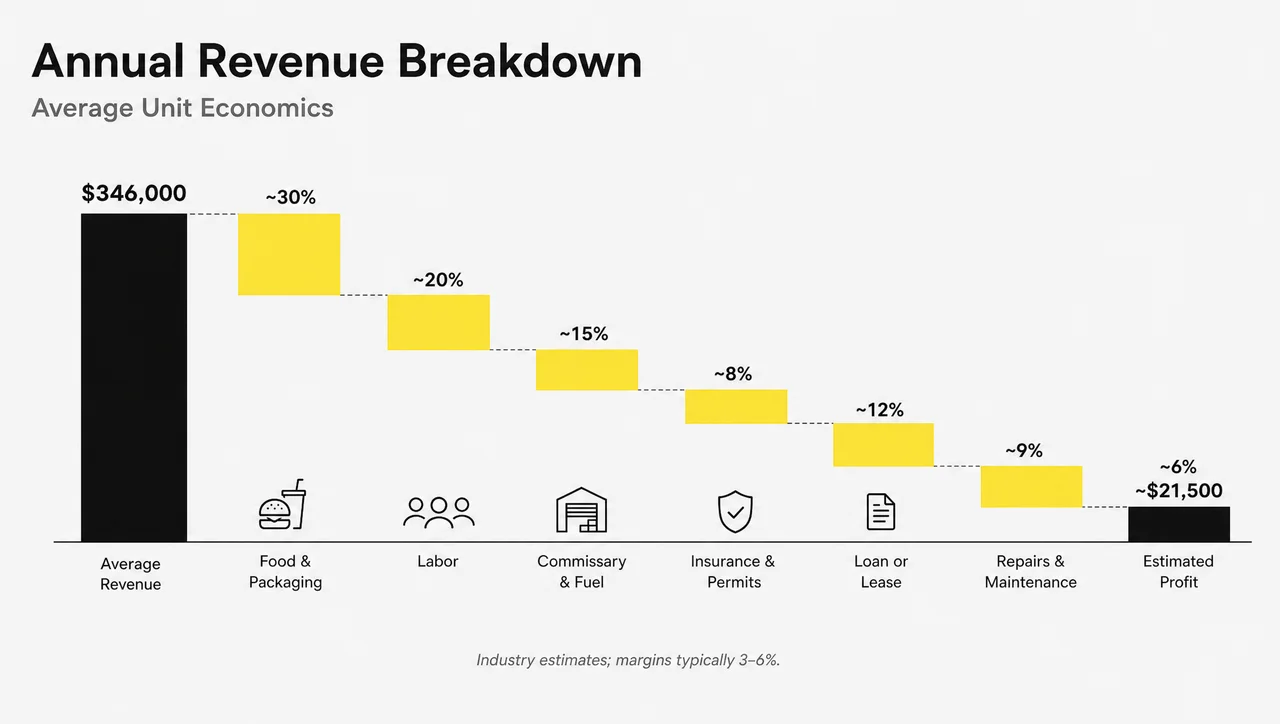
The strengths are real: mobility, no dining room rent, a brand that travels to its customers, and a path to more trucks or a restaurant. Research by the Institute for Justice, covering 12 years of county-level data, found that growth in food trucks was not followed by a decline in restaurants, a useful point when a city council hears that trucks hurt local businesses.
A food truck is not a cheap restaurant. Startup budgets of $50,000 to $250,000, margins of 3 to 6 percent and a weather-dependent schedule leave little room for error. The truck costs less than a dining room, but the risk per dollar is similar.
How to become a food truck owner if you have never worked a line? Work one first, as in the section on what to do before you spend anything. Many owners also start with catering or farmers market pop-ups under a commissary license, then buy a truck once the menu has proven itself.
Why Food Trucks Fail
Food trucks usually fail for a handful of repeat reasons: too little steady income, too much at once, growing too fast, and spending too much before the concept is proven. Knowing them in advance is cheaper than learning them on the road.
- No steady spots. Without two or three reliable locations or regular catering, sales swing too much to cover fixed costs. Fix: build a route and a catering base before you add festivals.
- Juggling everything alone. Licenses, locations, events, equipment and staff pile up quickly. Fix: a written weekly routine and at least one trained helper.
- Expanding too fast. A second truck before the first one is profitable doubles the problems. Fix: perfect one truck first.
- Not staying lean. Expensive builds and early splurges eat the reserve. Fix: keep spending low for the first year and reinvest.
- No industry experience. Owners who never worked in food service meet the pace, the inspections and the hours all at once. Fix: work a season first.
- Debt taken on for a dream. Loans that assume best-case sales leave no room for a slow winter. Fix: plan on the low end of the sales forecast and weigh the cost of what you give up to do this.
“60 percent of food trucks fail” is a number without a source. It circulates on industry blogs, but no reliable dataset tracks food truck survival separately. The failure reasons above are well documented; the percentage is not.
Can You Start a Food Truck With No Money?
You can’t start a food truck with no money at all, but you can start with far less than a new build by testing the menu first and delaying the biggest expense, the vehicle. Health permits, insurance and food cost money on day one. Operators who say they started “from nothing” usually mean a self-built trailer for about $20,000 and several months of work.
- Start with pop-ups or a tent. Sell at farmers markets, breweries and bars, or take preorders for pickup from a commissary, to prove the menu has buyers. A tent setup costs about $5,000 to $15,000.
- Start with a cart. A cart with a three-item menu can serve several locations a day without staff, and its profits can pay for the truck later.
- Rent a permitted truck. Some commissaries and builders rent trucks by the day or month, so you can sell before you buy.
- Lease or rent-to-own. Lower upfront cost, higher monthly payments.
- Use small loans. SBA microloans of up to $50,000 fit a used trailer or working capital.
- Take on a partner. Someone with a kitchen, a truck or cash in exchange for a share.
Each route has a cost. Renting and leasing cost more per month than owning, and a partner takes part of the profit. Pick the one that gets you to real sales fastest, then buy the truck with the proof in hand.
When a Food Truck Is the Wrong First Business
A food truck is the wrong start if the numbers, the city or the schedule do not fit. Check these conditions before you commit:
- You have less than $10,000 in reserve, or less than three months of fixed costs. One rainy fortnight or a failed generator stops sales while commissary rent, insurance and loan payments keep coming.
- Your city allows trucks only in a few zones, caps vendor permits, or charges thousands a year in fees. Annual fees in the U.S. Chamber study ranged from $590 to $17,066 depending on the city.
- Your menu needs more than 12 items or long cook times. A truck line cannot hold a full restaurant menu, and orders slower than a few minutes kill the line.
- You cannot work 60-hour weeks in the busy season. Prep, driving, service and cleaning fill 10 to 12 hours a day, and weekends are the peak.
- Winter shuts down street sales for three or more months where you live, and you have no catering or indoor-event plan. The loan payment does not pause in January.
- You have never worked a shift in food service. Test the work on someone else’s truck before you sign for your own.
If two or more of these apply, start with a tent, a cart or catering, and move to a truck once the numbers work.
Questions and Answers
1 How do you start a food truck business with no experience?
Work a season on another truck or in a busy quick-service kitchen first. Then test your menu at markets, pop-ups or catering gigs from a licensed kitchen before you buy a vehicle. Take a food protection manager course early, because most health permits require one on the team.
2 What does it take to start a food truck?
It takes a tested concept, a vehicle that meets your county’s health code, a registered company with an EIN and a sales tax permit, a commissary, a health permit, a fire inspection, a vendor permit and insurance. Budgets typically run $50,000 to $250,000, and preparation takes three to eight months.
3 What is the first step to starting a food truck?
Call your local health department before you buy anything. Ask for the mobile food unit plan review packet: it lists the sinks, tanks, equipment and documents your truck needs, so you shop for a vehicle that can pass. Then write the business plan and line up funding.
4 What licenses are needed to start a food truck?
You need business registration and a local business license, an EIN, a sales tax permit, a health permit, a fire inspection, a mobile vendor permit, vehicle registration and a food protection manager certificate. Florida and Texas issue statewide food truck licenses, while most states license trucks county by county.
5 Do I need a commissary for a food truck?
In most U.S. counties, yes. The health department wants a licensed kitchen for prep, storage, fresh water and waste disposal, and some ask you to log every visit. A few states, such as Florida, exempt fully self-sufficient trucks, confirmed at plan review.
6 Is owning a food truck profitable?
It can be. Industry estimates put average sales at $250,000 to $500,000 a year, but typical margins are 3 to 6 percent. The strongest trucks turn a profit within a year, while most take two to three years, depending on food cost, labor and how many good selling days and catering jobs they book.
7 How long does it take to open a food truck?
Usually three to eight months. Buying a used truck can take a week, while health plan review alone takes from about 12 weeks to six months depending on the county. Submit plan review as early as possible, because it decides your opening date.
8 Should I start with a food truck or a food trailer?
A trailer costs less and rarely breaks down, but it needs a tow vehicle and more room to park. A truck suits several stops a day on city streets. If your budget is tight, a trailer, cart or tent lets you test the menu first.
9 Can I sell food from my food truck in any city?
No. Each city or county issues its own vendor permits and parking rules, such as distance limits from restaurants or time limits at a spot. Even in states with a statewide license, local zoning and event permits still apply, so check each city before you add it to your route.