How Seasons Affect the Food Truck Industry: Sales, Menus, and Operations



Seasons affect the food truck industry through foot traffic, event calendars, and weather: in cold-weather markets, summer months run about 25–30% above average monthly revenue and winter months fall 20–35% below it, while in Sun Belt cities the peak and slow seasons trade places.
How Do Seasons Affect the Food Truck Industry? What Changes Each Season
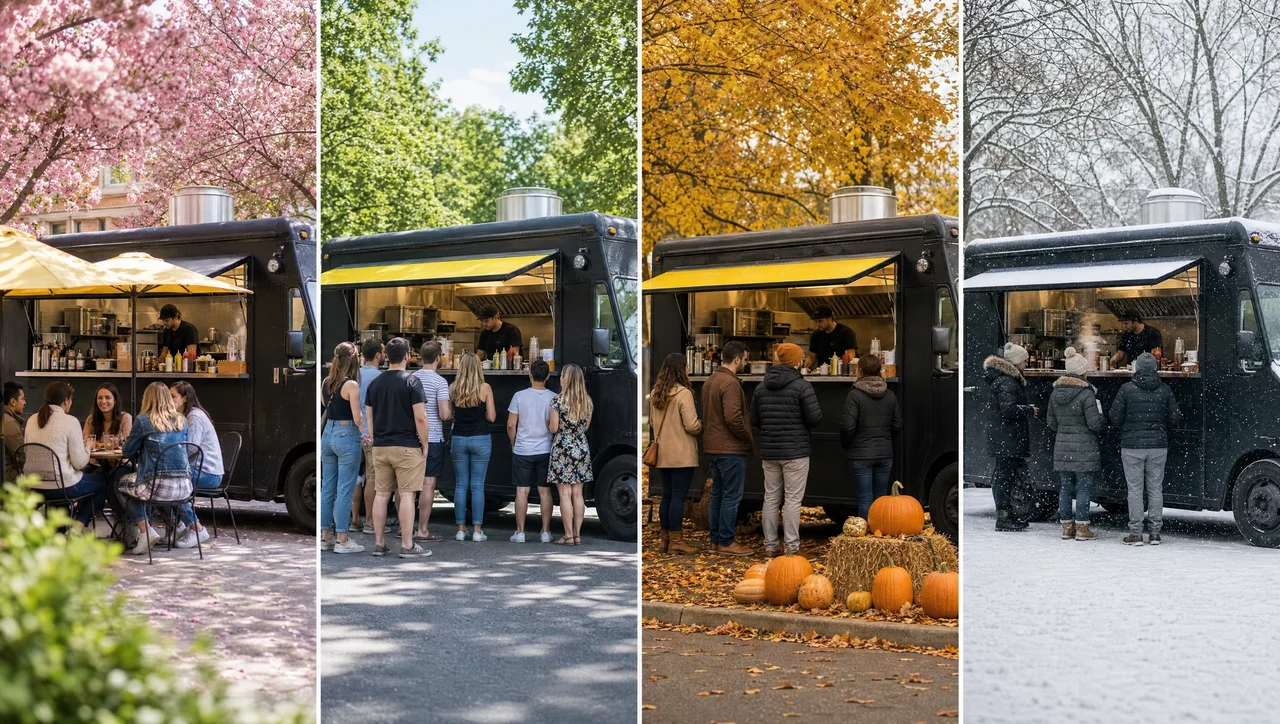
Seasons affect the food truck industry through five changes that arrive at once: how many people pass by, which events fill the calendar, what customers want to eat, how the equipment behaves, and how long the crew works. The table shows how these factors shift across a typical year in a cold-winter US market.
| Season | Demand | Events | Menu | Operations | Crew and daylight |
|---|---|---|---|---|---|
| Spring (Mar–May) | Recovering, weather-dependent | Festivals, farmers markets, races return | Lighter dishes, first seasonal produce | Rain and temperature swings cancel planned days | Hiring and training before peak |
| Summer (Jun–Aug) | Highest in most northern markets | Fairs, concerts, street food festivals | Cold drinks, fast sellers, combos | Refrigeration and power under heat load | Longest shifts, burnout risk |
| Fall (Sep–Nov) | Steady, then declining | Football, campus events, Halloween, Thanksgiving | Pumpkin, apple, soups, chili | Earlier sunsets cut evening service | Schedules shift to lunch and events |
| Winter (Dec–Feb) | Lowest in cold markets | Holiday markets, indoor fairs, private parties | Soups, noodle bowls, hot drinks | Freezing water lines, weak batteries, icy roads | Reduced hours, some trucks close |
Month-by-Month Revenue: Peak Season and Slow Months
Peak season for most food trucks in the US runs from May through September, and July is usually the busiest time of the year. One industry revenue index sets the average month at 100, and it rates January at 65 and July at 125. These figures are an estimate across many concepts, so treat them as a pattern, not a forecast for a single truck.
| Month | Revenue index | Month | Revenue index |
|---|---|---|---|
| January | 65 | July | 125 |
| February | 70 | August | 120 |
| March | 85 | September | 110 |
| April | 95 | October | 105 |
| May | 110 | November | 80 |
| June | 120 | December | 75 |
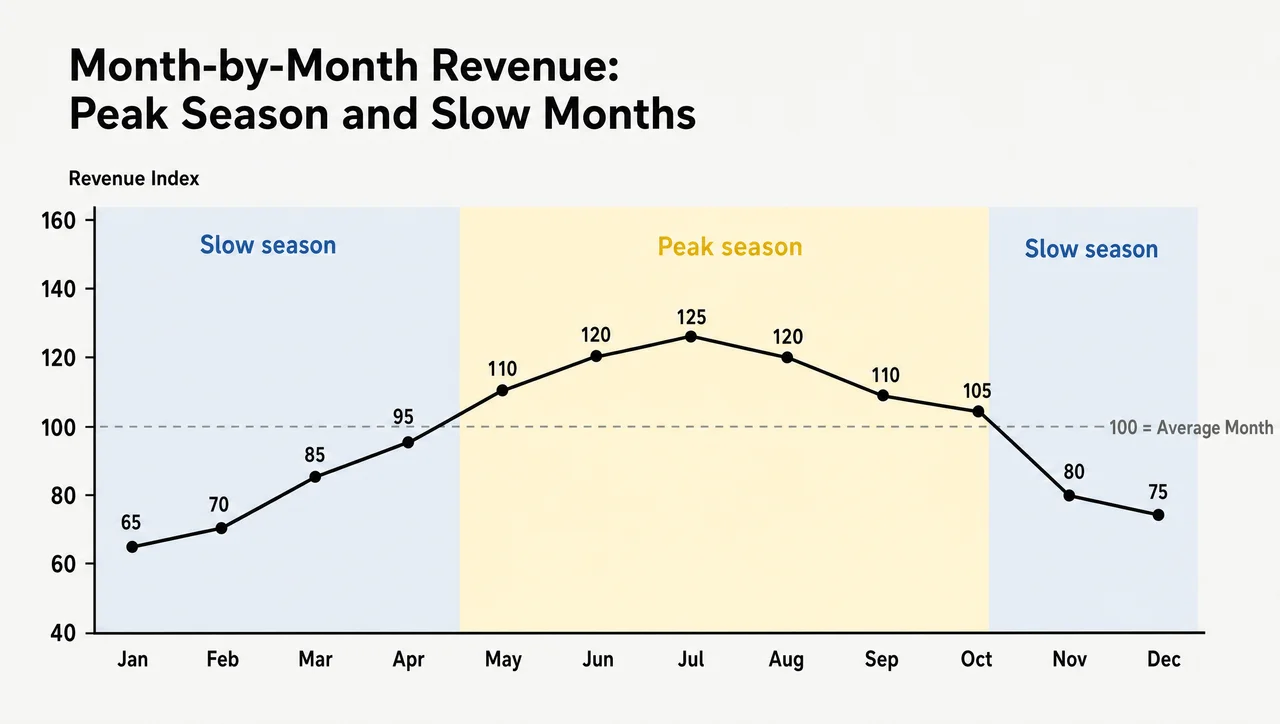
The best months sit between May and October. The weakest stretch, November through February, is also when weather has the most power over daily sales.
Climate Seasons vs. Business Seasons
A calendar season and a sales season are not the same thing. Winter still holds high-revenue dates, such as holiday markets, tree lightings, corporate parties, and New Year’s events. A summer month can go quiet in a desert city. Planning by business seasons (peak, shoulder, slow, and event spikes) gives a truer picture than planning by the weather alone.
⚠️ Winter is not the dead season for every food truck. In Phoenix, the strong selling season runs from October through May, and summer is when many operators slow down or shift to catering.
Why Seasonality Hits Independent Operators Hardest
IBISWorld counted 92,257 food truck businesses in the US in 2025, a 16.9% increase over the prior year. Most of them are small: industry estimates put roughly 91% of food trucks under independent ownership. Without a chain’s cash reserves, one weak quarter can decide whether a truck survives.
Washington, DC, shows how hard the seasons affect the food truck industry in a cold city. The regional food truck association loses about 20% of its members each winter, and in 2016 a third or more of the city’s 404 licensed trucks parked for the season. IBISWorld’s 2026 outlook adds price pressure on top of seasonality: it expects industry revenue to slip 1.1% as higher tariffs push vendors to raise prices.
Spring and Summer Food Truck Season: Events, Crowds, and Heat
Spring and summer bring the biggest food truck crowds because warmer temperatures, longer daylight, and outdoor events line up at the same time. The same heat can also empty parks and push the temperature inside a truck past safe working levels.
Spring: Festivals Return, Weather Stays Unpredictable
Spring reopens farmers markets, park weekends, races, and local festivals. Rain and sudden cold snaps still wipe out planned days, so spring revenue swings more week to week than summer revenue. Menus move from hearty winter dishes toward lighter bowls, salads, and sandwiches, which makes spring a good time to test new items before the rush.
Spring is also when the summer calendar fills up. One barbecue truck operator starts booking summer events in January and is usually fully booked by the end of March.
Summer Food Truck Demand at Peak Season
In northern and midwestern markets, summer food truck demand peaks with fairs, concerts, festivals, and late evening service. Customers switch to cold drinks, frozen desserts, and light wraps. Experienced operators shorten the peak-season menu to fast, profitable items and push combos, which raises the average ticket and keeps lines moving.
Peak season has costs of its own. More trucks compete for the same events, and crews work long days: one operator describes 80–100-hour workweeks during the busiest months.
When Summer Heat Becomes the Slow Season
In Texas and the desert Southwest, the calendar flips. An Oaxacan-style truck in South Austin saw sales fall 65% after summer began. A manager at a Dallas park truck estimated business was down about 85%, and on a 95°F day the inside of the truck reached 104.4°F. A Round Rock burger and barbecue trailer reported summer sales 40% to 50% below its spring numbers. A Tucson taqueria owner loses about 30% of customers in summer and struggles every day to keep food cold.
Heat also creates a compliance problem. Cold-holding equipment must keep food at 41°F or below no matter how hot it is outside, and a refrigerator running in a 100°F-plus box works much harder to stay there.
⚠️ Summer is not the best season everywhere. In desert and Gulf markets, it is often the weakest stretch of the year.
Seasonal menus don’t have to mean reprinting the board: with digital menu boards for food trucks, a price or item you change in the POS updates the screen on its own.
Fall and Winter: How Cold Weather Changes the Food Truck Business
Fall and winter shrink a food truck’s audience in cold-weather markets: daylight gets shorter, outdoor events thin out, and freezing temperatures add equipment risk. Sales in the coldest months often fall by half, yet holiday events and indoor venues keep many trucks running.
Fall: Shorter Days, Back-to-School, and Holiday Events
Early fall is often steady. Offices and campuses bring back weekday lunch traffic, while football games and harvest festivals add weekend crowds. Earlier sunsets cut into evening service, and menus shift to pumpkin, apple, squash soup, and chili. Halloween and Thanksgiving events keep a truck visible to families. Fall is also the time to lock in winter work: holiday market spots are commonly reserved in September and October.
Winter Food Trucks: How Much Sales Drop
Truck owners in cold markets report revenue drops of 50% or more in winter, with the harshest days bringing only a sale or two. Weather plays a bigger role in this season than in any other. Planalytics measures the share of restaurant sales tied to weather, and that share peaks in November and December at over 5% nationally, double the level seen in summer and fall.
Operators describe the same pattern. In a regional food truck group, owners agreed that December through February is the slump, and several said they close for those months unless a large event is booked.
⚠️ Winter food trucks do not all disappear. The Minnesota Food Truck Association keeps a list of trucks still serving through Minnesota winters, and several Metro Detroit trucks stay open all season.
Operating a Food Truck in Winter: Water, Power, and Propane
Running a food truck in winter adds failure points that summer never tests:
- Water lines. Insulate pipes or use heated hoses, because a burst water line can shut down service. For long storage, drain the tanks and blow out the lines.
- Generator. Cold makes generators harder to start, so keep them sheltered and serviced.
- Batteries. Cold drains batteries faster. Batteries removed for the off-season should be stored somewhere warm and dry.
- Refrigeration. Fridges and prep equipment exposed to extreme cold can malfunction and spoil or freeze ingredients.
- Truck build. Thermal insulation, sealed doors, and enough electrical capacity for heaters decide whether the truck can work in January at all.
- Roads. Snow tires and a snow removal plan for the serving area protect both the driver and the customers.
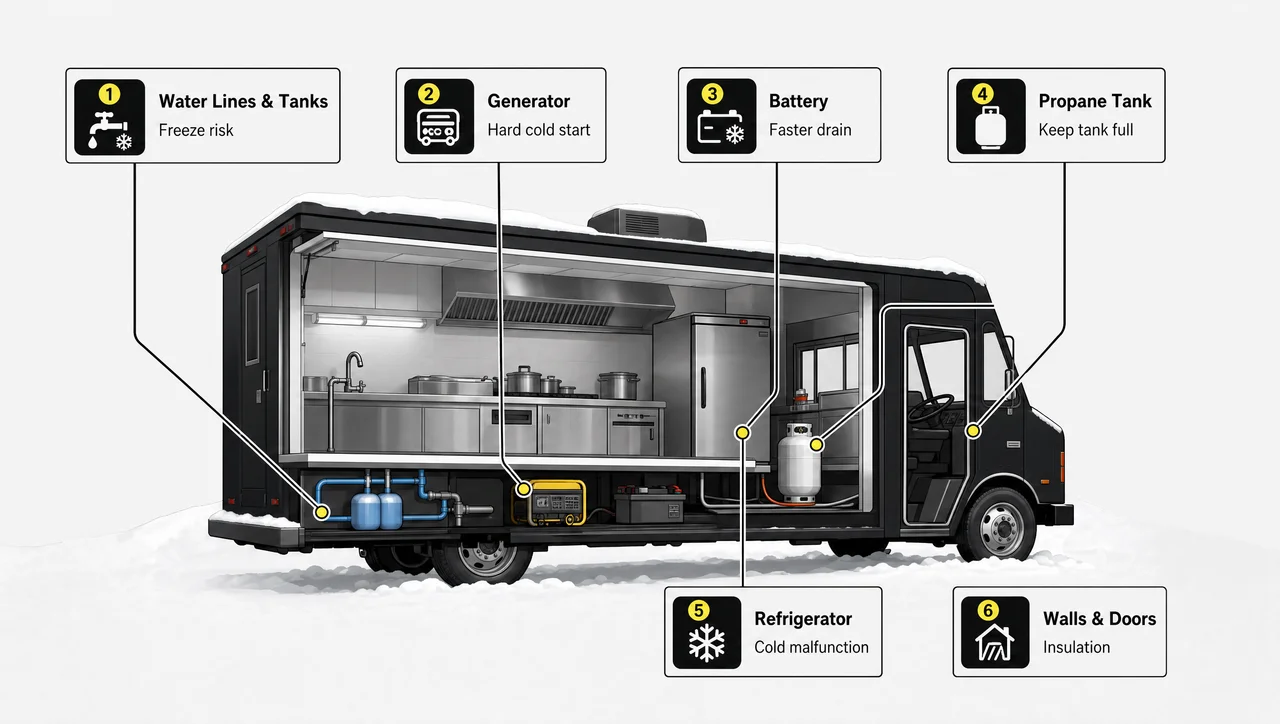
⚠️ Propane does not freeze in normal winter weather. It keeps vaporizing down to about −44°F. Tank pressure can drop near −20°F, but the inline regulator keeps cooking equipment at temperature, and keeping the tank from running low helps hold pressure.
Winter Food Truck Ideas That Keep Sales Moving
- Hot menu. Soups, chili, ramen and noodle bowls, loaded baked potatoes, hot chocolate, and cider.
- Shorter waits. Heaters near the window and pre-ordering keep customers from standing in the cold. Online ordering integration moves the wait indoors.
- Holiday events. Holiday markets, tree lightings, ice rinks, and New Year’s celebrations.
- Indoor partners. Breweries, coffee shops, food halls, and shared kitchens that host a limited menu.
- Catering and private orders. Corporate parties and family events. One operator runs private orders from November through March without taking the trailer out.
- Delivery. Delivery services bring the food to customers who won’t come outside.
How Seasons Affect the Food Truck Industry by Region
How seasons affect the food truck industry depends on climate. Cold markets slow down in winter, desert and Gulf markets slow down in summer, and mild coastal markets see the smallest swing. The head of the DC-area food truck association has stressed that seasonality matters far more there than in places like Florida or California.
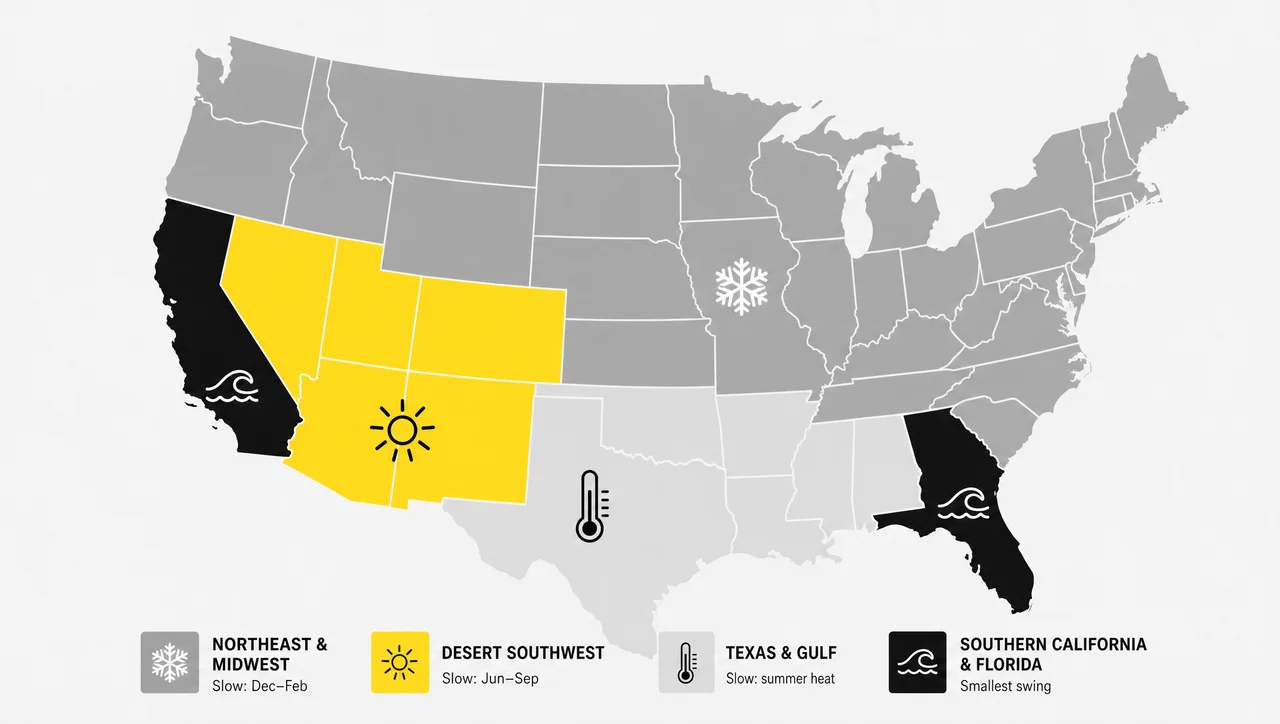
| Region | Peak season | Slow season | Main seasonal risk |
|---|---|---|---|
| Northeast and Midwest (DC area, Minnesota, Michigan) | May–September | December–February | Frozen equipment, icy roads, short days |
| Desert Southwest (Phoenix, Tucson) | October–May | June–September | Heat inside the truck, refrigeration strain |
| Texas and Gulf (Austin, Dallas, San Antonio) | Spring and fall | Summer heat waves | Crew safety, customers staying indoors |
| Mild coastal (Southern California, Florida) | Year-round with event spikes | Rainy spells, post-holiday dip | Tourist-season swings |
Coastal and tourist towns add one more layer: demand follows visitor seasons, so a beach town can peak when inland markets are quiet.
How Seasons Change Food Truck Menus, Staffing, and Locations
Beyond sales, seasons affect the food truck industry through three recurring decisions: what to serve, how many people to schedule, and where to park.
Seasonal Menus and Ingredient Costs
Seasonal produce sets the rhythm: tomatoes and zucchini in summer; pumpkins, apples, and kale in fall; root vegetables and slow-cooked dishes in winter. Ingredient prices move with harvests, and tariffs add pressure on top. A practical pattern is to keep the core items all year and rotate two or three seasonal specials. Ready-made food truck menu templates make it easier to swap those specials in and out without redesigning the whole menu. Comfort food also differs by region, so a winter special that sells in Minneapolis may not work in Atlanta.
Seasonal Staffing: Peak Hours, Burnout, and Slow-Month Cutbacks
Peak months stretch a small crew to its limit, while slow months force cuts. During brutal summers, Texas taco truck owners have laid off employees and trimmed hours, and those cuts can hurt the business all year because workers may take jobs elsewhere. In cold markets the same squeeze happens in January. Cross-training staff and using slow weeks for training help keep a reliable crew for the next peak.
Seasonal Locations and the Event Booking Calendar
The best spots are booked months ahead, so a food truck’s location plan runs on a different clock than its menu:
- January–March: apply for summer festivals and fairs; some trucks are fully booked by the end of March.
- March–April: choose two or three main summer locations and set the event calendar.
- September–October: reserve holiday market spaces and book corporate year-end events.
- Fall: sign recurring weekday lunch agreements with offices, one to three visits a week.
- Winter: move to heated food truck parks, breweries, and indoor fairs.
Keeping Seasonal Menus and Prices Current
Every seasonal switch means new items, new prices, and dishes that disappear from the board. How a truck displays its menu decides how much work each switch takes.
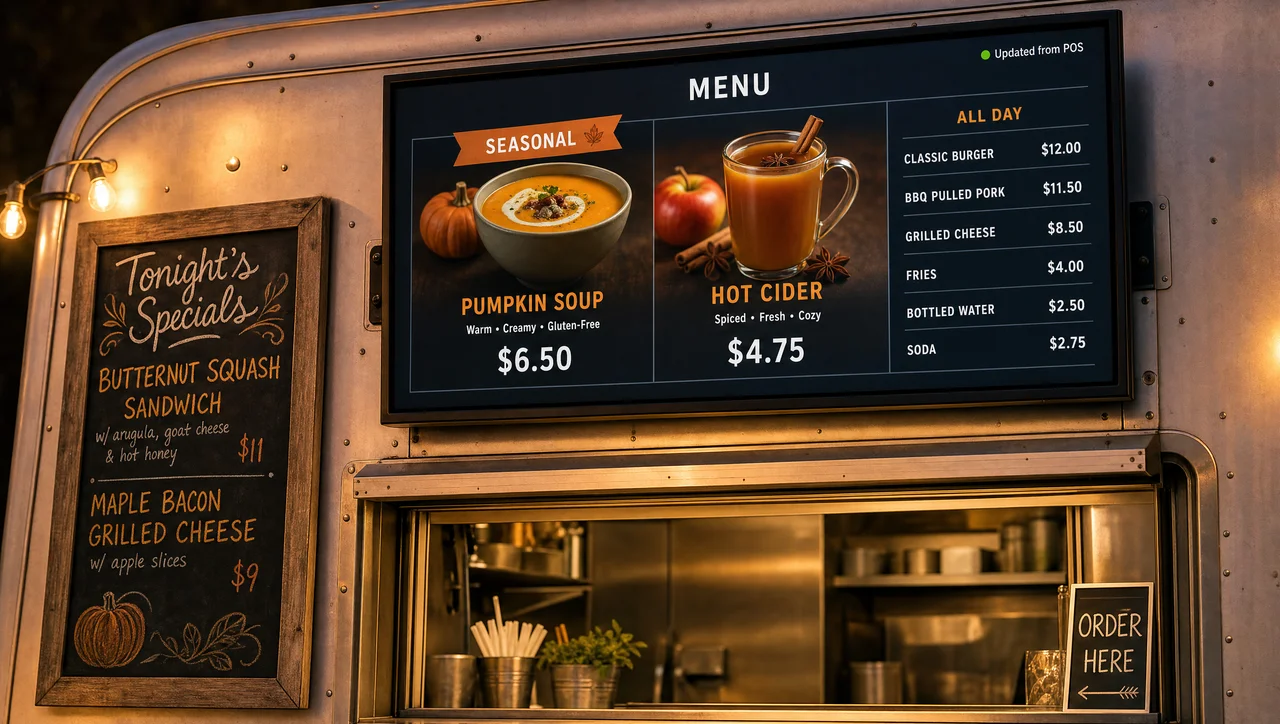
| Menu format | Seasonal change | Price change | Limitation |
|---|---|---|---|
| Chalkboard | Rewritten by hand | Rewritten by hand | Readability depends on handwriting and light |
| Printed panel or vinyl | New print for each version | New print | Reprint cost and lead time |
| Digital menu board | Swapped on schedule | Pulled from POS | Needs power, and a connection to receive updates |
A screen-based menu is a form of digital signage, and it removes most of the manual steps. With Decker, a price or item changed in the POS regenerates the menu image automatically, and the update reaches the screen in about 1–5 seconds with no designer involved. Items marked unavailable in the POS are hidden from the screen, so customers don’t order what the truck has run out of. Display rules can switch breakfast to lunch on schedule or put hot drinks first on a cold day. In the Burger Shop case (Downtown LA, four screens, POS integration), menu updates went from days or weeks to minutes.
There are limits worth knowing. Decker devices keep an offline cache, so the last published menu stays on screen when the signal drops, but new prices sync only after the connection returns. And if a truck runs one menu at one price all year, a chalkboard does the job just as well.
How Seasonality Affects Food Truck Monthly Income
Food truck monthly income rises and falls with the seasons, so profit earned in peak months has to carry the slow ones. One estimate puts peak-season revenue at $25,000–$50,000 a month and off-season revenue at $10,000–$25,000. On the profit side, a truck that nets $8,000 in July might net $3,000 in January in a cold-weather market. Actual numbers depend on the city, the concept, and the event calendar.
Using Last Season’s Sales to Forecast the Next
- Export monthly sales by location and by item from the POS.
- Mark the days with bad weather, heat waves, and major events.
- Compare the same months year over year instead of month to month.
- Set the slow-season reserve as the monthly gap between an average month and a slow month, multiplied by the number of slow months.
- Book next year’s key events as soon as the numbers show which locations paid off.
When Staying Open Through the Slow Season Doesn’t Pay
An open window is not always the better choice. Staying closed, catering, or taking a maintenance break usually wins in these situations:
- The day’s sales don’t cover the morning’s prep. One DC vendor packed up early after a winter day that paid her helper’s $90 wage but covered only about half of the $300 in meat she had bought that morning.
- The truck gets too hot for the crew. One Dallas truck stops service once the heat reaches about 109–110°F.
- Refrigeration can’t hold 41°F or below. At that point, the food safety rule decides for you.
- Roads are icy or snow-covered. A heavy truck on slick roads puts the driver and the vehicle at risk.
- The calendar is empty from December through February. Several operators close for those months unless a big event is booked, and switch to private orders.
During a stretch of extreme Phoenix heat, one Cajun food truck owner moved her effort into building a catering business, which is often the best way to keep income flowing when curbside sales stall.
Questions and Answers
1 What is the best season for food trucks?
In most northern and midwestern US markets, summer is the best season, and May through September brings the largest crowds and events. In the desert Southwest, the strongest stretch runs from October through May.
2 What are the slowest months for food trucks?
In cold-weather markets, January and February are usually the slowest, with December close behind. One revenue index puts January at about 65% of an average month.
3 Do food trucks operate in winter?
Many do. Winter food trucks serve holiday markets, breweries, indoor fairs, and private events, and state associations such as Minnesota’s track trucks that stay open. Others park for the season and switch to catering or private orders.
4 How do the seasons affect the food truck industry in hot states?
In hot states, seasons affect the food truck industry in reverse, and summer is often the slow season. One Austin truck lost 65% of its sales once summer started, and trucks in Arizona do most of their business between fall and spring.
5 How much do food trucks make a month in the off-season?
Industry estimates put off-season revenue at $10,000–$25,000 a month, compared with $25,000–$50,000 in peak months. Profit falls further than revenue because fixed costs stay the same.
6 How do food trucks keep water lines from freezing?
Operators insulate pipes or use heated hoses, park indoors overnight when possible, and drain the tanks and blow out the lines before long-term storage.
7 Should a food truck close for the winter?
Closing makes sense when daily sales don’t cover prep and labor, when roads are unsafe, or when no events are booked. Trucks with holiday market spots, indoor partners, or catering contracts often stay profitable through winter.
8 When should a food truck book summer events?
Start in January. The best festivals and fairs fill months ahead, and some trucks have their entire summer booked by the end of March.