Menu Board Ideas 2026: Layouts, Formats and Seasonal Swaps for Every Counter



The best menu board ideas share one goal: a guest standing in line finds your signature item, its price and the combo within a few seconds. Below are 40 menu board ideas for restaurant counters, cafes, bars and bakeries, with menu board examples sorted by layout, venue, format, season and budget.
- Put one signature item where nobody can miss it, and keep every price next to its dish.
- Pick the format by how often your menu changes: chalk for daily changes, a letter board for weekly ones, print for a seasonal menu, a screen for changes at any hour.
- Swap seasonal items on a date you set in advance, not “when someone gets to it.”
Menu Board Ideas at a Glance
The best menu board ideas make one item stand out, keep prices next to dishes and match how often the menu changes. Chalk art, wood rails and photos are styling on top of those three jobs. Menu boards get read once, while guests walk up, so simple menu board ideas usually beat elaborate ones. The table compares the 12 formats and techniques that come up most often in the 40 ideas below.
| Idea | Best for | Typical cost (US) | How often you can change it |
|---|---|---|---|
| Signature item spotlight | Any counter | $0 on an existing board | With every menu change |
| Combo block | Burger, sandwich and QSR counters | $0 on an existing board | Weekly |
| Hand-lettered chalkboard | Cafes, bistros, daily specials | $23–130 | Daily |
| Stacked chalk panels | Cafes with 3–5 categories | $70–95 for 3–4 boards | Daily, one panel at a time |
| Hanging double-sided board | High ceilings, day and night menus | From $380 | Weekly |
| Retro letter board | Coffee bars, bakeries, diners | $85–240 | Weekly (letters take time) |
| Lightbox | Bars, dark dining rooms | $80–425, prints from $32 | Seasonally (new insert) |
| Framed printed poster | Menus that rarely change | $120–145 (24×36 print + frame) | Seasonally |
| Tabletop specials card | Tables, registers | $8–13 per holder | Daily or weekly |
| Seasonal panel | Any board with a fixed core menu | $25–45 per reprint | Four times a year |
| DIY chalk-paint wall | Small cafes on a tight budget | About $34 per quart of paint (110 sq ft) | Daily |
| Screen with dayparts | Changing prices, several locations | $250–600 TV + $0–80 a month for software | Any time, on a schedule |
Menu board examples by format. Costs are typical US retail prices for one board, checked in November 2026, without shipping or installation; change frequency assumes one staff member updates the board.
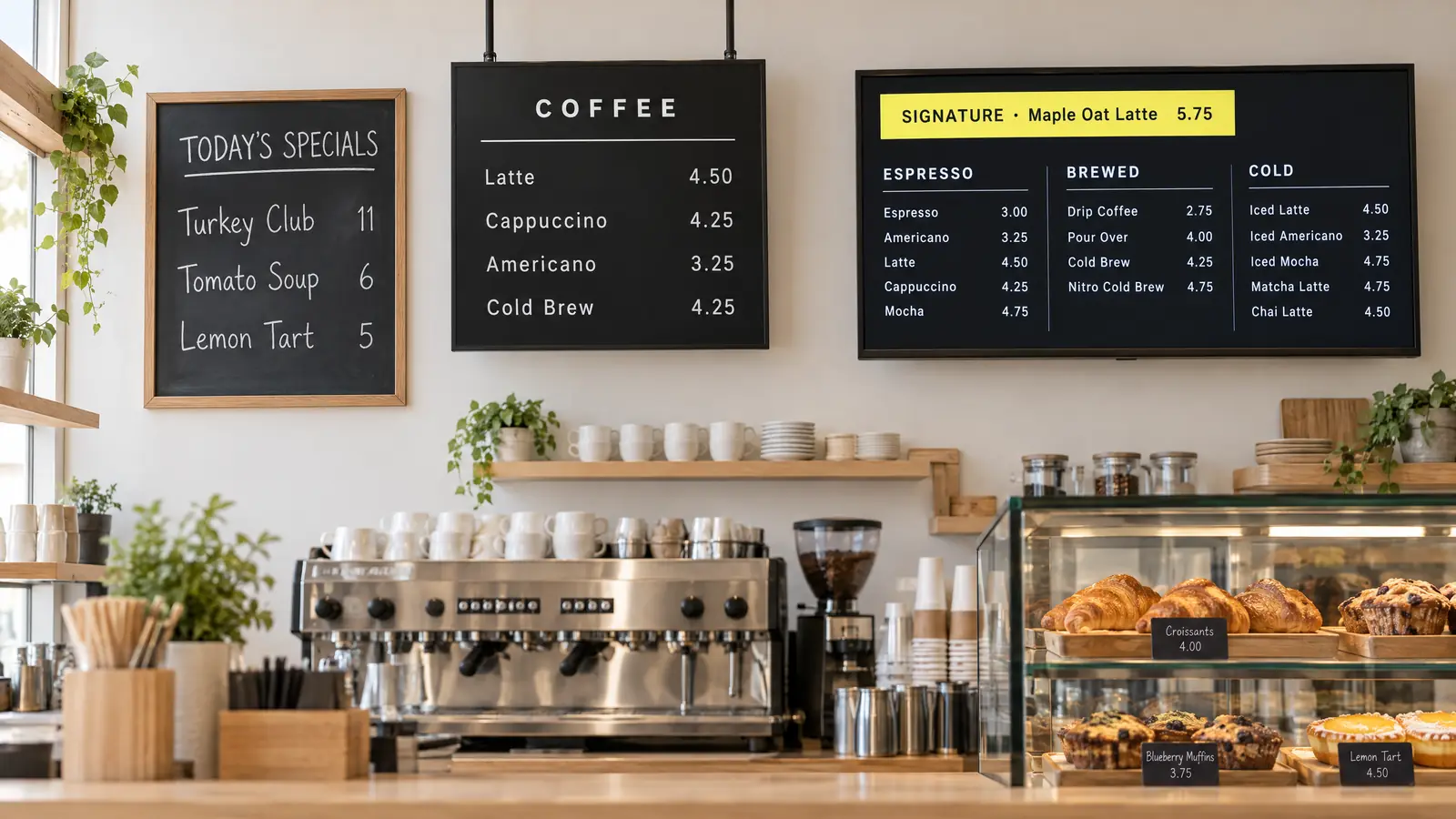
Creative menu board ideas that still sell include a framed signature dish, stacked chalk panels with one category each, a double-sided hanging board for day and night menus, a retro letter board and a seasonal panel that slots in without redrawing the rest.
Menu Board Layout and Design Ideas That Guests Read in Seconds
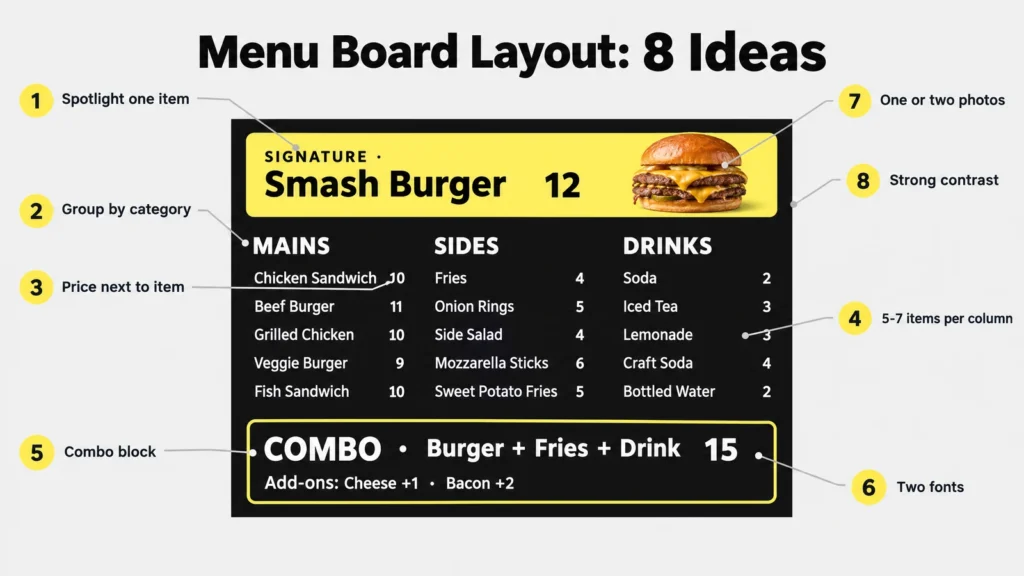
A menu board layout works when guests at the back of the line spot the signature item and its price. Ideas 1–5 cover where items sit; ideas 6–8 cover how the board looks. Both sets apply to restaurant menu board design ideas for a quick-service counter and to a ten-item cafe board.
Layout ideas
1. Spotlight one signature item. Put a frame, a color block or a photo around one dish, either the one you most want to sell or the one people come for. One highlight guides the eye. Four highlights cancel each other out.
Myth check: The “golden triangle”, the claim that guests look at the center of a menu board first and then the top right, has no support in eye-tracking research. A 2017 study by Sybil Yang at San Francisco State University found that diners read menus in order, like a book, with no “sweet spot.” For a menu board, that research argues for putting the spotlight where reading starts: top left, or the first panel guests see from the door.
2. Group by category in the order guests decide. Most people choose a main, then a side, then a drink. Lay the board out the same way: mains, sides, combos, drinks. Desserts and extras go last or on a counter card.
3. Keep prices right next to items. A price at the far end of a dotted line makes guests trace across the board and match the wrong row. Put it one space after the name or directly under it. In a 2009 Cornell study at a Culinary Institute of America café, guests whose menus showed prices without dollar signs spent about 8% more, so on a menu board “12” instead of “$12.00” is worth a test.
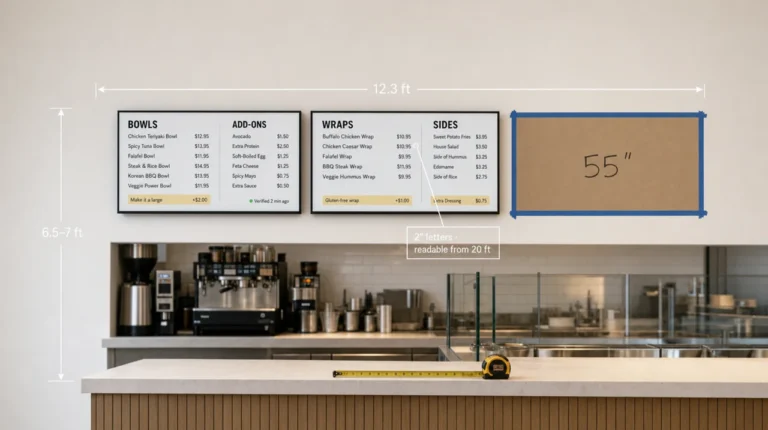
4. Cap each column at 5–7 items. Menu boards read from 15–20 feet away stay legible at 5–7 items per column, and letter height follows the sign-maker rule of about 1 inch per 10 feet.
5. Give combos and add-ons their own block. A combo buried in the list reads like one more item. A boxed block (burger, fries and a drink for one price) shows the deal at a glance, with add-ons on one line beneath it.
Design ideas
6. Two fonts, two weights. One display font for category names, one plain font for items and prices, in regular and bold. Thin and script fonts blur at 15 feet, so keep them away from prices. Most modern menu board design ideas start from this rule.
7. Show one or two best sellers, not every item. A photo pulls attention to the dish next to it; ten photos pull attention nowhere and push the type smaller. Cute menu board ideas such as hand-drawn icons follow the same limit: one or two per board, next to the items you want to sell.
8. Use strong contrast and one accent color. Light text on a dark background holds up in rooms with window glare; dark text on a light background suits dim, warm rooms. Choose one accent color for prices or category names and use it nowhere else. The next sections apply these eight rules to restaurants, cafes and chalkboards.
Restaurant Menu Board Ideas
Restaurant menu board ideas depend on service style: counters need boards read on the move, dining rooms need one board for specials. The five ideas below follow that split. Creative restaurant menu board ideas still have to pass one test: can a first-time guest order without asking a question?
Counter and QSR boards
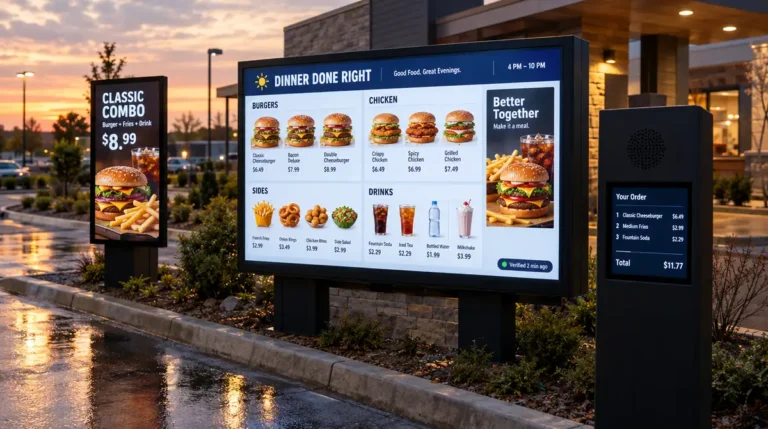
9. Three-panel split: mains, combos, drinks. Counter menu boards read best as three panels, one category each, so guests decide step by step as the line moves. Put combos in the middle panel, between the two choices a combo joins.
10. Breakfast-to-lunch switch at a fixed time. Change the board at the same time every day, say 10:30 or 11:00, and print that time on it, so a guest arriving at 10:55 knows what’s coming.
Menu boards in chains with 20 or more locations must show calories: FDA rules (21 CFR 101.11) require a calorie count next to each standard item. The same FDA rule puts two statements on the board: that 2,000 calories a day is used for general nutrition advice, and that more nutrition information is available on request. Reserve space for both in the layout from the start.
Full-service restaurants
In a dining room, the board answers one question: what is different today?
11. Daily specials at the host stand. Guests waiting for a table read whatever is in front of them. Three or four of today’s specials on a small board there get them choosing before they sit down.
12. Chef’s pick of the week. One dish, one line on why the chef picked it, one price. Change it on the same weekday so regulars learn to look for it.
13. Sold-out line instead of a marker cross. A marker line through an item looks careless and leaves guests guessing. Use a “Sold out today” strip or magnet, and take it off the next morning.
Restaurants that change prices across several boards or locations often move the core menu to digital menu boards for restaurants and keep chalk for specials.
Cafe and Coffee Shop Menu Board Ideas
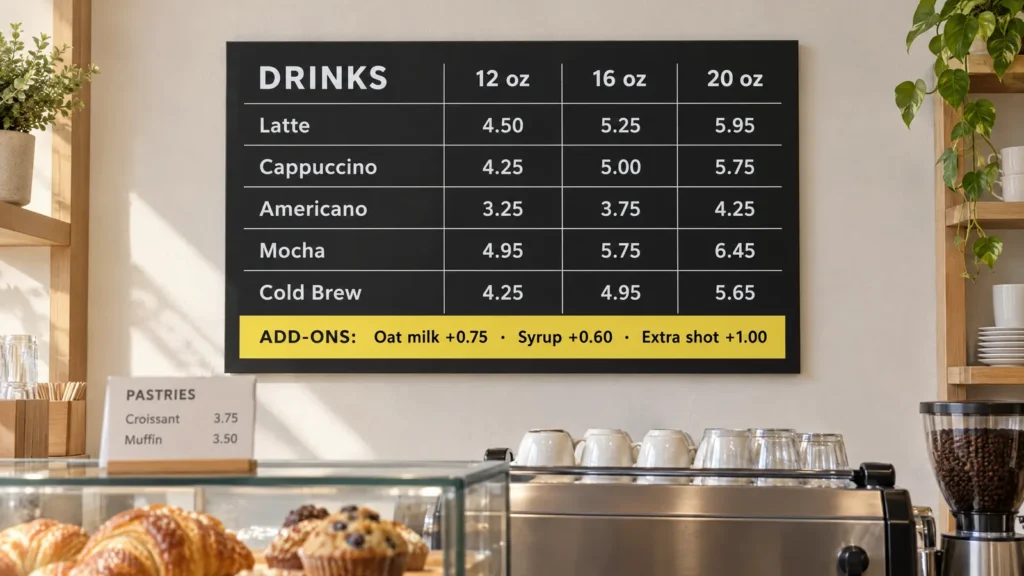
Cafe menu board ideas solve one problem: fitting three sizes and a dozen add-ons onto one board above the counter. Most menu board ideas for cafe counters come down to grids and grouping, not decoration. Coffee menu board ideas that work at 7 a.m. are the ones a half-awake guest reads once and orders from.
Sizes, add-ons and pastries
14. Size grid as columns. Put 12, 16 and 20 oz as column headers and list drinks as rows, one price per cell. Three prices crammed after each drink name is the quickest way to make a cafe board look cluttered.
15. Add-ons in one row. List milk alternatives, syrups and an extra shot once, in a single row at the bottom, with one surcharge each. That beats repeating “+ oat milk” under every drink.
16. Pastry card at the case, not on the main board. Guests choose pastries by looking at them. A small card on the display case with names and prices frees the main board for drinks, which guests can’t see.
Coffee shop menu board ideas
Coffee shop menu board ideas start from how regulars order: drink type first, size second.
17. Four short blocks: espresso, brewed, cold, tea. This split matches how regulars think about their order, and many coffee shop menu board design ideas build on it. Keep each block to 4–6 drinks.
18. Seasonal drink panel with an end date. “Maple oat latte, until November 30” tells regulars to order it now and tells staff when the panel comes down.
19. Hanging board over the counter. In a narrow cafe, a board hung from the ceiling stays visible over the line and frees the back wall for the espresso machine. More hanging formats follow below.
Cafe menu board design ideas like wood rails or a muted palette work on top of this structure, not instead of it.
Chalkboard Menu Ideas
Chalkboard menu ideas work best for menus that change daily, because a rewrite takes minutes and needs no reprint. The catch is handwriting: a chalk board menu looks only as good as the person who wrote it that morning. The six chalk menu board ideas below make the result less dependent on one steady hand.
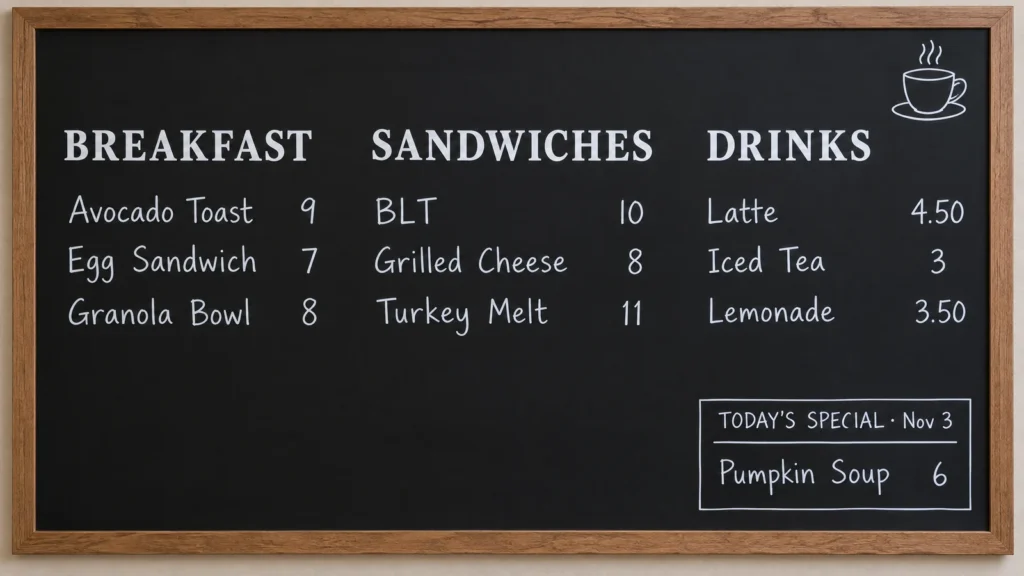
20. Printed or vinyl headers, chalk prices. Have category names and your logo cut in vinyl or painted once, and write only items and prices by hand. The board stays consistent even when a different person updates it each shift.
21. Liquid chalk markers or chalk sticks. Chalk sticks smudge when a sleeve brushes the board but wipe off with a dry cloth. Liquid chalk markers give sharper lines and don’t smudge, but they need a non-porous surface: sealed slate, glass, metal or a coated board. On porous chalkboard paint they can leave ghost marks, so test in a corner first.
22. Stacked chalk panels. Hang three or four small boards in a column, one category per panel. When the sandwich list changes, you rewrite one panel, not the whole wall. Among chalkboard menu board ideas, this one suits cafes with 3–5 categories best.
23. One chalk drawing per board. A coffee cup, a seasonal leaf or the signature dish: one illustration draws the eye, five make the board hard to read.
24. Daily special corner with the date. Write today’s date above the special. It shows the board is current and saves staff from answering “Is that still on?”
25. Chalk-paint wall section. Paint a framed section of wall with chalkboard paint. Menu chalk board ideas like this suit cafes with a long wall and frequent changes; plan for the daily cleaning it needs.
Chalk falls behind when prices change across several boards or locations, or when nobody on shift writes neatly.
Hanging, Retro and Other Menu Board Formats
The format of a menu board should match how often you change it and how far guests stand from it. A letter board that takes 20 minutes to reset makes no sense for a daily menu, and a chalkboard adds little to a menu that hasn’t changed in a year.
Hanging boards
Hanging menu board ideas solve two problems at once: a crowded back wall and a line that blocks the view.
26. Double-sided board on rods. Hanging menu boards keep the back wall free, and a board on ceiling rods can turn: the daytime menu on one side, the evening menu or happy hour on the other. Staff flip it at a set time instead of rewriting.
27. Lower edge above the line. The bottom of a hanging board should clear the heads of people standing in line, or the back of the queue sees only the person in front.
Retro letter boards
Old school retro menu board ideas trade update speed for character, since every letter goes up by hand.
28. Felt or peg letter board. White letters on black felt give a diner or cinema look that suits coffee bars and bakeries. Keep spare letters sorted in a labeled box. Updates take longer than chalk, so a letter board fits menus that change weekly, not daily.
Lightbox and printed panels
29. Lightbox for dark rooms and bars. A backlit panel stays readable in a dim bar or at a late-night counter where a chalkboard disappears. You change a printed insert, so it suits menus that change a few times a year.
30. Framed printed poster. For a menu that changes once a season, a printed poster in a simple frame is the cheapest way to look finished. Reprint the insert, keep the frame.
Not every board goes on the wall. Menu display board ideas for the counter (a stand at the register, an easel by the pastry case) catch the decision at the last step. Food menu display board ideas work best for add-ons and impulse items: one stand, three to five items.
Delis, Pizza Shops, Bars and Bakeries: What Each Board Must Show
Every venue’s board must show one thing clearly: a deli its sandwich builder, a pizza shop its sizes, a bar its taps. Get that part right and the rest of the board can stay simple.
Delis
31. Build-your-sandwich steps. Number the choices: 1 bread, 2 protein, 3 cheese, 4 toppings, 5 sauce. Good deli menu board ideas follow this path because it matches the order the sandwich is made. House sandwiches go in a separate block for guests who don’t want to build.
Pizza shops
32. Size grid with a topping price per size. Columns for 10, 12 and 16 inch, rows for pizzas, plus one line for extra toppings with a price under each size. One topping price with no size attached leads to questions at the register.
Bars and taprooms
33. Tap list with ABV, pour size and a happy hour block. Each line shows tap number, beer, style, ABV, pour size and price; happy hour sits in a fixed block with days and hours. Beer and drink menu board ideas need the most frequent updates because taps rotate; for cocktails, swap ABV for the base spirit. See menu boards for bars and pubs.
Bakeries and ice cream shops
34. Flavor of the day and sold-out flags. A bakery board centers on what’s still in the case: a “Today” panel for the daily bake and a small “Sold out” tag to hang over an item once it’s gone.
35. Cup, cone and scoop grid. For an ice cream shop, a grid with cup, cone and waffle cone across and one to three scoops down answers every price question at once. List flavors separately, since they change.
Seasonal Menu Board Ideas
Seasonal menu board ideas work when the swap date is on the calendar before the season starts. Otherwise the pumpkin drink stays up until December and the summer salad arrives in July. Set the date, prepare the panel a week ahead and swap it the night before.
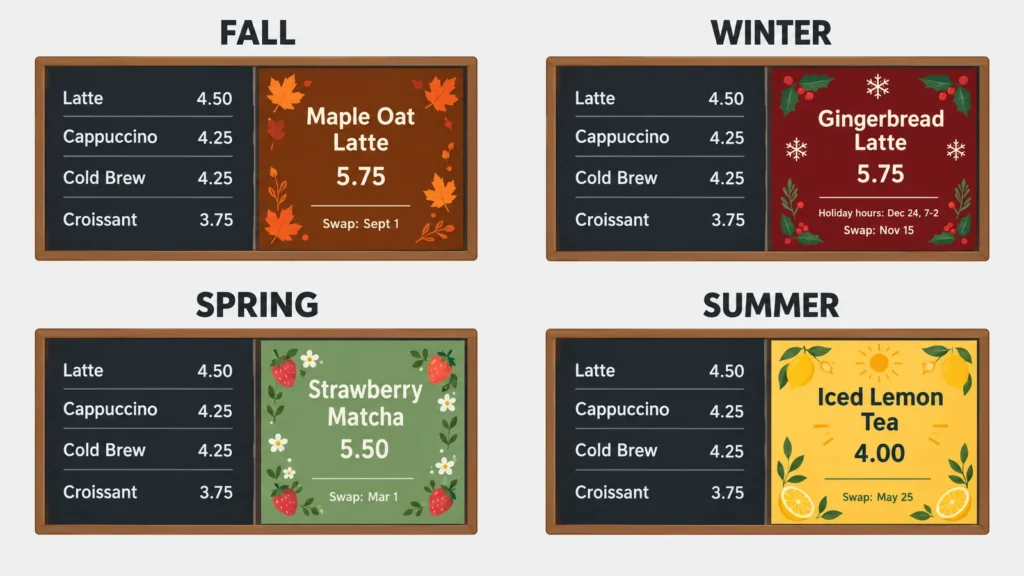
| Season | What to swap | Typical items | When to swap |
|---|---|---|---|
| Fall | Seasonal drink panel, warm specials | Pumpkin, apple and cinnamon drinks, soups | Late August–September |
| Winter / Christmas | Holiday drinks, gift cards, holiday hours | Peppermint and gingerbread drinks, holiday pastries | Mid-November |
| Spring | Lighter dishes, fresh produce | Asparagus, peas, berries, first iced drinks | March |
| Summer | Cold drinks, patio menu | Iced coffee, lemonade, salads, ice cream | Late May |
Fall menu board ideas need the earliest start, since large coffee chains launch fall drinks in late August and guests expect the change. Spring, summer and Christmas menu board ideas follow the same three rules:
36. A seasonal panel that slots in. Reserve one panel, or a quarter of the board, for seasonal items. You swap that panel; the core menu stays untouched and never needs redrawing.
37. A “Back next season” line. In the last week, add “Back next fall” under the seasonal item. Regulars order it once more, and nobody asks where it went the next day.
38. Holiday hours on the same board. Post your Christmas Eve and Christmas Day hours two weeks ahead on the board guests already read, not on a note taped to the door.
Ready layouts: fall and Christmas designs, plus the full menu board template library. Next comes the cheapest option of all: building the board yourself.
DIY Menu Board Ideas on a Small Budget
DIY menu board ideas trade money for time: the materials cost little, but every price change is done by hand. Homemade menu boards suit one location with a stable menu, and they stop working once prices change every month.
39. Plywood, chalkboard paint and vinyl headers. You need a sanded plywood or MDF panel, primer, chalkboard paint, a small foam roller, cut vinyl letters for category names and trim for the frame. Prime the panel, roll on two or three thin coats and wait out the cure time printed on the can. Then season the surface: rub the side of a chalk stick over the whole board and wipe it off, so the first menu doesn’t burn in. Apply vinyl headers last. The same build works as a DIY board for a restaurant, as long as you size it for the viewing distance (idea 4).
40. A TV you already own plus a free template. A spare TV, an HDMI streaming stick and a ready-made layout make the cheapest screen setup: you edit prices on a laptop instead of repainting.
When a Screen Beats Chalk and Print
Screens pay off when the menu changes faster than you can repaint, reprint or rewrite it. Four signals tell you you’ve reached that point:
- Prices change more than once a month.
- You run dayparts: breakfast, lunch, happy hour.
- Items sell out during a shift while the board keeps offering them.
- You have more than one location, and every board has to match.
The food menu board ideas in this article carry over to a screen unchanged: the size grid, the combo block, the seasonal panel, the sold-out line. Decker has templates for these formats. Prices come from your POS (Toast, Square or Clover) or an Excel sheet and reach the screen in 1–5 seconds; see POS integration. A schedule switches breakfast to lunch, the stop-list hides sold-out items, AI design is on the Professional plan, and Decker Player runs the menu on any TV with HDMI. The trial is free for 30 days on up to 5 screens, with no card required.
When Chalk and Print Still Win
A screen isn’t worth it when the menu rarely changes or fits on one hand-kept board. Printed and chalk menu boards still win if:
- your menu changes less than once a quarter, since four reprints a year are simpler than running a screen;
- you have one location and about 10 items or fewer, which one printed or chalk board covers;
- your daily menu is handwritten as part of the style, and guests come partly for that;
- the spot where the board hangs has no power outlet or network, and running them would cost more than the board itself.
In those cases, the chalk, letter board and print options above do the job for less.
Questions and Answers
1 What are some creative ideas for menu boards?
Pick ideas that also make ordering faster: a framed signature dish, a chalk drawing of the seasonal item, a hanging board that flips from day to night menu, or a retro letter board for a coffee bar. Ideas that slow the line down, like five fonts or ten drawings, cost more than they add.
2 How do I create a menu board for my restaurant?
List items by category in the order guests decide, cap each column at 5–7 items and highlight one signature dish. Pick the format by how often the menu changes, size lettering at about 1 inch per 10 feet of viewing distance and check the board from the back of the line before mounting it. Chains with 20 or more locations also need FDA calorie counts on the board.
3 What is the best menu board layout?
The best menu board layout reads like a page: categories in ordering sequence, a price beside each item, the signature dish where reading starts and combos in their own block. San Francisco State University eye-tracking research found that diners read menus in order, so sequence on a menu board matters more than a “sweet spot.”
4 How many items should a menu board have?
Count per column: 5–7 items stays readable at 15–20 feet, so a three-panel counter board holds about 15–21 items before the type has to shrink. Move extras to a counter card or a second board rather than using smaller letters.
5 How do you make a chalkboard menu look professional?
Have headers and the logo made in vinyl so only items and prices are handwritten. Use liquid chalk markers on a non-porous board, keep to one drawing and line prices up in one column. One person per shift updates the board, and a dated specials corner shows it’s current.
6 How often should you change your menu board?
Menu boards need three update rhythms: specials change daily or weekly, seasonal items four times a year on set dates, and the core menu whenever a price or item changes. Never leave a wrong price up. If prices change more than once a month across several boards, a screen starts to make sense.