Easy Food Truck Menu Ideas for 2026: Picks for First-Time Owners, Small Kitchens, and Tight Budgets



Easy food truck menu ideas are dishes that cook on one station, reuse the same prepped ingredients, and reach the window in a few steps: street tacos, smash burgers, loaded fries, grilled cheese, rice bowls, breakfast burritos, and churros lead the list for compact kitchens and first-time owners. Below are 60 picks sorted by cook station, 5 real truck menus with prices, cuisine menus, price math, and board templates.
Food Truck Menu Items: What Makes One Easy
A food truck menu item is easy when it passes 4 tests: it cooks on one station, shares prep with other items, holds safely under the FDA Food Code, and gets assembled at the window instead of cooked from raw. Each menu pick on this page passes at least three of the four, and most pass all of them.
- One station. Each item needs a single station: the flat-top, the fryer, the oven, or no heat at all. An item that needs two stations at once creates a bottleneck at the busiest moment of the shift.
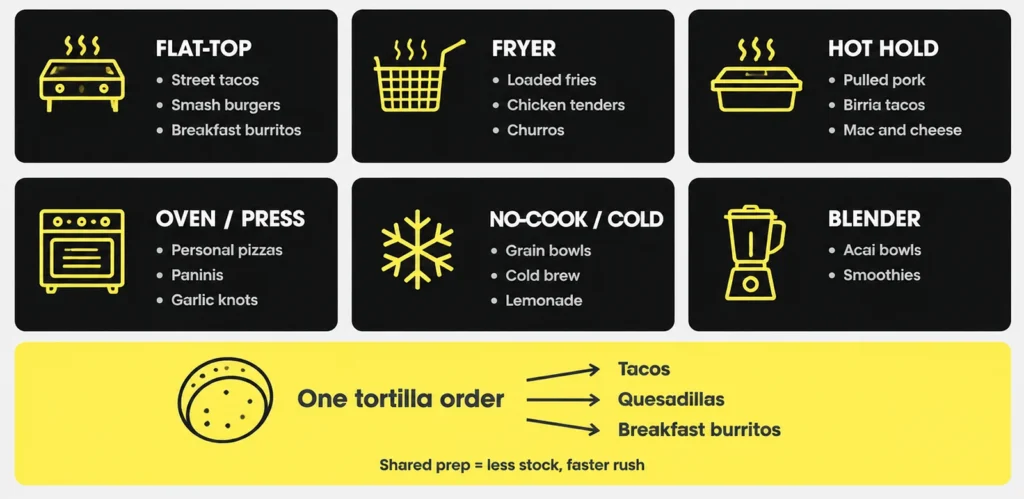
- Shared prep. Its base ingredients appear in at least two other items. A tortilla that wraps tacos, quesadillas, and breakfast burritos costs less to stock than three separate breads.
- Safe holding. The cooked parts sit hot at 135°F or above, or cold at 41°F or below, until an order comes in.
- Assembly, not cooking. Most of the work happens before service. During the rush, the cook finishes and builds instead of starting from raw.
Tacos, burgers, and fries keep showing up on lists of easy food truck menu ideas for beginners for exactly this reason: one cook can turn them out fast, the same way, all shift. The tests also explain why a dish you love at home can fail on a truck. Anything that needs plating, a fragile emulsion, or two cooks at once belongs in a restaurant kitchen; on a truck it slows every ticket queued behind it.
🧊 “No-cook” does not mean “no rules.” Cut tomatoes, cut leafy greens, and cooked rice count as time/temperature control for safety (TCS) foods under the FDA Food Code, so a salad or bowl menu still has to stay at 41°F or below.
With the tests in hand, the next step is matching items to the station you already own.
60 Easy Food Truck Food Ideas, Sorted by Cook Station
The 60 easy food truck food ideas below, reviewed on November 10, 2026, fall into 6 cook stations: flat-top, fryer, hot hold (steam wells and steamers), oven or press, no-cook cold prep, and blender. Pick one station as the engine, then add one or two no-cook items or drinks to round out the order. A flat-top truck can run tacos, quesadillas, and breakfast burritos from one tortilla order. A fryer truck can turn one chicken delivery into tenders, sandwiches, wings, and popcorn chicken.
| # | Item | Station | Shares prep with | Easy upsell |
|---|---|---|---|---|
| 1 | Street tacos (asada, al pastor, chicken) | Flat-top | Quesadillas, burritos, bowls | Extra protein, guacamole |
| 2 | Quesadillas | Flat-top | Tacos, nachos | Sour cream, salsa trio |
| 3 | Smash burgers | Flat-top | Cheesesteaks, breakfast sandwiches | Double patty, bacon |
| 4 | Smash burger tacos | Flat-top | Smash burgers, street tacos | Pickles, special sauce |
| 5 | Gourmet grilled cheese | Flat-top | Breakfast sandwiches, soup cups | Tomato soup cup |
| 6 | Philly cheesesteaks | Flat-top | Burgers, loaded fries | Peppers, extra cheese |
| 7 | Breakfast burritos | Flat-top | Tacos, breakfast sandwiches | Chorizo, hash browns |
| 8 | Breakfast sandwiches | Flat-top | Burgers, grilled cheese | Hash brown, coffee combo |
| 9 | Griddled hot dogs (incl. Sonoran-style) | Flat-top | Chili, loaded fries | Bacon wrap, chili and cheese |
| 10 | Bulgogi or spicy pork rice bowls | Flat-top | Korean-Mexican tacos, bao | Fried egg, kimchi |
| 11 | Griddle noodles (yakisoba, pad thai style) | Flat-top | Rice bowls | Shrimp, extra vegetables |
| 12 | Arepas | Flat-top | Taco fillings | Cheese, avocado |
| 13 | Mini pancakes | Flat-top | Breakfast menu | Fruit, chocolate drizzle |
| 14 | Loaded fries | Fryer | Cheesesteaks, chili, nachos | Premium toppings |
| 15 | Chicken tenders | Fryer | Chicken sandwiches, wings | Extra sauces, bigger basket |
| 16 | Nashville hot chicken | Fryer | Tenders, sandwiches | Heat level, pickles |
| 17 | Wings with house sauces | Fryer | Tenders | Sauce flight |
| 18 | Fried chicken sandwiches | Fryer | Tenders, slaw for tacos | Pickles, spicy glaze |
| 19 | Popcorn chicken cups | Fryer | Tenders | Dipping sauce |
| 20 | Baja fish tacos | Fryer | Street tacos, slaw | Chipotle crema |
| 21 | Shrimp baskets | Fryer | Fish tacos | Extra shrimp, fries |
| 22 | Corn dogs | Fryer | Hot dogs | Cheese-stuffed upgrade |
| 23 | Churros with dips | Fryer | Mini donuts | Chocolate or caramel dip |
| 24 | Mini donuts | Fryer | Churros | Cinnamon sugar, glaze |
| 25 | Funnel cake | Fryer | Churros, mini donuts | Fruit topping |
| 26 | Pulled pork sandwiches | Hot hold | Pulled pork nachos, mac bowls | Slaw, pickles |
| 27 | Brisket sandwiches (smoked ahead) | Hot hold | Plates by weight, mac bowls | Burnt ends |
| 28 | Birria tacos with consommé | Hot hold | Quesadillas, birria ramen | Extra consommé |
| 29 | Mac and cheese bowls | Hot hold | Pulled pork, loaded fries | Brisket or bacon topper |
| 30 | Chili and chili dogs | Hot hold | Hot dogs, loaded fries | Cheese, onions |
| 31 | Rice bowls (teriyaki, burrito) | Hot hold | Tacos, wraps | Fried egg, avocado |
| 32 | Curry bowls (butter chicken, chana masala, Caribbean curry) | Hot hold | Kati rolls, rice bowls | Naan, extra protein |
| 33 | Soup cups | Hot hold | Grilled cheese | Bread or crackers |
| 34 | Meatball subs | Hot hold | Pizza sauce, garlic knots | Melted provolone |
| 35 | Nachos with cheese sauce | Hot hold | Tacos, chili | Jalapeños, protein |
| 36 | Elote cups | Hot hold | Tacos | Tajín, cotija |
| 37 | Steamed bao buns | Hot hold | Rice bowls (same proteins) | Third bun |
| 38 | Hot cocoa and cider | Hot hold | Churros, donuts | Whipped cream |
| 39 | Personal pizzas | Oven / press | Garlic knots, meatball subs | Premium toppings |
| 40 | Detroit-style squares | Oven / press | Pizza sauce, cheese | Corner piece, cup pepperoni |
| 41 | Piadina or flatbread handhelds | Oven / press | Pizza dough | Prosciutto, pesto |
| 42 | Pressed paninis | Oven / press | Grilled cheese fillings | Soup or chips combo |
| 43 | Baked potato bar | Oven / press | Chili, cheese sauce | Bacon, broccoli |
| 44 | Baked empanadas | Oven / press | Taco fillings | Dipping sauce |
| 45 | Garlic knots | Oven / press | Pizza dough | Marinara cup |
| 46 | Warm cookies | Oven / press | Ice cream sandwiches | Milk or cold brew |
| 47 | Liège waffles | Oven / press | Breakfast menu, ice cream | Fruit, cookie spread |
| 48 | Wraps and pitas | No-cook / cold | Bowls, salads | Feta, hummus |
| 49 | Grain and salad bowls | No-cook / cold | Wraps, rice bowls | Grilled chicken |
| 50 | Poke bowls | No-cook / cold | Rice bowls | Avocado, extra fish |
| 51 | Lobster or shrimp rolls | No-cook / cold | Shrimp baskets | Double meat |
| 52 | Banh mi | No-cook / cold | Rice bowl proteins, pickled vegetables | Fried egg, extra protein |
| 53 | Yogurt parfaits | No-cook / cold | Acai bowls | Fresh fruit |
| 54 | Ice cream sandwiches | No-cook / cold | Warm cookies | Sprinkle roll |
| 55 | Cold brew coffee | No-cook / cold | Breakfast items | Flavor shot, size up |
| 56 | Fresh lemonade | No-cook / cold | Aguas frescas | Fruit flavor |
| 57 | Aguas frescas | No-cook / cold | Lemonade, taco menus | Large size |
| 58 | Acai bowls | Blender | Smoothies, parfaits | Nut butter, granola |
| 59 | Smoothies | Blender | Acai bowls | Protein scoop |
| 60 | Frozen lemonade or slush | Blender | Lemonade | Popping boba |
The overlap column is where easy food truck menu ideas make their money, more than the dishes themselves. Prep happens before service at every station: batch the proteins, portion the sides, and set the hot hold before the first order, so the board only has to show what is left. Real food truck menus already work this way, as the five below show.
5 Real Food Truck Menus With Prices (Checked November 10, 2026)
Five real food truck menus with prices, copied from each truck’s ordering page on Best Food Trucks on November 10, 2026, show how easy food truck menu ideas look in practice: 52 entrée lines across five cities, a median entrée price of $12, and a top price between $13 and $16 on every truck. Menus change, so treat these as shapes to copy, not price lists to lift.
1. Mexican Truck: Carne Asada “The Art of Grilling,” Phoenix
Source: Carne Asada truck menu. The truck runs five meats (asada, al pastor, birria, carnitas, grilled chicken) through tortillas, bowls, and one ramen.
| Item | Price |
|---|---|
| Taco (corn tortilla, choice of meat) | $3.25 |
| Quesataco with consommé | $4.75 |
| Sonoran hot dog (bacon-wrapped) | $6 |
| Breakfast burrito / breakfast platter | $10.50 each |
| Bowl (choice of meat) | $12 |
| Burrito (12-inch Sonoran flour tortilla) | $12 |
| Hot Cheeto burrito | $14 |
| Birria ramen | $16 |
| Soda or bottled water | $2 |
What it teaches: the same taco becomes a $4.75 quesataco once it is crisped with cheese and served with a consommé cup, a 46% lift for one extra step. The two novelty lines, a Hot Cheeto burrito and birria ramen, sit at the top of the board and reuse fillings the truck already holds.
2. Pizza Truck: Forno Vero Neapolitan Kitchen, Atlanta
Source: Forno Vero menu. Nine of its 13 food lines come from one dough.
| Item | Price |
|---|---|
| Marinara pizza (no cheese) | $10.99 |
| Margherita / Bianca pizza | $12.99 each |
| Contadino pizza | $13.99 |
| Speziato pizza | $14.49 |
| Carni / Forno San Marzano (prosciutto, arugula) pizza | $15.99 each |
| Piadina handheld (caprese or pepperoni) | $9.49 each |
| Salads (Mista, Bella, Mercato, Spinaci) | $7.99–$10.99 |
| Stuffed peppadew peppers / crostini | $6.99 / $7.49 |
What it teaches: the Margherita at $12.99 anchors the board, and cured-meat pies add $3 (about 23%) for one premium topping. The piadina gives a $9.49 handheld from the same dough for guests who want less than a full pie. The truck also prints “No substitutes” on its pizzas, a line-speed rule disguised as a menu note.
3. Grilled Cheese Truck: Cheese-N-Chong, Cincinnati
Source: Cheese-N-Chong menu. Nine of ten entrées are the same grilled sandwich with a different filling.
| Item | Price |
|---|---|
| Classic grilled cheese (cheddar and mozzarella on sourdough) | $7 |
| Pickle Rick (pickles and ranch) | $8 |
| Classic with bacon / classic with ham | $9 each |
| Jersey Shore / Tropic Thunder | $10 each |
| The Green (avocado, bacon) | $11 |
| The Bourbanator (bourbon bacon jam) | $12 |
| Chicken bacon ranch / chicken quesadilla | $13 each |
| Tomato soup or California medley soup | $4 |
| Chips / flat-top hash brown / corn salad | $1 / $2 / $3 |
| Bottled soda or water | $3 |
What it teaches: the classic at $7 is the way in, and every named sandwich above it climbs in $1 steps to $13. Named items do real work here: “The Bourbanator” sells a $5 jump over the classic for one jar of bacon jam. A $4 soup cup turns a $7 sandwich into an $11 lunch.
4. Asian Bowl and Bao Truck: Butterlicious, Columbus
Source: Butterlicious menu. Six bowls share one build, and four bao share another.
| Item | Price |
|---|---|
| Tofu bowl / vegetable bowl (coconut rice, kale, corn, pickled cucumber) | $12 each |
| Fried chicken bowl / pork belly bowl | $13 each |
| Bulgogi bowl / shrimp bowl | $14 each |
| Bao buns (tofu or fried chicken) | $5 each |
| Bao buns (bulgogi or fried pork belly) | $5.50 each |
| Loaded fries | $8 |
| Biscoff strawberry cheesecake egg rolls (2) | $4 |
| Chocolate iced coffee / strawberry cold-foam drink | $4 / $5 |
What it teaches: the protein sets the price, not the dish. Tofu, chicken, and beef bowls step from $12 to $13 to $14 with identical toppings, so the cook builds one bowl six ways. The $4–$5 specialty drinks cost more than the $1.99–$3 sodas on the other trucks that list drinks.
5. Chicken Truck: Max’s Hot Chicken, Nashville
Source: Max’s Hot Chicken menu. Fourteen lines come from seven base items sold in different sizes and baskets.
| Item | Price |
|---|---|
| Cheeseburger / signature chicken sandwich / gyro sandwich | $8.99 each |
| 2 / 3 / 4 chicken tenders basket | $10.99 / $13.99 / $15.99 |
| Loaded fries with chicken tenders | $11.99 |
| 6 wings / 6 wings basket | $12.99 / $13.99 |
| Cheeseburger basket / chicken sandwich basket | $12.99 each |
| Gyro basket / gyro plate / chicken salad | $13.99 each |
| French fries | $3.99 |
| Homemade brownie | $4.50 |
| Coke, Dr Pepper, Sprite, or water | $1.99 |
What it teaches: the tender ladder rewards a bigger order. Per tender, the price falls from about $5.50 in the 2-piece to about $4 in the 4-piece. The basket upgrade is less consistent: it adds $1 to wings but $4 to $5 to sandwiches. A fixed combo delta, such as “+$4 for fries and a drink,” is easier to read on a board and faster to ring up.
What the Five Menus Have in Common
Across the five real food truck menus, the pattern behind these food truck menu ideas is tighter than the cuisines suggest. Every truck runs 1 to 7 base builds and multiplies them with proteins, sizes, or baskets, and no entrée goes above $16. Counts below use each truck’s Entrees section only; sides, desserts, and drinks are left out.
| Truck | Entrée lines | Base builds | Lowest entrée | Highest entrée | Median entrée |
|---|---|---|---|---|---|
| Carne Asada (Phoenix) | 9 | 7 (taco, quesataco, burrito, bowl, ramen, breakfast platter, hot dog) | $3.25 | $16 | $10.50 |
| Forno Vero (Atlanta) | 13 | 3 (pizza, piadina, salad) | $7.99 | $15.99 | $10.99 |
| Cheese-N-Chong (Cincinnati) | 10 | 2 (grilled sandwich, quesadilla) | $7 | $13 | $10 |
| Butterlicious (Columbus) | 6 | 1 (rice bowl; bao sold as sides) | $12 | $14 | $13 |
| Max’s Hot Chicken (Nashville) | 14 | 7 (tenders, wings, burger, chicken sandwich, gyro, loaded fries, salad) | $8.99 | $15.99 | $12.99 |
- Count builds, not lines. A board with 10 to 14 lines can still be an easy menu when those lines come from 1 to 7 builds. Prep load follows the builds.
- A cheap way in, a $13–$16 ceiling. Every truck has a way in under $10 (a $3.25 taco, a $5 bao, a $7 grilled cheese, a $7.99 salad, an $8.99 sandwich), and every truck tops out between $13 and $16.
- Upgrades are priced in small steps. $1 protein steps, $2 bacon, $1.50 for consommé, and $3 for a premium pizza topping all sell more easily than a separate new dish.
- Drinks stay cheap unless they are special. Soda and water run $1.99–$3; only the crafted drinks reach $4–$5.
Those patterns hold across cuisines, so the next section applies them truck type by truck type.
Menu Ideas by Cuisine: What Each Truck Type Sells
The food truck menu ideas by cuisine below each have a core of 5 or 6 items that share prep, plus one add-on that lifts the ticket. Each menu is built from the same 3 or 4 bases, so treat it as a starting menu, not a finished one: cut anything your truck can’t hold or cook on the station you chose.
Mexican and Taco Food Truck Menu Ideas
Mexican food truck menu ideas start with street tacos because one tortilla, three proteins, and a salsa bar cover most of the board. A taco truck builds the rest from the same mise en place, and Mexican menu templates give it a ready board.
- Carne asada, al pastor, and chicken tacos on corn tortillas
- Quesadillas and a breakfast burrito for the morning shift
- Birria tacos with a consommé cup as the signature item
- Burrito bowls for customers who skip tortillas
- Chips with salsa or guacamole, and elote in a cup
- Horchata or aguas frescas
Keep a taco menu to 3 or 4 proteins. Every extra protein adds a pan, a holding well, more prep, and a waste risk. The format also has the longest track record on the street: in 1974 Raul and Maria Martinez fitted a stove and grill into a 1950s ice cream truck in Los Angeles, and the truck that became King Taco took about $70 on its first night. The business opened its first restaurant in 1975 and grew to more than 20 locations across Southern California.
Burger Food Truck Menu Ideas
A burger truck menu works best with smash burgers, because thin patties cook in a few minutes on the same flat-top that toasts the buns. Smashed burgers made the National Restaurant Association’s Top 10 overall trends for 2026, so the format sells itself.
- Single and double smash burger, plus one signature burger with a sauce people remember
- Smash burger tacos: the same patty smashed onto a tortilla
- Crispy or grilled chicken sandwich
- Black bean or plant-based patty for the veggie crowd
- Fries, then loaded fries as the premium side
- A combo: burger, fries, and a drink
Ground beef has to reach 155°F for 17 seconds under the Food Code, and a thin smashed patty gets there fast, which is part of why the format suits a truck.
BBQ Food Truck Menu Ideas
A BBQ truck menu depends on cooking ahead: the pitmaster smokes brisket and pork before service and holds them hot, so the window only slices and builds.
- Pulled pork and brisket sandwiches
- Smoked chicken or sausage links
- Meat plates by the half pound, and ribs by the bone or half rack
- Mac and cheese, slaw, and beans as sides from the hot hold
- Burnt ends as a limited special that sells out
Price brisket as a surcharge or by weight, not as a fixed plate, so a jump in meat costs doesn’t wipe out the margin on every plate. Anything smoked the day before must cool from 135°F to 70°F within 2 hours and reach 41°F within 6 hours total, then reheat to 165°F within 2 hours before it goes back into the hot hold.
Pizza Food Truck Menu Ideas
A pizza truck menu stays easy when every pie uses the same dough ball and the oven runs personal sizes that bake fast enough for lunch rushes and events.
- Three to five signature pies, Margherita included as the price anchor
- Pepperoni and one white pizza
- Detroit-style squares or slices for walking crowds
- A handheld flatbread or piadina from the same dough
- Garlic knots from leftover dough, a near-free add-on
- A side salad and one dessert, such as cannoli
The same oven supports Italian dishes like meatball subs, baked pasta cups, and focaccia sandwiches. Wood-fired ovens burn solid fuel, which brings separate fire-code rules, so check with the fire marshal before you buy one.
Chicken and Wings Food Truck Ideas
A chicken truck turns one delivery into most of the menu. Tenders, sandwiches, wings, and popcorn chicken all come out of the same fryer with the same breading.
- Tenders in 2, 3, and 4-piece baskets
- Nashville hot chicken with heat levels as the upsell
- Wings with 3 or 4 house sauces
- Crispy chicken sandwich topped with slaw and pickles
- Popcorn chicken cups for events
Poultry must reach 165°F, so test the fry time for your largest tender, not the average one. Most trucks run one or two fryer baskets, so cap the fried menu at what those baskets can carry in a rush.
Loaded Fries Food Truck Ideas
Loaded fries turn the cheapest base on the truck into a premium side or a full meal. One fryer, one bag of potatoes, and toppings you already hold for other items cover the whole category.
- Chili cheese fries from the chili pot
- Carne asada fries from the taco line
- Gochujang fries topped with chopped kimchi
- Parmesan and garlic-butter fries
- Poutine: fries, cheese curds, and hot gravy
Asian and Fusion Food Truck Ideas
Asian and fusion trucks run on one rice pot and a few marinated proteins seared on the flat-top. The Columbus menu above shows the model: one bowl build, six proteins, $12 to $14.
- Bulgogi or spicy pork rice bowls
- Bao buns, two or three to an order
- Banh mi built from the same proteins and pickled vegetables
- Griddle noodles such as yakisoba or a pad thai-style plate
- Poke bowls for a cold, health-forward lunch
- Korean-Mexican tacos as the crossover item
Sandwiches and Comfort Food Truck Ideas
Comfort food trucks sell familiar dishes with one upgrade, and the upgrade carries the price. Grilled cheese is the clearest case: one bread, two cheeses, and nine fillings made the Cincinnati menu above.
- Gourmet grilled cheese with a soup cup
- Philly cheesesteak
- Meatball sub
- Mac and cheese bowls with brisket or pulled pork on top
- Baked potato bar for winter stops
Breakfast Food Truck Ideas
Breakfast food truck menu ideas rank among the easiest to run, because eggs, potatoes, tortillas, and bread cover the whole menu on one flat-top.
- Breakfast burritos and breakfast tacos
- Egg sandwiches on a biscuit, bagel, or croissant
- Hash browns or breakfast potatoes
- French toast sticks or mini pancakes
- Coffee, cold brew, and orange juice
Most breakfast orders come during the morning commute, so speed matters more than variety. A truck that shares a lunch concept can put the breakfast board on a schedule so the display switches over at a set time.
Coffee Truck Menu Ideas
A coffee truck is the one concept on this page with no cook station at all: an espresso machine, a grinder, and a cold-brew batch carry the menu. Its margin comes from sizes and add-ons, not from new drinks.
- Espresso, americano, latte, and cappuccino in two sizes
- Cold brew batched the night before
- One seasonal latte and one non-coffee drink, such as chai or cocoa
- Alternative milk and syrup shots as add-ons
- Pastries bought in, or one baked item such as a warm cookie
Healthy Food Truck Ideas: Bowls, Wraps, Smoothies
Healthy food truck ideas rely on cold assembly: grains, greens, and grilled proteins get prepped ahead and built to order without a fryer.
- Grain bowls with a choice of chicken, tofu, or falafel
- Wraps and stuffed pitas
- Hummus and veggie plates
- Acai and smoothie bowls
- Fresh juices and smoothies
The “light” label hides one cost. Cold bowl menus use more cooler space than fryer menus, because cut greens, cut tomatoes, and cooked grains need cold holding at 41°F or below.
Seafood: Rolls, Tacos, and Baskets
Seafood menus should lean on fried or chilled formats, since both keep the cook time short.
- Fish tacos with slaw
- Shrimp baskets with fries
- Lobster or shrimp rolls as a premium item
- Clam chowder in cups for colder days
Seafood carries one of the highest food costs on a truck menu, so price the premium roll separately from the everyday basket and review it whenever your supplier’s price changes.
Indian Street Food: Wraps and Bowls
Indian street food fits a truck well when curries cook ahead and go out as wraps or rice bowls.
- Chicken tikka or paneer kati rolls
- Butter chicken or chana masala bowls with rice
- Samosas as a fried snack
- Mango lassi or masala chai
Desserts and Ice Cream Trucks
Dessert trucks need the least cooking on the street: churros, mini donuts, and scooped or packaged ice cream finish in under a minute.
- Ice cream, soft serve, or ice cream sandwiches
- Churros with dipping sauces
- Mini donuts and funnel cake
- Warm cookies by the piece or in a box of four
- Shaved ice in summer, hot cocoa in winter
A dessert truck uses one or two stations at most, so it suits events and catering add-ons. Beyond cuisine, the next lever is a twist that makes a familiar item feel new.
Unique Food Truck Ideas: Creative Twists That Stay Easy
Unique food truck ideas work when you add one twist, such as a Korean BBQ glaze, to an item from any of the 6 stations above, not when you invent a dish that needs new equipment. Keep the tortilla, the bun, or the fry and change only the filling, the sauce, or the cuisine.
- Korean-Mexican tacos. Bulgogi or spicy pork in a corn tortilla with kimchi slaw, cooked on the same flat-top.
- Birria ramen. Birria consommé poured over noodles reuses a broth you already make; the Phoenix truck above prices it at $16, its top line.
- Smash burger tacos. A smashed patty on a tortilla with pickles and sauce, one flat-top and two existing ingredients.
- Global grilled cheese. Kimchi cheddar, pesto mozzarella, or a brisket melt goes on the same press.
- Breakfast all day. Breakfast burritos sell at lunch and late night with no new prep.
- Loaded fries by cuisine. Gochujang fries, carne asada fries, or poutine come from one fryer.
- Dessert crossovers. Cheesecake egg rolls or churro bites use the fryer you already run.
Unique food truck menu ideas still have to pass the four easy tests from the top of this page. If it adds a second station or a third holding temperature, it won’t scale in a rush. A popular idea gets copied fast, so pair a familiar base with one twist a competitor can’t copy overnight.
🎨 Not to be confused with: ideas for the truck’s paint, wrap, and kitchen layout. This page covers only what goes on the menu.
Next, the 2026 trend data shows which of these twists diners already want.
Food Truck Menu Trends for 2026
The 2026 trends that fit a truck are the ones that need no new station: smashed burgers, global comfort food, value options, proteins sold as add-ons, and clear allergen labeling all appear in the National Restaurant Association’s Top 10 overall trends for 2026, based on a survey of culinary professionals in October 2025.
| NRA 2026 trend | What it means on a truck |
|---|---|
| Smashed burgers | Single, double, and smash burger tacos on one flat-top |
| Comfort foods and global comfort foods | Birria, curry bowls, grilled cheese, mac and cheese |
| Value menus and options | A $3–$5 entry item, like the $3.25 taco or $5 bao above |
| Proteins as add-ons | Extra meat at $1–$4, or a protein ladder like $12 / $13 / $14 bowls |
| Clear menu labeling, icons, and cues | Vegan, gluten-free, and spice icons next to each item on the board |
| Allergen-friendly menus | Mark sesame, nuts, and shellfish; keep one item free of all three |
| Local sourcing | Name one local ingredient on the board and price it as the premium line |
| Compostable and reusable packaging | Fewer container sizes; one bowl and one clamshell cover most items |
Value matters more than usual this year. IBISWorld sizes the US food truck industry at $2.9 billion in 2026 and expects revenue to slip 1.1% as tariffs push vendors to raise prices. That is a reason to keep a cheap entry item on the board even as mains climb. Run one trending item as a weekly special first, and move it into the core only after two weeks of sales. Trends bring attention; the next question is which items actually make money.
Most Profitable and Most Popular Food Truck Items
Food truck items that earn the most pair a cheap base like potatoes, tortillas, dough, or rice with an add-on customers happily pay for, such as a $3.00 extra protein or a BBQ glaze. The most popular items overlap with that list: tacos, burgers, fries, chicken, and handheld desserts. Most pricing guides suggest a food cost of roughly 28% to 35% of the menu price, which leaves 65 to 72 cents of every dollar for labor, fuel, fees, and profit. Drinks and desserts usually sit below that range, while BBQ and seafood sit above it.
Popular food truck menu ideas have more in common in format than in cuisine. Each one comes off a single station in a few minutes, starts from an inexpensive base, and travels in one hand. That is why the same items repeat on lists and on the five real menus above.
Two numbers decide whether an item earns its spot: the food cost of one portion and how long it ties up a station. An item that holds one fryer basket for 4 minutes caps that basket at 15 orders an hour. If it sells for less than your average ticket, it costs you capacity. Track food cost per item and you will spot weak sellers within the first few weeks. Combos lift the average ticket, and tacos and fries win on both counts.
| Item | Cheap base | Where the margin comes from |
|---|---|---|
| Loaded fries | Potatoes | Toppings priced as a premium side |
| Tacos | Tortillas | Extra protein, guacamole, combos |
| Grilled cheese | Bread and cheese | Soup combo or bacon add-on |
| Pizza by the slice | Dough and sauce | Premium toppings |
| Rice bowls | Rice | Protein ladder ($1 steps) |
| Churros and mini donuts | Flour and oil | Dipping sauces, box sizes |
| Specialty drinks | Coffee, water, sugar | Add-on flavor shots and size ups |
At the concept level, the most profitable food truck ideas follow the same rule: build most of the menu from rows like these. Once you know what earns, the next job is putting it in order.
How to Build an Easy Food Truck Menu in 7 Steps
A food truck menu stays easy when you build it in 7 steps that turn food truck menu ideas into a working board: choose the concept, pick a signature item, then fill the core, sides, add-ons, drinks, and combos around it. Each step narrows the next one.
- Match the concept to your station. Pick from the cook station you already own or plan to buy. A fryer truck and an oven truck lead to different menus, and the station also decides your fire-code needs.
- Pick one signature item. This is the dish that brings people back and gets posted, such as birria tacos or a double smash burger.
- Build a core of 5 to 8 items around it. Every item should reuse at least one prepped ingredient from the signature. Protein choices and sizes can multiply these into 10 to 14 board lines without adding builds.
- Add two to four sides. Fries, chips, slaw, soup, or elote raise the average ticket with almost no added prep.
- List add-ons next to each item. Extra protein, cheese, sauce, or a size up, priced in $1 to $3 steps.
- Set drinks and combos. A main, side, and drink bundled at one fixed upcharge speeds up ordering.
- Test for two weeks, then cut. Track sales and food cost by item and drop anything that sells only a few times a shift or creates a prep bottleneck.
Those seven parts (signature, core, sides, add-ons, drinks, combos, and a rotating special) also answer the common question of how to make a menu for a truck. Pick the lane with three questions: how fast your station turns the dish out, how much margin it leaves, and what your regular stops lack. If three food trucks at your stop already sell tacos, the gap is somewhere else. A menu rarely fails because one dish tastes bad; it fails when the list grows past what one line can cook. Next, match the lineup to the places you park.
Match Your Food Truck Menu to the Stop and Daypart
A food truck menu should match its stop: the same truck sells different items at an office lunch, a brewery, and a festival, because each stop changes order speed, group size, and price tolerance. Use the table to choose which lines to show at each stop.
| Stop or daypart | What wins | What to show on the board |
|---|---|---|
| Morning commute | Speed, one hand | Breakfast burritos, egg sandwiches, coffee combos |
| Office lunch | Under 5 minutes, $10–$15 | Bowls, tacos, one combo, pre-order option |
| Brewery or taproom | Shareable, salty | Loaded fries, wings, pretzels, smash burgers |
| Festival or large event | Volume over choice | 2 or 3 pre-batched items, one drink, cash-friendly prices |
| Late night | Hot, filling, cheap | Tacos, quesadillas, fries, all-day breakfast burritos |
| Catering or private event | Planned volume | BBQ plates, pizza, bowls priced per guest |
A screen makes this easier than print, because you can hide lines by stop instead of printing a board for each one. Once the lineup fits the stop, the next step is pricing it.
Food Truck Menu Prices, Examples, and Board Display
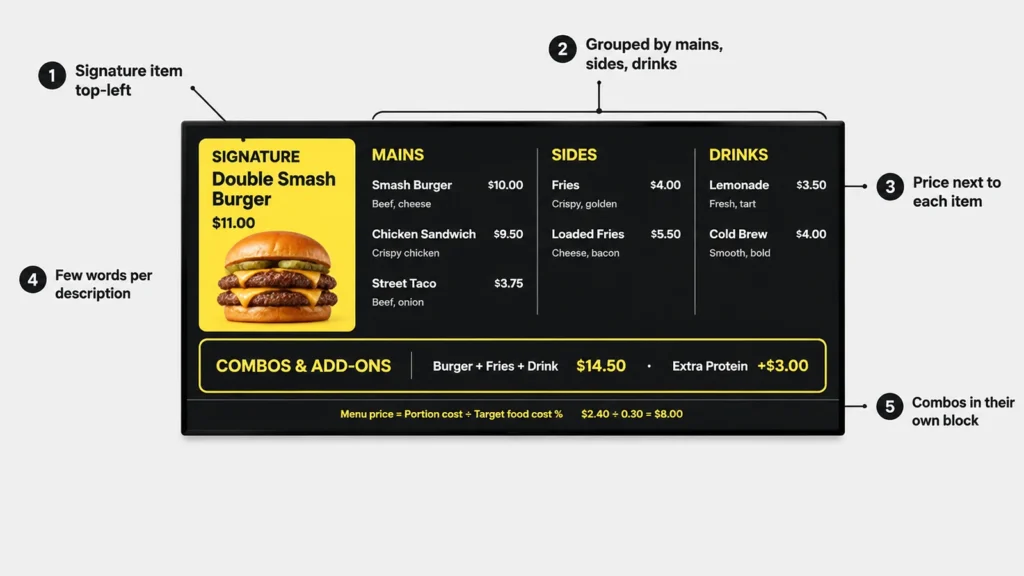
Food truck menu prices come from one division you can run next to any POS report: portion cost ÷ target food cost %, rounded to a clean number, so a $2.40 plate at a 30% target sells for $8.00. Use the same price math for every item on the board.
Menu price = Portion cost ÷ Target food cost %
$2.40 ÷ 0.30 = $8.00
Here are food truck menu examples built with that formula, one row per menu tier. Use your own invoices; the portion costs below serve as illustrations.
Here are food truck menu examples built with that formula, one row per menu tier. Use your own invoices; the portion costs below serve as illustrations.
| Menu tier | Example item | Portion cost | Target food cost | Menu price |
|---|---|---|---|---|
| Entry item | Single taco | $1.10 | 30% | $3.75 |
| Core main | Smash burger | $3.20 | 32% | $10.00 |
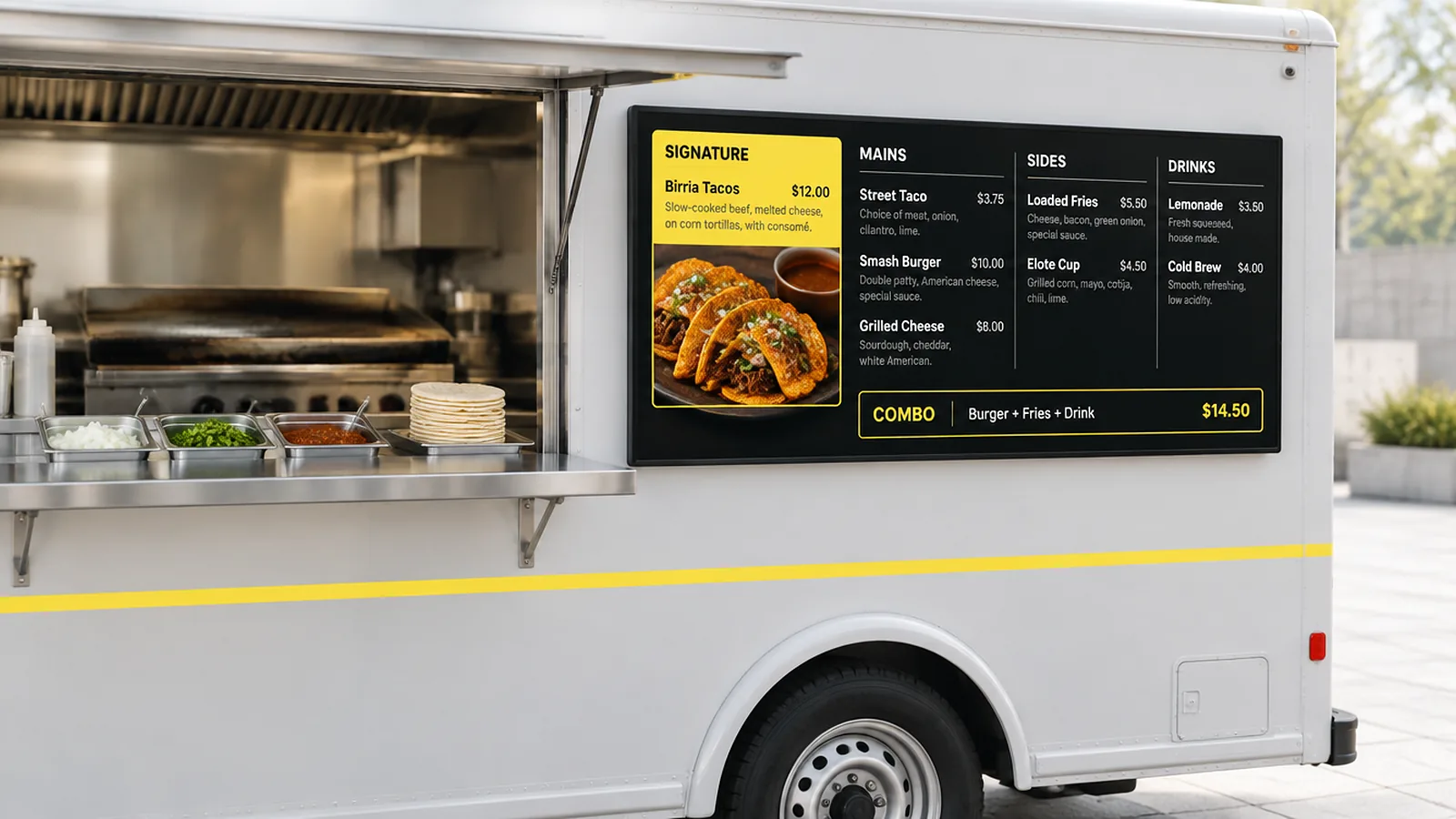
| Combo | Burger + fries + drink | $4.40 | 30% | $14.50 |
| Side | Loaded fries | $1.40 | 25% | $5.50 |
| Add-on | Extra protein | $0.90 | 30% | $3.00 |
| Drink | Lemonade | $0.50 | 15% | $3.50 |
The real food truck menus above confirm the ranges: a way in under $10 on every truck, a median entrée of $12, ceilings of $13 to $16, and sodas from $1.99 to $3. Prices still vary by city and by event fees, so check two or three trucks at your own stops before you print anything, and change prices only when invoices change.
Once the items carry prices, the board decides how fast people order. These display rules keep the line moving:
- Put the signature item in the top-left or center of the display, where eyes land first.
- Group items by mains, sides, combos, and drinks, with prices right next to each item.
- Keep item descriptions to a few words; customers read the screen while walking up.
- Use one or two photos of your best sellers, not a photo for every item.
- Show combos and add-ons as a separate block so they stand out, with one fixed combo upcharge.
- Add small icons for vegan, gluten-free, spicy, and major allergens next to the items they apply to.
Food truck menus that change during the day run better on a screen than on print, which matters for daypart switches and stop-by-stop lineups. With Decker’s digital menu boards for food trucks, you can change a price, swap breakfast for lunch, or hide a sold-out item without reprinting the board. Next, pick a layout so the board looks finished on day one.
Free Layouts for Your Food Truck Menu Ideas
A ready-made layout turns these food truck menu ideas, or any item from the 6 stations above, into a board in minutes: pick a layout, replace the dishes and prices, and show it on a screen in your truck. Every Decker template works with the menus on this page, and the same layout fits a screen in the window or a TV inside the hatch. Browse Decker’s menu templates and swap in your own items.
Next, put the board on a screen, then check the safety and fire rules that decide what you can cook and hold.
Your Food Truck Menu, Ready for a Screen
Turn these food truck menu ideas into a screen menu: pick a template, add 5 to 8 items with prices, then swap breakfast for lunch without reprinting. Start free
Food Truck Safety and Fire Rules That Shape an Easy Menu
Truck menus answer to two rulebooks: food safety rules decide which easy items a truck can hold at 135°F or 41°F and for how long, and fire rules decide which stations need a hood. Your health department enforces its own version of the FDA Food Code, and your fire marshal enforces NFPA 96, so check both before you finalize the menu.
Holding, Cooling, and Reheating
- Hot and cold holding. Cooked TCS foods stay at 135°F or above; cold TCS foods stay at 41°F or below.
- Cooling cook-ahead food. Food cooked the day before must cool from 135°F to 70°F within 2 hours, then to 41°F or below within 6 hours total.
- Reheating for hot holding. Cooked and cooled food must reach 165°F within 2 hours before it goes back into the hot hold. Reheating only to 135°F is not enough.
- Time as a control. Many health departments allow TCS food out of temperature control for up to 4 hours. The food must start at 135°F or above, or 41°F or below, carry a marked discard time, and go in the trash after 4 hours.
Cooking Temperatures by Station
| Station | Typical items | Food Code minimum |
|---|---|---|
| Flat-top | Smash burgers, ground-meat tacos | 155°F for 17 seconds (ground meat) |
| Flat-top or oven | Steak, fish, eggs cooked to order | 145°F for 15 seconds |
| Fryer | Tenders, wings, chicken sandwiches | 165°F, instantaneous (poultry) |
| Hot hold | Birria, chili, pulled pork, curry | Hold at 135°F; reheat to 165°F within 2 hours |
| No-cook / cold | Bowls, poke, rolls, cut produce | Hold at 41°F or below |
Allergens, Labeling, and Fire Code
- Major allergens. Sesame became the ninth major food allergen on January 1, 2023. The full list covers milk, eggs, fish, crustacean shellfish, tree nuts, peanuts, wheat, soybeans, and sesame.
- Calorie labeling. The FDA menu labeling rule covers chains with 20 or more locations and defines a location as a fixed position, so FDA states that food trucks are not covered.
- Hood and suppression. Fire codes based on NFPA 96 typically require a Type I hood with an automatic fire-suppression system over any appliance that makes grease-laden vapors, such as a fryer or flat-top, and many fire marshals require service every 6 months.
- Spacing at events. The 2024 edition of NFPA 96 calls for 10 feet of clearance between mobile cooking operations and from building entrances, unless the local authority sets a different distance.
⏱️ Holding food warm “until it sells” is not a safe plan. Under time as a public health control, food that leaves temperature control must be served or thrown away within 4 hours.
🥜 A truck does not have to post calories the way a 20-location chain does, but marking sesame, nuts, and shellfish still cuts allergen questions at the window.
Rice and cut greens need cooler space before they go on the board, and a fryer needs a hood before it goes on the truck. Ask your health department which items need a commissary, which need a hand sink on board, and whether your county uses the 4-hour time rule. Those answers can move an item from easy to impossible, which is why the next section covers when easy stops working.
Easy Menu Limits: When Simple Is the Wrong Call
An easy menu is the wrong call when your event, market, or equipment needs something other than speed and low prep, such as 500 guests in 2 hours or a stop full of taco trucks. Five situations come up most often:
- The event outpaces any griddle. If an event promises 500 guests in a 2-hour window, that’s about 4 orders a minute. No truck flat-top keeps up with smash burgers at that pace, so switch to one pre-batched item, such as pulled pork sandwiches.
- Your stop already has the same idea. If three or more food trucks at your regular stop already sell tacos, a fourth easy taco menu competes on price alone. A narrower specialty can win more than the easiest option.
- You don’t have the station the item needs. Fried items need a fryer plus the hood and suppression system your fire marshal requires. Without them, 12 of the 60 items in the table above drop off the menu.
- You sell plated catering, not street food. A 100-guest plated dinner at 2 plates a minute takes 50 minutes to serve one course from a single window. Handheld street items don’t translate to that format.
- Your costs swing every week. Brisket, seafood, and avocado can move faster than you can reprint a board. Price them as a surcharge or a daily special instead of a fixed core item.
Check the expected guest count before you pick an event menu. In these cases, compare the trade-offs below before you commit.
Easy Menu or Broad Menu: Pros and Cons
An easy menu of 5 to 8 core items trades variety for speed and consistency, while a broad menu of 15 or more distinct items trades speed for choice. Most new food trucks do better starting easy and widening later, one tested item at a time.
| Factor | Easy, tight menu (5–8 items) | Broad menu (15+ items) |
|---|---|---|
| Ticket speed | Fast; one station, repeat builds | Slower; more stations in use |
| Food waste | Low; shared ingredients | Higher; slow movers spoil |
| Training | One cook learns one station in days | Takes longer to master |
| Customer choice | Limited, widened by proteins and sizes | Wide |
| Storage | Fits a small truck | Often exceeds cooler space |
| Equipment and permits | One station, often one hood | More appliances, more inspections |
| Brand recall | Strong signature item | Harder to remember |
A menu that starts easy can add items once sales prove demand. Before the questions owners ask most, here is how this guide was checked.
How We Checked This Guide
This menu guide was checked line by line: every price against the five trucks’ public ordering pages on November 10, 2026, and every safety rule against the FDA Food Code 2022, FDA guidance, and fire-marshal checklists based on NFPA 96. Trend data comes from the National Restaurant Association’s 2026 What’s Hot Culinary Forecast, and market figures from IBISWorld. Portion costs in the pricing table are illustrations; use your own invoices. Rules vary by city and county, so confirm the final menu with your health department and fire marshal. The full source list sits at the end of the page, and the questions owners ask most come next.
Questions and Answers
1 What is the most profitable food to sell on a food truck?
The most profitable food truck menu items are loaded fries, tacos, grilled cheese, pizza slices, churros, and specialty drinks. Each one sits on a cheap base, and food trucks sell its add-ons at a premium.
2 What is the easiest food truck to start?
Simple food truck ideas built on one station work best: tacos or breakfast burritos on a flat-top, or coffee and pastries with no cook station. Food trucks that start with one station cut prep and training time, and most easy food truck menu ideas on this page fit that model.
3 How many menu items should a food truck have?
Most guides suggest five to ten core items, plus a few sides, add-ons, combos, and drinks. Start at the low end and add items only after sales show demand.
4 How do I make a menu for my food truck?
Choose one concept, pick a signature item, build five to eight core items around shared ingredients, then add sides, add-ons, drinks, and combos. Price each item from its portion cost.
5 What are the 7 parts of a food truck menu?
A working food truck menu lists seven parts: a signature item, core items, sides, add-ons, drinks, combos, and a rotating special. Restaurant menus split courses differently.
6 What are good food ideas for a pop-up or a small truck?
Choose small food truck ideas that need one station, little prep, and little cooler space: grilled cheese, hot dogs, churros, cold brew, or lemonade. They also work for pop-up stands.
7 Are pizza food trucks profitable?
They can be, because dough, sauce, and cheese cost little and premium toppings carry the margin. The trade-off comes from a costly oven and a tighter hourly cap set by bake time.
8 Do BBQ food trucks make money?
BBQ trucks often post a high average ticket, but food cost and smoker time run high. They tend to do best at events and catering, where large orders and prep get planned ahead.
9 How do I attract people to my food truck with the menu?
Lead with one signature item, show prices clearly on the display, and post a photo of your best seller. Short food truck menus on a readable display sell faster than a long list, and a combo block lifts the average ticket.
10 Do food trucks have to list calories or allergens on the menu?
The FDA calorie labeling rule covers chains with 20 or more locations and does not cover food trucks. Local rules vary, so ask your health department about allergen notices.