LED Sign and Digital Signage Financing: Lease, Loan or Monthly Plan?


LED sign financing usually means an equipment loan or a lease paid over 12 to 60 months. Paying upfront or taking a loan costs the least in total, a lease protects cash flow with a lower first payment, and a monthly plan fits when most of the bill is software rather than the screen.
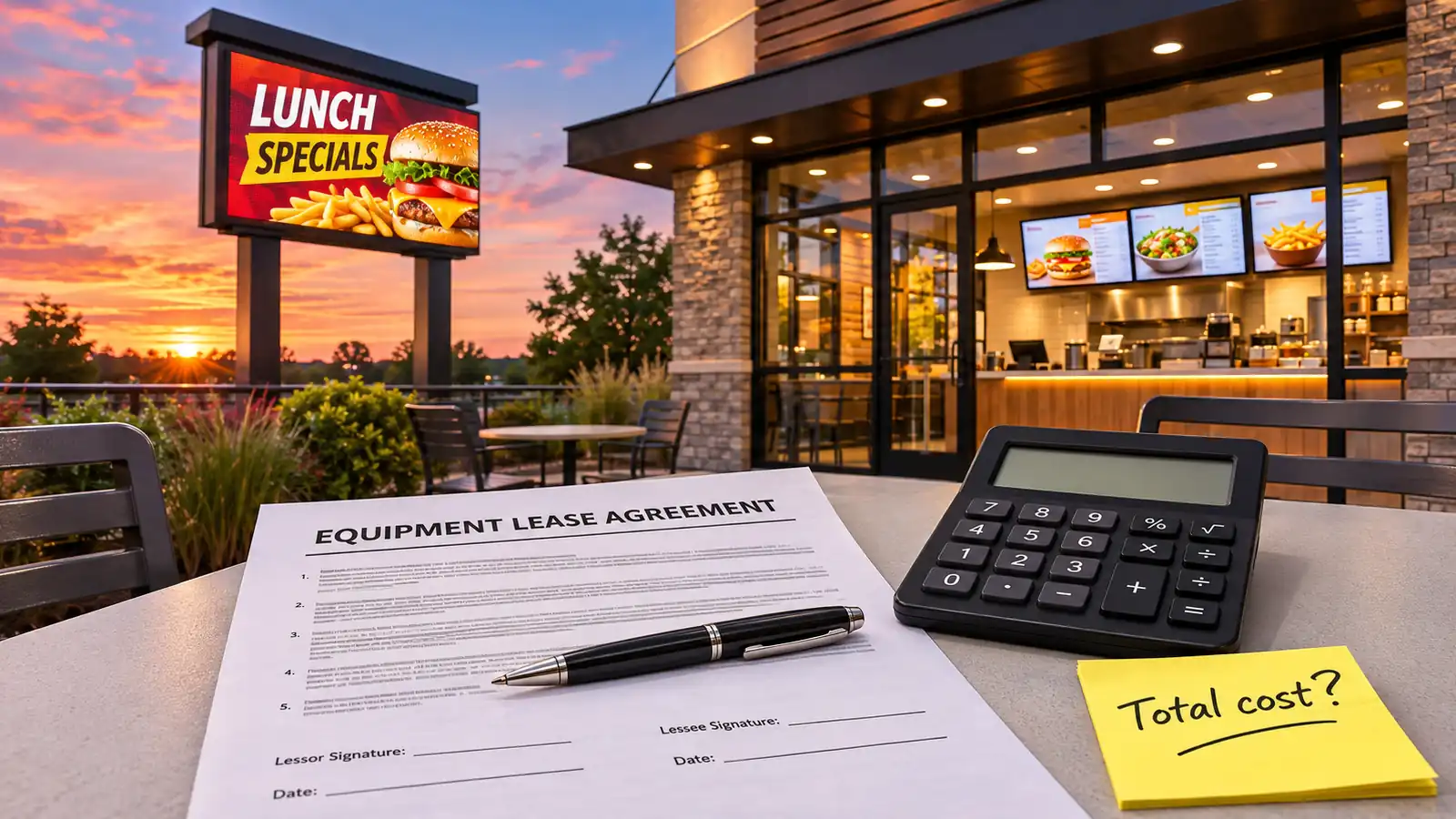
Rates, loan limits and tax rules here were checked in 2026. Every example below uses the same $20,000 LED sign, so each LED sign financing option can be compared on one number: the total you pay to keep the sign. Next come the six options side by side.
LED Sign Financing Options at a Glance
There are six ways to pay for an LED sign or digital signage, and they differ in upfront cost, total cost and who owns the sign when payments end.
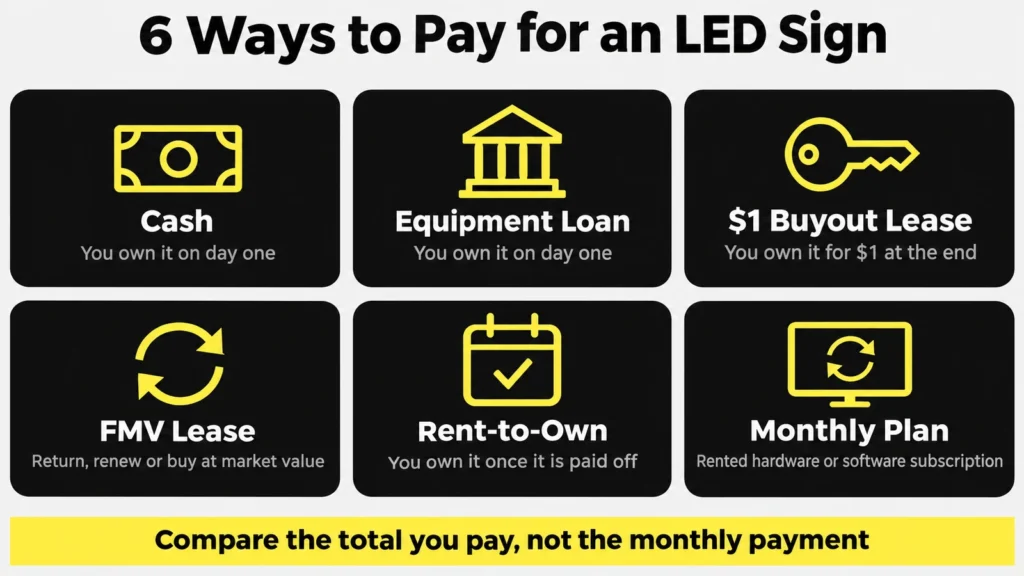
| Option | Upfront | Typical term | Who owns it at the end | Best for |
|---|---|---|---|---|
| Cash (paying upfront) | Full price | None | You, from day one | Businesses with reserves that want the lowest total |
| Equipment loan | Down payment set by the lender | 12–60 months; up to 10 years through SBA | You, from day one; the sign is collateral | Owners who will keep the sign for its full life |
| $1 buyout lease | First payment, often no money down | 12–60 months | You, for $1 at the end | Owning the sign while keeping cash free |
| FMV lease | First payment | 12–60 months | The lessor; you return, renew or buy at market value | Screens you expect to replace |
| Rent-to-own | First month | Month to month toward a purchase price | You, once the purchase price is paid | Testing a location before you commit |
| Monthly plan | Little or nothing | Month to month or yearly | Rented hardware stays with the vendor; software is a subscription | Indoor screens where software is most of the bill |
Digital signage financing can cover more than the LED signs or screens themselves. Many lenders include design, permits and installation in the amount they finance, so ask the sign company to quote the whole project as one number. To size that number before you apply, price each line: installed outdoor LED signs typically start around $10,000. In addition, electrical work and the permit come on top of the LED sign cost.
Equipment Loans for LED Signs and Screens
LED sign financing through an equipment loan is a purchase that makes you the owner from day one, with the sign itself as collateral.
Sign financing comes from three places: a bank or credit union, an online equipment lender, or a sign company financing program run with a finance partner. Banks usually price lowest but ask for more paperwork and time in business. Online lenders and sign company programs decide faster and usually charge more. As of November 2026, equipment financing runs from about 4% to 45% APR across lender types, and established businesses with good credit are usually quoted about 6% to 15%. Credit, time in business, the term and the resale value of the sign set where an offer lands.
SBA-backed loans cover equipment too. The 7(a) program lends up to $5 million, with equipment terms of up to 10 years, and the 504 program lends up to $5.5 million for long-life fixed assets. For one $20,000 sign the paperwork is usually heavier than the deal needs, but a restaurant planning a remodel can fold the sign into the same loan.
How business sign financing runs, step by step:
- Get one quote for the whole project: the sign, installation, electrical work and the permit.
- Apply with the lender. Credit requirements and approval time depend on the lender.
- Choose the term and the monthly payment, and read the total of payments before you sign.
- The sign is built and installed, and the lender pays the sign company.
- Payments start on the date the contract sets, and in contrast to most leases, the sign is yours from that day.
Leasing an LED Sign: FMV vs $1 Buyout
LED sign leasing lowers the first payment, but the end-of-term option that you choose decides what the sign really costs and who keeps it.
On an LED sign lease, the fair market value (FMV) structure has the lowest payment of the three common structures because the lessor expects to get part of the sign’s value back. At the end, you return the sign, renew the lease or buy it at its market value at that time. In digital signage leasing, FMV terms suit screens you plan to replace. Many FMV contracts renew automatically unless you send written notice by a set date, sometimes 90 days before the term ends, so put that date in your calendar on the day you sign.
Of the two common leases, a $1 buyout lease spreads the full price over the term. Payments are higher than on an FMV lease, and the sign is yours for $1 at the end, so in practice it works like a loan written as a lease. A 10% PUT lease sits between the two: the payments are lower than on a $1 buyout, and you must buy the sign for 10% of its original price when the term ends.
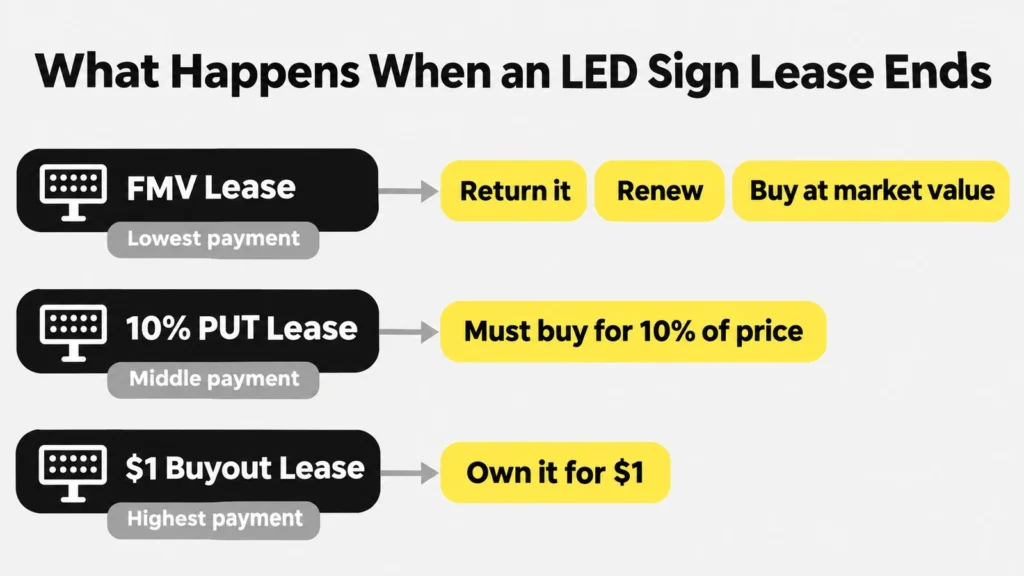
Lessors set payments with a lease rate factor: the price times the factor equals the monthly payment. The factor alone hides the term and the end-of-term price, so ask for the total of payments as well. The same rule applies to a digital signage lease for indoor screens and to sign leasing for an outdoor pylon.
“A lease keeps the debt off your balance sheet” is out of date. Under the ASC 842 lease standard, private companies have recorded leases longer than 12 months on the balance sheet for fiscal years beginning after December 15, 2021, and that includes operating leases. Only leases of 12 months or less can stay off it. Therefore, compare leases and loans on cash and total cost, not on how the balance sheet looks.
Monthly Plans: Renting Hardware vs Paying Only for Software
A monthly plan for digital signage can mean two deals that work very differently: renting the hardware, or paying only for the software on screens you own. An LED sign rent to own agreement and digital signage as a service both bundle the screens, players, software and support into one payment. You can usually hand a rent-to-own sign back, and the service model moves the repair risk to the vendor. The trade-off is usually the highest total over time and a contract tied to one vendor for the whole term, so ask what happens to the screens if the vendor shuts down.
Vendor programs and POS-linked advances often price a deal with a factor rate instead of interest. Before you set one beside an equipment loan quoted with an estimated APR, check factor rate vs interest rate and APR side by side: a 1.25 factor repaid in 12 equal monthly payments works out to roughly 43% APR, not 25%. California and New York already require many small-business financing offers to show that estimated figure.
For indoor menu boards, the cheapest monthly plan is often the plainest one: buy the screens outright and pay a digital signage subscription per screen per month. Counter screens cost a fraction of an outdoor LED sign, so financing them mostly adds interest and paperwork to a purchase small enough to pay once.
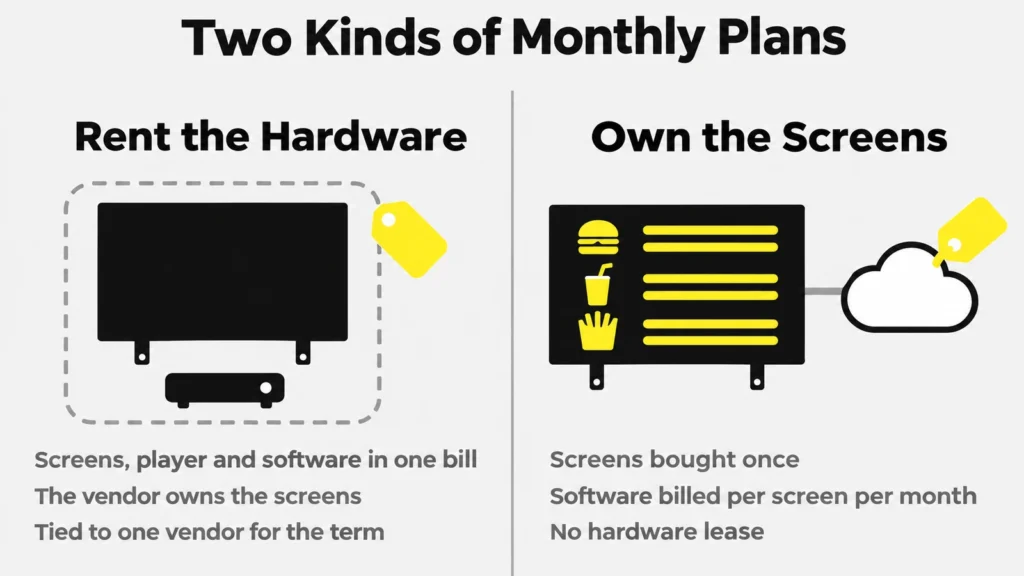
Decker works on that model. The menu runs in a smart TV’s built-in web browser, so there is no player to buy or lease, and a Decker Player or the Android TV app covers sites where the internet drops every day. On the Professional plan, prices and sold-out items sync from the POS or from Excel. Plans are billed per screen per month, one screen stays free with no card, and every paid feature can be tested on up to five screens for 14 days. In other words, the screens are a one-time purchase and only the software is a monthly bill. Current per-screen rates are on the Decker pricing page.
Equipment Lease vs Loan: What a $20,000 Sign Really Costs
Equipment lease vs loan comes down to one number that matters: the total you pay over the term, plus what it costs to keep the sign at the end.
In an example with a $20,000 sign, 60 monthly payments, a 12% annual rate, no fees and a $3,000 expected value at the end of the FMV lease, the five structures compare like this:
| Option | Monthly payment | Paid over 5 years | At the end | Total to keep the sign |
|---|---|---|---|---|
| Cash | None | $20,000 at purchase | You own it | $20,000 |
| Equipment loan | $445 | $26,694 | You own it | $26,694 |
| $1 buyout lease | $445 | $26,694 | Buy for $1 | $26,695 |
| 10% PUT lease | $421 | $25,224 | Must buy for $2,000 | $27,224 |
| FMV lease | $409 | $24,490 | Return it, or buy at market value | $27,490 if you buy it for $3,000 |
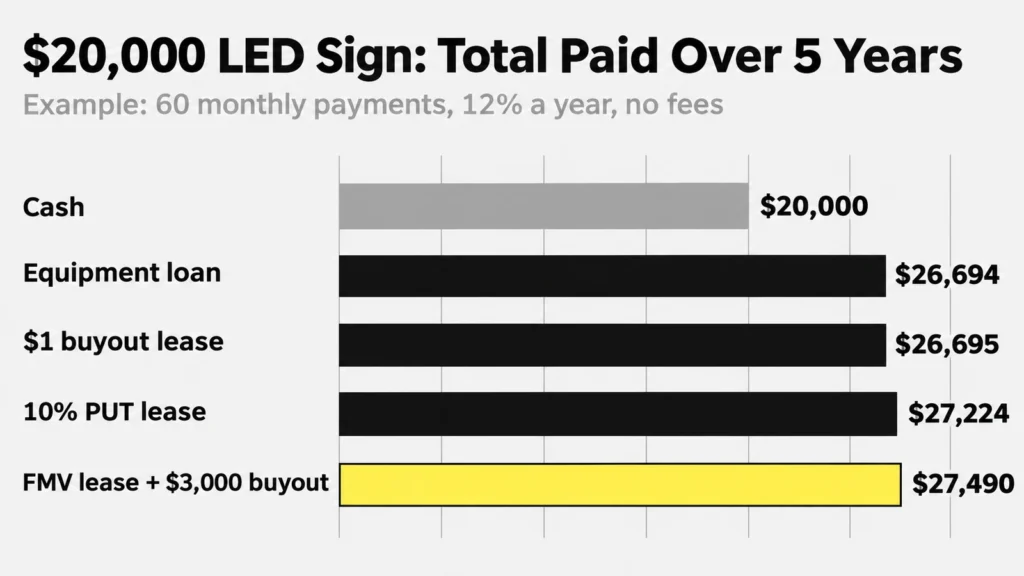
With these numbers, the FMV lease has the lowest payment and the highest total if you keep the sign. The rate moves the total more than the structure does. At 9%, the same loan costs $416 a month and $24,911 in total; at 20%, it costs $530 a month and $31,793.
The lease vs buy equipment question also depends on how long the sign will work. Outdoor LED signs rated for 100,000 hours last roughly 10 to 11 years at 24 hours a day, so a five-year loan leaves about half their life free of payments. A screen you expect to replace in three years suits an FMV lease better.
“Rated for 100,000 hours” does not mean 11 years at full brightness. The rating usually measures the time until the LEDs fade to half their original brightness, so plan the term around the years the sign stays bright enough to read from the road.
Section 179 and Lease Deductions
The tax benefits depend on who owns the sign. A purchased sign, whether paid upfront, with a loan or with a $1 buyout lease, can be written off under Section 179 in the year it is placed in service, up to $2,560,000 for tax years beginning in 2026. Bonus depreciation covers 100% of qualifying property acquired after January 19, 2025. Payments on a true FMV lease are usually deducted as a business expense instead. A pole or monument sign set in a concrete footing may count as a land improvement rather than equipment, which changes the write-off, so confirm the class with your tax professional. This is general information, not tax advice.
“Deduct the payments, then deduct the sign again” is not how it works. Under a $1 buyout lease you are treated as the owner, so you deduct depreciation or Section 179 plus the interest, not every payment plus the full price on top.
Overall, the cheapest structure on paper can still lose money if the contract terms work against you.
Contract Terms to Check Before You Sign
Most of the expensive surprises in LED sign financing sit in clauses that cover the end of the term, renewal and cancellation, not in the monthly payment.
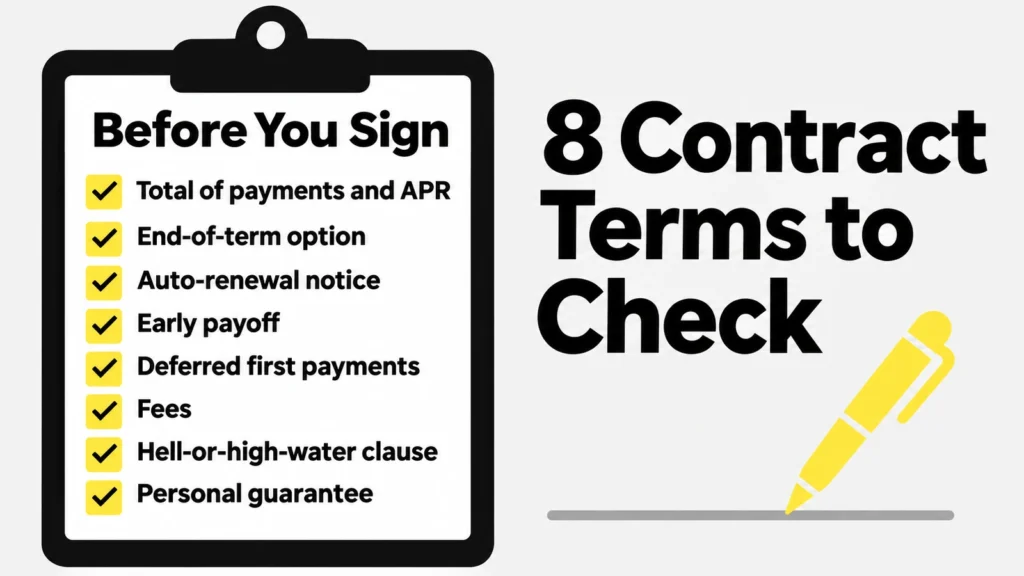
- Total of payments and estimated APR. Non-bank lenders must disclose an estimated APR on offers up to $500,000 in California, where the rules cover lease financing too, and up to $2.5 million in New York. Banks are exempt in both states, and New York also exempts true leases, which usually include FMV leases, so on those deals ask for the total in writing yourself.
- End-of-term option. FMV, 10% PUT or $1 buyout, and whether the buyout price is fixed in the contract.
- Auto-renewal notice. How many days before the end you must send written notice, and what each extra month costs.
- Early payoff. Whether paying off early saves the remaining interest or still charges every remaining payment.
- Deferred or reduced first payments. What the payment becomes after the intro months, and whether the term gets longer.
- Fees. Documentation, origination and late fees, plus who pays sales tax and insurance on the sign.
- Hell-or-high-water clause. Payments stay due even if the sign breaks, so check the warranty and service terms separately.
- Personal guarantee. Whether the owner signs personally, even when the contract is in the business name.
A low monthly payment is not a cheap deal. A $30,000 sign quoted at $600–$800 a month over 60 months adds up to $36,000–$48,000 in payments before fees. Compare totals, never payments. As a result, the payment alone says little about the price.
When Financing a Sign Isn’t Worth It
Financing a sign is the wrong move when interest, fees and paperwork cost more than the cash that the deal keeps free. Four cases where paying upfront, or waiting, wins:
- The project costs less than a few thousand dollars. Published minimums for LED sign and screen financing start at about $3,000 with some sellers and $10,000 with some lenders, and documentation fees take a large share of a small deal.
- The term runs longer than the hardware. A consumer TV lasts 3–5 years in signage use, so a five-year contract outlives the screen it paid for.
- Your property lease ends before the contract does. The payments continue while the sign stays bolted to a building you are leaving.
- The business is under 6 months old and the lender asks for a personal guarantee on the full amount. A smaller sign paid from savings carries less risk than a five-year obligation in your own name.
Therefore, pay cash when your reserves still cover three months of fixed costs after the purchase: LED sign financing would only add interest to LED signs you could already afford.
Questions and Answers
1 Can you finance an LED sign?
Yes. Banks, online equipment lenders and sign companies working with finance partners offer LED sign financing as a loan or a lease, commonly over 12 to 60 months, for indoor and outdoor LED signs alike. Many lenders include installation and permits in the financed amount. Rates and approval rules depend on the lender.
2 Is it better to buy or lease equipment?
Buy, with cash or a loan, when you will keep the equipment for most of its life and want the lowest total. Lease when you expect to replace it within a few years, want the lowest payment or need to keep cash free. An FMV lease costs the least per month but the most if you buy the equipment at the end.
3 What are the two types of equipment leases?
The two main types are the fair market value (FMV) lease and the $1 buyout lease. With an FMV lease, the lessor owns the equipment and you return, renew or buy it at market value. With a $1 buyout lease, you pay off the full price and own it for $1. Accountants usually treat FMV leases as operating leases and $1 buyout leases as finance leases.
4 What is the 90% rule in leasing?
It is a common test for a finance lease. If the present value of the lease payments equals 90% or more of the equipment’s fair value, the lease is treated like a purchase. Under ASC 842, the 90% figure is a widely used benchmark for “substantially all” of the value, not a fixed legal line.
5 Will sign financing affect my personal credit?
It depends on the lender and the contract. LED sign financing in the business name can build business credit, but many lenders also ask the owner for a personal guarantee and check personal credit when you apply. Ask whether the check is soft or hard before you submit the application.
6 How long does sign financing approval take?
It depends on the lender. Online lenders and sign company programs often decide within a day, while bank and SBA loans take longer because they ask for tax returns and financial statements. Therefore, send a complete quote for the sign, installation and permit with the application to speed it up.
Sources
- U.S. Small Business Administration — 7(a) Loans
- U.S. Small Business Administration — 504 Loans
- California Department of Financial Protection and Innovation (DFPI) — Commercial Financing Disclosures
- New York Department of Financial Services (DFS) — Commercial Finance Disclosure Law
- Internal Revenue Service — Rev. Proc. 2025-32 (2026 Section 179 limits)
- Financial Accounting Standards Board — ASC 842, Leases