Raydiant Alternatives With Public Prices for Restaurants Facing a Displai Renewal


The best Raydiant alternative for a restaurant is Decker: its POS-fed plan is posted at $12 per screen, paid monthly and played in the TV's own browser, while Displai, Raydiant's new owner, quotes about $49 per screen on a prepaid year. If the bill comes first, Display NOW costs $4.99 and Yodeck $8; for bar TV, Atmosphere TV. Next: 7 options.
What Are the Best Raydiant Alternatives?
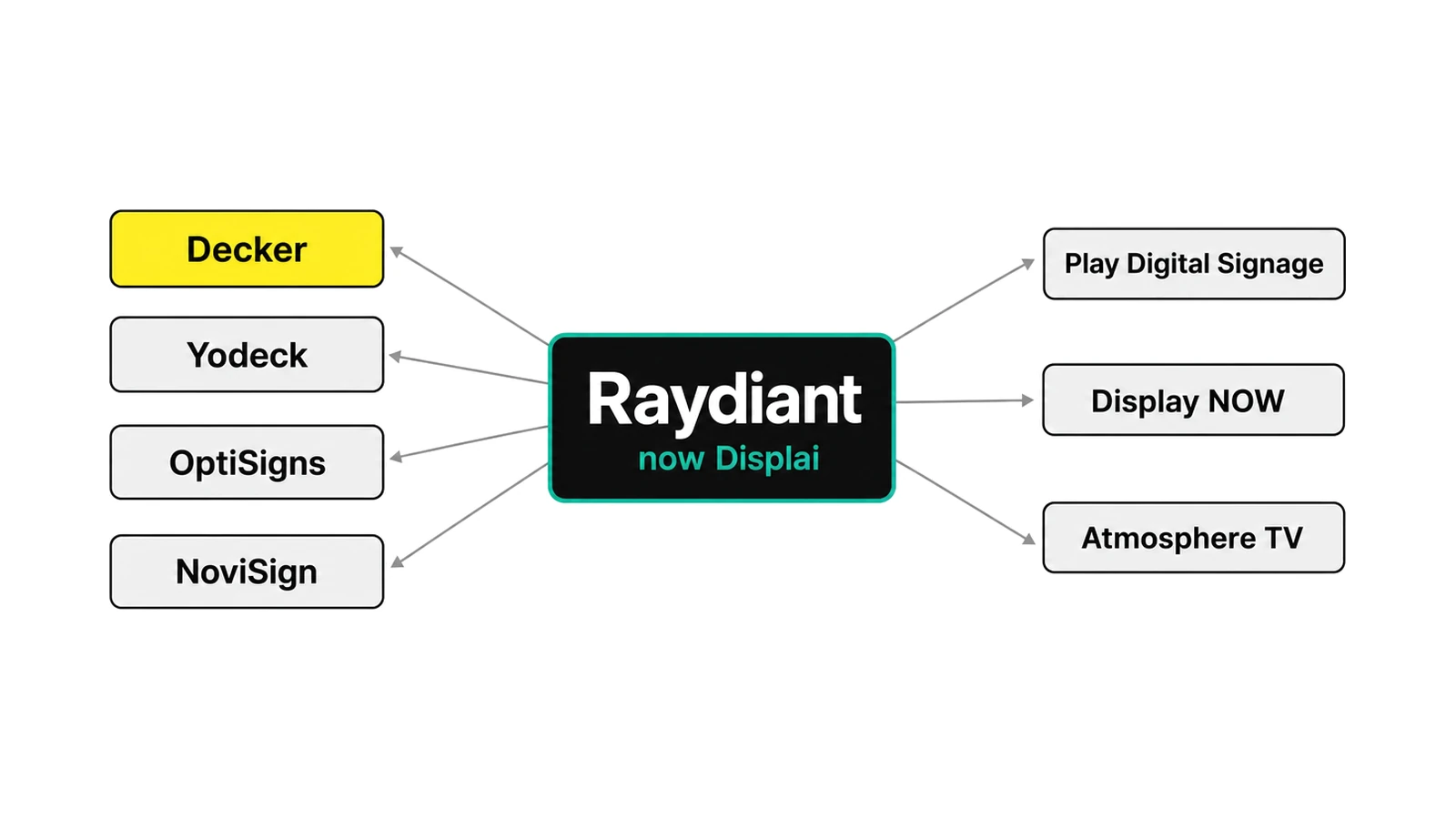
The best Raydiant alternatives are Decker, Yodeck, OptiSigns, NoviSign, Play Digital Signage, Display NOW and Atmosphere TV, each publicly priced.
- Decker — the Raydiant alternative that keeps the register-fed menu: Toast, Square and Clover sync on Professional at $12, billed monthly, and the board plays in the TV’s built-in browser.
- Yodeck — the Raydiant alternative for a small bill: $41 less per screen than Displai’s prepaid rate, and a Raspberry Pi player instead of the $169 box on yearly plans.
- OptiSigns — the Raydiant alternative with the widest device list: $10 on Standard, three free screens with its logo, and a Toast menu through OptiSync on Pro Plus.
- NoviSign — the Raydiant alternative closest on kiosks and touch screens, at $14 to $25 a screen on annual terms.
- Play Digital Signage — the month-to-month Raydiant alternative: $8, $12 or $16 a screen, with one screen kept free after a review.
- Display NOW — the cheapest paid Raydiant alternative here: $4.99 a screen on annual billing, Canva and Google Slides built in, and an app for Google TV and Fire TV.
- Atmosphere TV — the free Raydiant alternative for bar TV: curated channels for bars and restaurants, with room for your own promotions.
A bill nobody can read in advance tops the list of reasons to compare Raydiant alternatives: Displai pricing does not appear on displai.ai, which shows a demo form instead of plans, while G2 lists $49 per screen on a prepaid year plus a $169 device.
Ownership changed too: in May 2025, Displai Systems Inc. bought Raydiant’s products and customer contracts, so any Raydiant alternative now competes with a new vendor’s renewal terms. Reviews add the rest: screens losing their hub link, slow publishing and slow support.
Those three gaps decide which Raydiant competitors make sense for a counter. For a restaurant on Toast, Square or Clover, restaurant menu screens that list their price up front keep the POS link without the prepaid year. Next, both plan sheets go side by side, line by line.
The Raydiant Alternative With a Published Price: Raydiant vs Decker
Raydiant and Decker both read the POS, but Displai sells Raydiant by quote on a prepaid year while Decker posts monthly rates. As a Raydiant alternative, Decker puts the POS-fed menu on Professional at $12 per screen a month, between Essential at $8 and Premium at $16, and a yearly plan lowers each step by 15%; all three appear on Decker’s plan page before anyone books a call.
| Raydiant (now Displai) | Decker | |
|---|---|---|
| Price on the website | Demo request only | ✅ $8, $12 and $16 per screen a month |
| Billing | One year prepaid, about $49 a screen (G2) | ✅ Monthly, or 15% off on a yearly plan |
| Free option | 14-day trial on G2; no trial on displai.ai | ✅ Starter: one screen free with no time limit; 14-day trial of paid plans, no card |
| Registers named | Toast, Square, PAR and NCR Aloha in Displai’s marketplace; Lightspeed among its partners | ✅ Toast, Square and Clover; Excel import for any other register |
| POS menu starts at | Quote | ✅ Professional, $12 a screen |
| A price changes | The menu shows «the latest pricing and availability» from the POS | ✅ The layout rebuilds itself; changed lines redraw in 1–5 seconds |
| Hardware | Displai plug-in device on every screen, $169 on G2; BrightSign also works | ✅ The TV’s built-in web browser, no device to buy; Decker Player or the Android TV app only where the internet drops daily |
| What gets watched | «99.99% uptime» claim and a central dashboard | ✅ Decker Verifier reads the panel: black screen, wrong input, stale price |
| Self-checkout kiosks | ✅ Tablet, counter and standing kiosks tied to the POS | — |
| Staff boards and analytics | ✅ Hoopla performance boards and InSight foot-traffic analytics | — |
| Templates | ✅ 225,000 design templates, plus PosterMyWall designs | Templates plus an AI design generator on Professional |
| Scale | ✅ «10 to 10,000 locations» from one dashboard | Location management on Professional; franchise module, SAML SSO and audit logs on Premium; one-hour SLA on Enterprise |
A price you can read before the demo. Displai answers a pricing question with a booking form. On Decker, a five-screen counter can work out its monthly bill from the plan page in a minute: $60 on Professional, Toast sync included. Nothing locks that bill for a year, so the first month doubles as the test.
The same POS link without the prepaid year. Raydiant built its name on menus that follow Toast, and that link still matters most in a Raydiant alternative. Decker connects Toast, Square and Clover directly on Professional, and an 86’d item drops off the board while the layout closes the gap. Clover does not appear among the registers Displai names today. The setup per register sits on the page about register-fed menus for Toast, Square and Clover.
No box on every TV. Displai plugs its own device into each screen, while this Raydiant alternative needs none. Decker plays in the built-in web browser of a Samsung Tizen, LG webOS or Android TV, or any other browser, and keeps showing the last menu from its cache through short outages. A Decker Player or the Android TV app goes in only where the internet drops every day.
A Verifier that reads the panel itself, built into the player or mounted beside the screen, catches a dark panel or a TV on the wrong HDMI input that an uptime figure never shows.
Where Raydiant stays ahead: self-checkout kiosks, Hoopla staff boards, InSight analytics, PAR and NCR Aloha registers for large chains, and multi-location rollouts, with Chick-fil-A and Baskin-Robbins among the client logos on displai.ai. Decker builds none of these, so a chain that takes orders and payments on Displai kiosks keeps a real reason to renew instead of picking a Raydiant alternative.
🧮 Put a Raydiant alternative next to the Displai quote: open one Decker board in the TV’s browser on Starter, free with no time limit and no card, and add the POS feed on Professional at $12 only once the board earns it. Start free
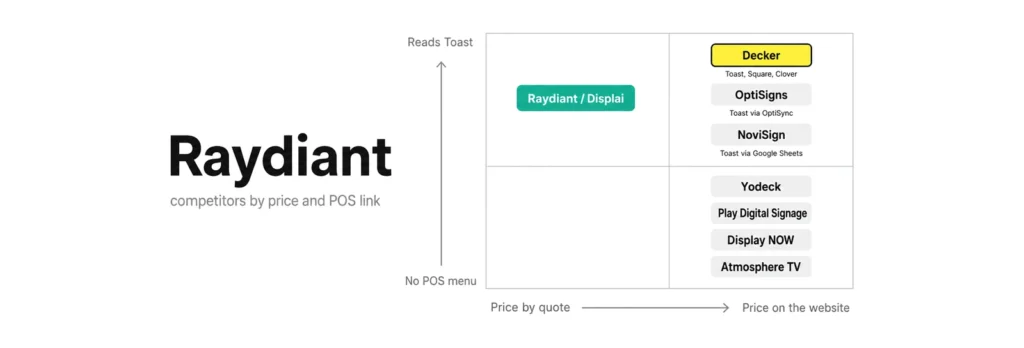
Two questions sort the other Raydiant competitors faster than any feature list: is the price public, and does the menu read Toast?
Raydiant Competitors Compared: Who Shows a Price and Who Reads Toast
Raydiant competitors are POS-linked menu platforms, low-cost bring-your-own-screen tools and free TV services for bars. SpotSaaS rates Raydiant Digital Signage 4.6 from 111 reviews and finds eight of its ten listed alternatives rated higher. Google’s AI answer for Raydiant alternatives names Yodeck, OptiSigns, ScreenCloud and Juuno. For a restaurant, the useful split is simpler: does the Raydiant alternative publish a price, and does it read the register?
| Platform | Rating | From, per screen a month | POS menu sync | Hardware | What changes vs Raydiant |
|---|---|---|---|---|---|
| Raydiant / Displai (reference) | 4.7 (318), Software Advice | Quote; about $49 prepaid (G2) | Toast, Square, PAR, NCR Aloha, Lightspeed | Own device, $169 | — |
| Decker | not listed | $8; POS sync at $12 | Toast, Square, Clover; Excel | TV browser | Monthly rates on the site, Clover added, no device |
| Yodeck | 4.8 (4,929), Capterra | $8 | None; DSMenu by hand | Free Pi player on annual plans | Menu typed by hand, $41 less per screen |
| OptiSigns | 4.8 (4,593), Capterra | $10 | Toast via OptiSync on Pro Plus | Apps for 14 device families, Apple TV and Roku included | Toast at $15 plus Toast’s API fee |
| NoviSign | 4.9 (121), Capterra | $14, annual | Toast via Google Sheets | Android, ChromeOS, Windows, BrightSign | Kiosks stay, POS shrinks to Toast |
| Play Digital Signage | 4.8 (954), Capterra | $8 | None | Bring your own | 24/7 chat, no POS |
| Display NOW | 4.5, Techjockey | $4.99, annual | None named | Google TV and Fire TV app | Canva built in, no POS |
| Atmosphere TV | 4.8, SpotSaaS | Free entertainment | None | Plug-in device | Channels plus your promos, no menus from POS |
Ratings come from the source named in each row; prices come from each vendor’s own page, checked in 2026.
Only Decker, OptiSigns and NoviSign among these Raydiant competitors read Toast, and only Decker adds Square and Clover. The other four win on price or entertainment, so a counter that relied on Raydiant’s POS menu gives that link up with them. The six profiles below look at each Raydiant alternative from the seat of a current Raydiant customer.
Yodeck
A Raydiant customer who moves to Yodeck pays $8 a screen, $41 under the prepaid rate, and on a yearly plan gets a free Raspberry Pi player in place of the $169 Displai box. The Toast link stays behind: Yodeck reads no register, so every price change is retyped in DSMenu. An account with a single screen pays nothing, so as a Raydiant alternative Yodeck suits boards whose prices change rarely. The guide to Yodeck alternatives covers who later outgrows Yodeck itself.
OptiSigns
As a Raydiant alternative, OptiSigns keeps a Toast menu running for under a third of Displai’s prepaid rate: Pro Plus costs $15 a screen against about $49. The trade is setup work, since the owner maps each menu field in OptiSync and pays Toast about $25 per location a month for API access, per OptiSigns’ help center. Screens without a POS feed cost $10 on Standard, and three logo-marked screens cost nothing. The guide to OptiSigns alternatives maps that Toast route step by step.
NoviSign
As a Raydiant alternative, NoviSign sits closest on kiosks: a touch widget, a kiosk builder and a videowall editor. Plans run $14, $17 and $25 per screen on annual terms. The Toast menu passes through Google Sheets on Business Plus, and NoviSign names no other register, so a Square counter loses its POS feed. The guide to NoviSign alternatives tests how fast that sheet carries a price change.
Play Digital Signage
As a Raydiant alternative, Play Digital Signage fits a customer whose main complaint is the prepaid year: its $8, $12 and $16 tiers bill month to month, and a yearly term is optional at 10% off. It runs on smart TVs and players the store already owns, so the Displai box comes off the wall without a paid replacement. The first screen stays free for 30 days, and for good once the owner posts a review; no tier reads a POS.
Display NOW
As a Raydiant alternative, Display NOW starts at $4.99 a screen a month on annual billing, or $7.99 month to month, about a tenth of Raydiant’s prepaid rate, with a free trial and no card. Canva and Google Slides designs reach the screen in a few clicks, and the player app runs on Google TV and Fire TV. Display NOW names no POS link.
Atmosphere TV
As a Raydiant alternative, Atmosphere TV replaces the entertainment side of a screen rather than the menu. It streams more than 30 free curated channels to bars and restaurants and lets the venue add its own promotions, events and messages between them. More than 60,000 businesses use it, according to the company, which also reports a 19% lift in repeat visits at participating restaurants; it reads no POS.
ScreenCloud and Juuno, both named in Google’s answer and both without a POS link, get a fuller look in the guide to ScreenCloud alternatives: ScreenCloud Core costs $20 a screen on annual billing, and Juuno $5, rated 4.9 on Capterra from 48 reviews. Next, the change of owner explains why so many Raydiant customers compare prices now.
From Raydiant to Displai: What Changed After the May 2025 Asset Sale
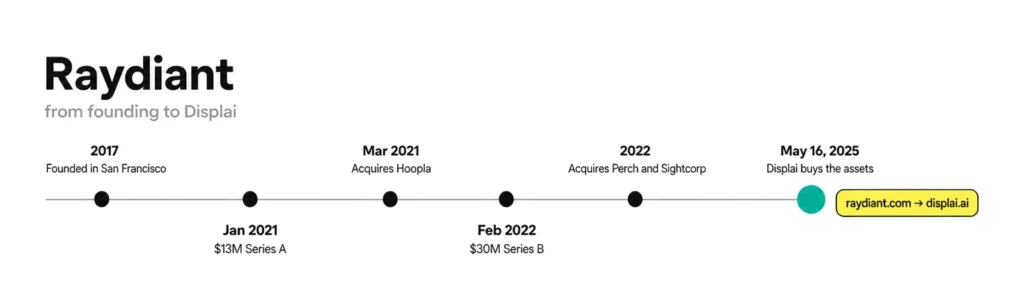
Displai Systems Inc. bought Raydiant’s products, technology and customer contracts on 16 May 2025, and raydiant.com now redirects to displai.ai. The deal also moved key team members across, according to invidis, after Raydiant could not find a buyer for the whole business. Displai put hospitality and restaurants first and promised uninterrupted service to existing customers. Its site claims «enterprise-class security» but names no SOC 2 report.
Raydiant itself started in San Francisco in 2017 under founder and CEO Bobby Marhamat. It raised a $13 million Series A in January 2021 and a $30 million Series B in February 2022, bought the staff-motivation platform Hoopla in March 2021, and added Perch and the AI start-up Sightcorp in 2022. LinkedIn now describes the business as «Raydiant is now Displai», with signage, employee experience and AI location insights. The Raydiant app and dashboard now run at dash.displai.ai, while older help pages still sit on support.raydiant.com.
For a Raydiant customer, the practical change sits in the contract. Before a Displai renewal or a move to one of the Raydiant alternatives, four points deserve a written answer:
- Which legal entity signs the renewal and holds the customer data.
- How long the prepaid term runs and what it costs to cancel early.
- What happens to the Displai devices if the restaurant closes the account.
- Which support hours and SLA apply after the move.
As a result, the renewal date has become the natural moment to test a Raydiant alternative side by side, starting with the tools that only Displai sells.
Raydiant Features That Keep Chains on Displai: Kiosks, Hoopla and InSight
Three Raydiant features that no menu platform in this guide matches are self-checkout kiosks, Hoopla staff leaderboards and InSight foot-traffic analytics. Displai’s kiosks range from tablets to counter and standing units, and restaurant guests order, scan items and pay on them. Raydiant’s Hoopla boards, bought in 2021, turn sales targets into gamified contests for restaurant and retail staff. InSight, sold as AI analytics, tracks foot traffic, demographics and in-store behavior.
The Raydiant software keeps its employee tools under the Engage name, now Displai Engage, with a Huddle communications hub and points for staff. A Menus app builds boards with photos, a tool every menu-focused Raydiant alternative also covers, and the app marketplace lists hundreds of third-party apps. Displai’s device connects over WiFi, ethernet or LTE, which suits a restaurant or food truck without a reliable network.
The bundle earns its price at a chain that sells through kiosks and runs weekly staff contests; NoviSign comes closest on kiosks, and none of the Raydiant alternatives in this guide replaces Hoopla. A coffee shop with three menu boards, however, pays for that bundle and never opens it.
What Raydiant Pricing Looks Like Without a Price List
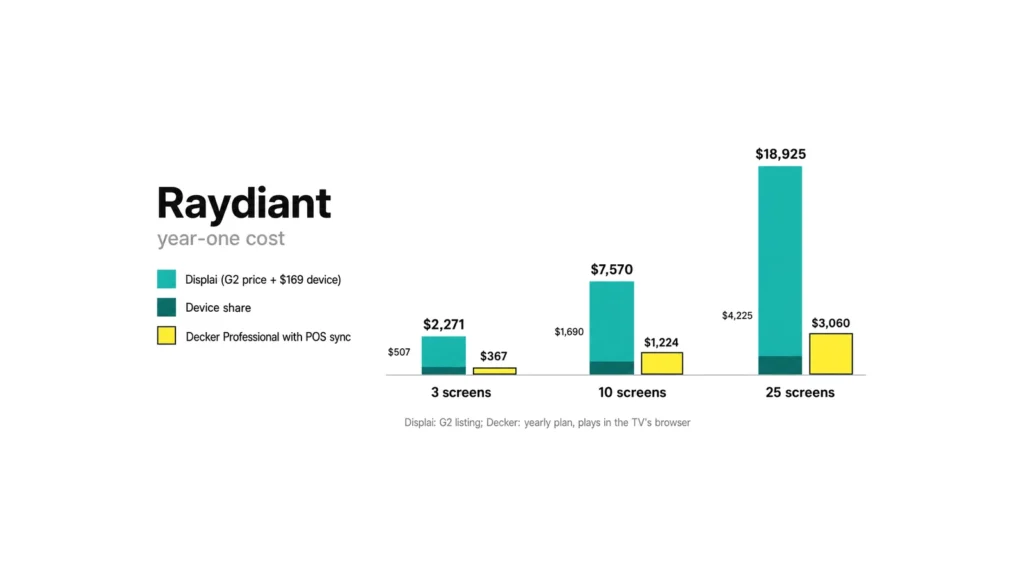
Raydiant pricing runs about $49 per screen a month on a prepaid year, plus a $169 device per screen, on G2’s listing. G2 dates that price data to October 2024, and Displai’s own site shows no plans, only a demo request, unlike most Raydiant competitors in this guide.
An archived Raydiant pricing page listed $59 per screen a month, or $49 a month prepaid annually, plus the same $169 hardware fee. One roundup adds $30 to $100 a month per screen for extra features and services. For a buyer, the Raydiant cost therefore depends on the term, the device count and any add-ons in the quote, which makes a written quote the only fair base for comparing Raydiant alternatives.
| Screens | Displai, year one (G2: $588 + $169 device per screen) | Decker Professional with POS sync, yearly plan |
|---|---|---|
| 3 | $2,271 | $367 |
| 10 | $7,570 | $1,224 |
| 25 | $18,925 | $3,060 |
Displai figures follow G2’s listing; Decker plays in the TV’s browser, so no device is added; Decker figures exclude any fee a POS vendor charges. Enterprise contracts follow a separate quote, at Displai and at every Raydiant alternative in this guide.
On software alone, ten screens cost $5,880 a year on Displai’s prepaid rate against $1,224 on Decker Professional with the yearly discount. The device line widens the gap in year one, because every Displai screen adds $169 before the first menu goes live, a cost most Raydiant alternatives avoid. Panels and mounts cost the same under either contract; what a screen costs once the TV and mount are in covers that half of the budget.
📋 «Raydiant starts at $59» and «$59.99 per screen» still circulate in roundups. That was the old month-to-month rate; the $49 figure applied only to a prepaid year with a $169 device, and Displai now publishes neither number. The ScreenRay player also shows up at $199 on some comparison pages, so ask for the per-screen rate, device fee and term in writing before comparing Raydiant alternatives.
Beyond price, Software Advice reviewers fill in what a price sheet cannot: what Raydiant customers keep and what makes them shop around.
Hub Dropouts and a 4.7 Score: Raydiant Pros and Cons in Reviews
Raydiant reviews average 4.7 on Software Advice from 318 ratings, with 83% at five stars. G2 also shows 4.7, and SpotSaaS lists 4.6 from 111 reviews. SelectHub counts 317 reviews and gives an analyst score of 85. Many reviews on Software Advice still carry the Raydiant name, which shows how recent the switch to Displai is.
Restaurant and retail reviewers praise ease of use, scheduling and the help desk. Complaints repeat three themes: screens that lose their connection to the hub, slow publishing and monthly per-screen fees, with one reviewer asking for a one-time purchase instead. SelectHub adds slow support responses, and one 2025 review on Capterra says phone support ended in 2024 and help now comes by text only. Shift’s roundup calls the offline mode weak, and those complaints drive most searches for Raydiant alternatives.
| Pros | Cons |
|---|---|
| ➕ Editor that works like PowerPoint, no code needed | ➖ Screens sometimes lose their link to the hub (Software Advice) |
| ➕ Template library plus PosterMyWall designs | ➖ Slow publishing and slow support replies (Software Advice, SelectHub) |
| ➕ Ordering and payment kiosks tied to the POS | ➖ No public price; a prepaid year on G2’s listing |
| ➕ One dashboard for many locations | ➖ A paid Displai device on most screens |
| ➕ Menus that follow Toast prices and 86’d items | ➖ Weak offline playback, per Shift’s roundup |
Overall, the Raydiant pros and cons point the same way: strong restaurant tooling, weaker value for a small restaurant counter, and Raydiant competitors with public prices win on that second point. Next comes the part most restaurants bought Raydiant for, the menu link.
How Raydiant Menu Boards Pull From Toast and Square
Raydiant menu boards pull prices and availability from the POS registers that Displai’s marketplace lists: Toast, Square, PAR and NCR Aloha. The Raydiant Toast integration synced the menu so that pricing, promos and 86’d items changed on the screen automatically, as The Spoon reported. On Toast’s community forum, users point to Raydiant in the digital signage section of Toast integrations, and one Raydiant partnership promised in-store and drive-thru menus plus kiosks from one platform.
Displai’s restaurant page promises to «show the latest pricing and availability» from the POS, but it names no register there. Its marketplace also lists Lightspeed, 7shifts schedules, Instagram, YouTube and PosterMyWall designs. Lightspeed’s partner page for Lightspeed Retail, last updated in 2022, credits Raydiant with a 35% drop in perceived wait time and a 37% lift in sales of promoted items, both vendor-reported.
Four written answers from Displai settle whether its POS link is worth the quote or one of the Raydiant alternatives fits better:
- Which POS registers connect on the plan in the quote.
- Whether Clover works today, since older Raydiant listings named it.
- How fast a price changed in the POS reaches the screen.
- What the screen shows if the POS link drops.
Decker answers the same questions on its plan page: Toast, Square and Clover on Professional, daypart menus, and an Excel import for any other register. That import lives in the menu builder Decker runs in the browser. Once those answers are in writing, the rest of a switch therefore comes down to the devices and the contract.
ScreenRay Boxes, PosterMyWall Files and the Toast Link: Moving Off Displai
Leaving Displai means settling three things that outlast the screens: the prepaid term, the ScreenRay or Displai box, and the POS link.
| Item | What happens on a switch | What to do |
|---|---|---|
| Prepaid term | Runs to its end date | Start the new platform the day after; ask Displai in writing what an early exit costs |
| ScreenRay or Displai box | No published path to other software | Retire it; a Decker menu board needs only the TV’s web browser |
| Older players: Windows, Mac, Chromebox, Fire TV Stick, BrightSign | Earlier Raydiant setups ran on them | Reuse them with many Raydiant alternatives |
| PosterMyWall designs | Stay in the PosterMyWall account | Export and download them for the next platform |
| Toast, Square or Clover link | Ends with the Displai account | Reconnect it and check one price and one sold-out item on the screen against the POS |
| Hoopla and InSight data | Stay with Displai | Export the reports you need before the term ends |
Because the annual term is prepaid, the cheapest cutover date is the first day after it ends, and a five-store group can run a test board on one of the Raydiant alternatives during the final month. For some operators, though, a renewal still costs less than a switch.
Five Displai Setups Worth Renewing
Displai stays the better renewal for kiosk ordering, Hoopla contests, InSight reports, 100-store contracts and terms that have six prepaid months left. A restaurant brand whose guests order and pay on Displai kiosks would rebuild its whole ordering flow on any of the Raydiant alternatives. A team that runs Hoopla boards for weekly sales targets has nothing to swap them for on a POS menu platform.
A marketing team that reports InSight foot-traffic figures each month would lose that data. A restaurant chain of 100 or more locations on one enterprise contract gets terms a small account never sees. An account with six or more prepaid months left loses money by leaving early for any of the Raydiant alternatives. Overall, in each of these five cases, a switch rebuilds a setup that works and saves less than it costs.
Questions and Answers
1 What is the best Raydiant alternative for a restaurant?
Decker is the best Raydiant alternative for a restaurant that wants to keep a POS-fed menu but drop the prepaid year: Professional costs $12 a screen month to month, Clover joins Toast and Square, and the board plays in the TV’s browser instead of on a $169 device. NoviSign stays closest on kiosks at $14 to $25, while Display NOW at $4.99 and Yodeck or Play at $8 cut the bill but not the POS link.
2 Is Raydiant now Displai?
Yes. Displai Systems Inc. bought Raydiant’s products, technology and customer contracts on 16 May 2025, and raydiant.com now opens displai.ai. Existing customers kept their service, and Raydiant digital signage now sells as Displai digital signage. Older help pages and reviews still carry the Raydiant name, and most searches for Raydiant alternatives still use the old brand.
3 What is Raydiant?
Raydiant is a signage and in-store experience platform founded in San Francisco in 2017 by Bobby Marhamat and now owned by Displai. The company counted about 4,500 client brands in 2022, and Chick-fil-A, Baskin-Robbins, Macy’s, Toyota and T-Mobile appear among its client logos, so the answer to who uses Raydiant spans restaurants, retail, hospitality and banking. The Raydiant company also built kiosks, Hoopla staff boards and InSight analytics, and restaurants comparing Raydiant alternatives weigh those extras against a public price.
4 How much does Raydiant cost?
Displai publishes no price. G2 lists $49 per screen a month on a prepaid year plus a $169 device, and an archived Raydiant page showed $59 month to month. Ten screens at $49 per screen on the prepaid rate cost $7,570 in year one with devices. Among Raydiant alternatives, Decker Professional costs $1,224 a year for the same ten screens with POS sync.
5 Does Raydiant have a free trial?
It depends on the source. G2’s listing shows a 14-day trial, SpotSaaS lists none, and displai.ai offers only a demo request. Among Raydiant alternatives, Decker Starter keeps one screen free with no time limit, and paid plans start with a 14-day trial, no card.
6 Does Raydiant work with Toast?
Yes. Toast users point to Raydiant among its digital signage integrations, and the link updated prices, promos and 86’d items on the menu. Displai also lists Square, PAR and NCR Aloha in its marketplace and names Lightspeed as a partner, while Clover appears only on older Raydiant listings. A Raydiant alternative such as Decker connects Toast, Square and Clover on one plan.
7 What happens to the ScreenRay or Displai box after switching?
It most likely retires with the account. Displai has not published a way to reuse ScreenRay or Displai boxes with other software. Older Raydiant setups on Windows, Mac, Chromebox, Fire TV Stick or BrightSign can move to several Raydiant alternatives, and Decker needs only the TV’s web browser.
8 Is there a free alternative to Raydiant?
Atmosphere TV costs nothing for its channels, but it shows no menu. For a menu, the free tiers stay small: one screen on Decker Starter or Yodeck, three logo-marked screens on OptiSigns and one on Play after a review, and none of them reads a POS. Therefore, a Raydiant customer can use one free screen from the Raydiant alternatives above to set a working board beside the Displai quote, and a ranked guide to screen software, free tiers included covers bigger fleets.
Sources
- Official websites of the brands reviewed in this article: plans, prices per screen, free plans, supported devices and POS integrations.
- Displai pricing on G2
- Displai on Software Advice
- invidis: Displai acquired Raydiant assets
- SelectHub: Raydiant analyst score
- Raydiant alternatives on SpotSaaS