How to Write a Food Truck Business Plan in 2026, From Business Model to Break-Even


A food truck business plan is a 15–20 page document that proves a mobile food concept can cover its truck payment, commissary kitchen and permits and still pay the owner. Below you get the business model choice, all nine sections, a free fill-in template, a costed sample and the payback math for a digital menu at the window.
In 30 seconds:
- A lender reads two parts of your plan closely: the costed menu and the financial projections.
- The standard food truck plan has 9 sections, from executive summary to funding request.
- First-year permits, fees and compliance averaged $28,276 across 20 U.S. cities in the U.S. Chamber of Commerce Foundation’s Food Truck Nation study.
- Our worked sample breaks even at 38 orders a day and needs 56 a day to also pay the owner.
- A digital menu at the window adds a 3–5% average sales lift in restaurant studies, which on a $346,000 truck is $10,380–$17,300 a year.
What Is a Food Truck Business Plan?
A food truck business plan is a written model of a mobile food business that shows lenders, commissary landlords and event organizers how the truck sells enough food, at a high enough margin, to cover its fixed costs and pay its owner.
The plan works as a decision tool before it works as a loan document. You build it on paper, for free, before you wire $40,000 to $150,000 for a vehicle — the range Square cites for the truck alone. A mobile food truck business plan differs from a restaurant plan in four places: a route or location schedule instead of a lease, a commissary agreement instead of an on-site kitchen, event fees instead of rent, and a hard ceiling on how many orders one service window can push out during lunch.
Three readers open the same food truck plan and look for different things:
- You want to know whether the concept clears its costs before you buy anything.
- A lender underwrites a depreciating vehicle plus permits you may not have yet, so it checks the financial projections and the collateral.
- A commissary or event organizer checks your permits, insurance and menu.
Planning also changes outcomes. A study published in Small Business Economics found that entrepreneurs who write a plan are 152% more likely to actually start their business, and research by Palo Alto Software with University of Oregon economists, covering nearly 3,000 plan writers, found that plan finishers were about twice as likely to grow their business and secure capital.
The U.S. food truck market in numbers
| Metric | Value | Source |
|---|---|---|
| U.S. food truck industry revenue, 2026 | $2.9 billion, down 1.1% year over year as tariffs push vendor prices up | IBISWorld |
| Food truck businesses, 2026 | 88,353 (12.5% average annual growth since 2021) | IBISWorld |
| Mobile food services employment, 2024 | 44,119 workers, up 907% from 4,383 in 2000 | U.S. Bureau of Labor Statistics |
| Employer mobile food establishments | 11,611 with $3.97 billion in receipts | U.S. Census Bureau, County Business Patterns |
Two numbers in that table tell different stories. IBISWorld’s $2.9 billion spread over 88,353 businesses averages about $32,800 per business, because the count includes part-time and seasonal operators. The Census receipts spread over employer establishments come to about $342,000 per truck with staff. Your plan should say which benchmark you compare yourself with, because a lender will notice the gap.
Choose Your Food Truck Business Model First
Your food truck business model — where you sell, how often you move and whether you grow to more trucks — sets the revenue, menu and staffing numbers that every later section of your food truck business plan depends on, so choose it before you write anything else.
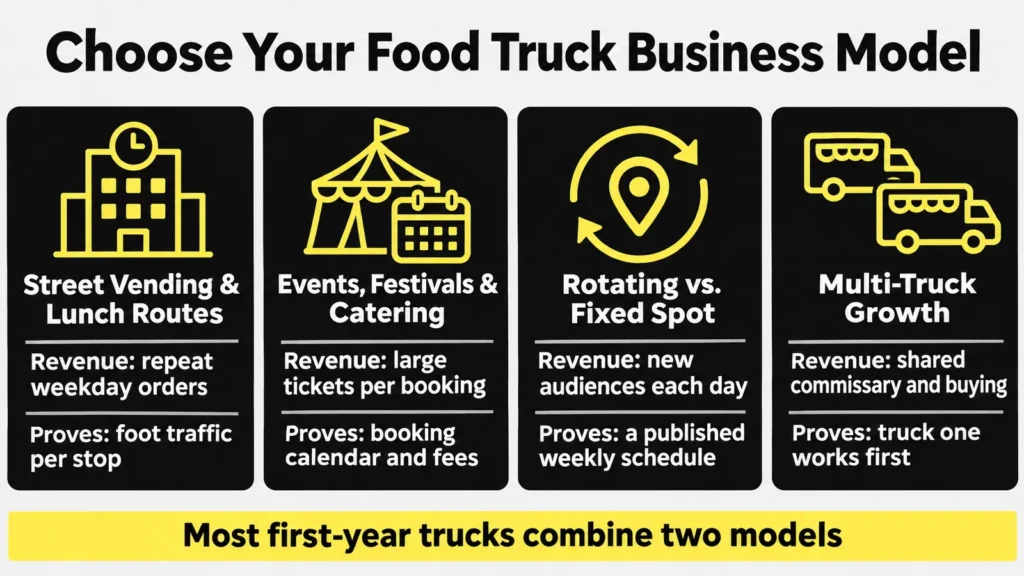
Most first-year trucks combine two of the four models below. The mix matters more than the label: a truck that earns 70% of its revenue from weekday lunches needs a different menu, schedule and marketing plan than one that lives on weekend festivals.
| Business model | Revenue driver | Typical risk | What the plan must prove |
|---|---|---|---|
| Street vending and lunch routes | Repeat weekday orders | Weather and parking rules | Foot traffic per stop and day |
| Events, festivals and catering | Large tickets per booking | Event fees and gaps between bookings | Booking calendar and fee structure |
| Rotating locations | New audiences each day | Lost regulars | A published weekly schedule |
| Multi-truck growth | Shared commissary and purchasing | Permits for every unit | That truck one works before truck two |
Street Vending and Lunch Routes
The lunch route sells to office workers, campuses and breweries on a fixed weekly rhythm. It competes with fast food more than with restaurants: an NPD Group survey found that nearly half of food truck visitors would otherwise have bought from a fast food chain. Price the menu against that alternative. Technomic data shows 60% of food truck customers take the food elsewhere to eat, so you don’t need seating in the plan, but you do need speed.
Events, Festivals, and Private Catering
Events bring large crowds and higher tickets, but the host usually takes a flat fee, a share of sales, or both. Put that commission in the financial plan as a variable cost per event, not as overhead. Private catering is the most predictable line because the guest count and price are agreed in advance.
Rotating-Location vs. Fixed-Spot Model
A rotating truck meets new customers every day but loses the regulars who can’t find it. A fixed spot in a truck pod or a private lot builds repeat business but adds lot rent. If you rotate, the plan needs a weekly location schedule and a way to publish it. Changing locations also changes the menu: a breakfast stop and a late-night brewery stop rarely sell the same items at the same prices.
Single Truck vs. Multi-Truck Growth Plan
A second truck doubles permits, inspections and staff, and in some cities the paperwork alone is a barrier: the Food Truck Nation report notes that an owner running a first truck full-time may face more than 30 days of bureaucracy to add a second. Write the growth step as a condition — for example, “a second truck after 12 months above break-even” — not as a promise.
How to Write a Food Truck Business Plan: Section by Section
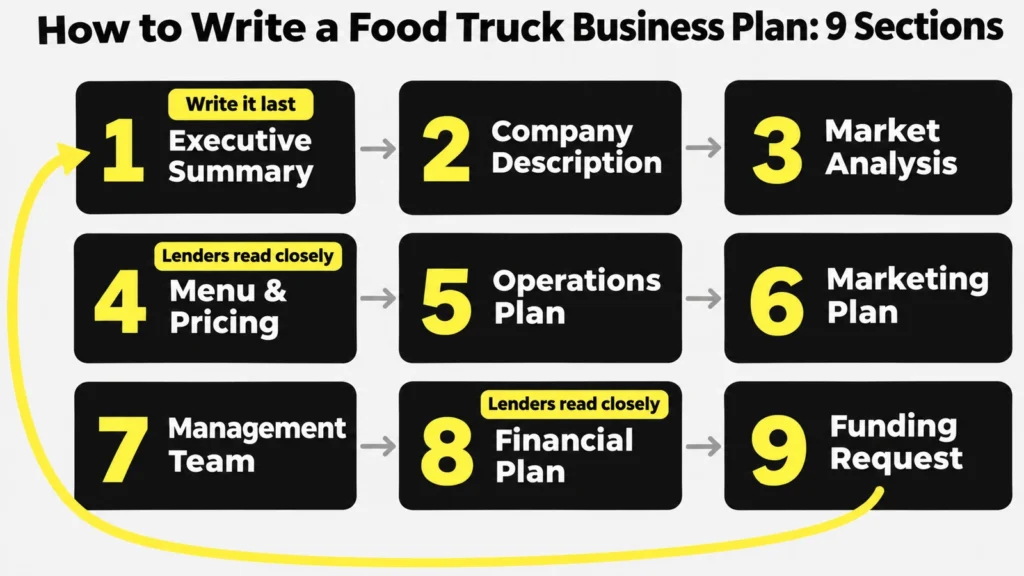
To write a food truck business plan, fill nine sections in a fixed order — executive summary, company description, market analysis, menu and pricing, operations, marketing, management, financial plan and funding request — and write the executive summary last.
The nine food truck business plan components follow a standard order, and a business plan for a food truck loan uses the same one, so lenders know where to look. Knowing how to write a business plan for a food truck comes down to the numbers inside each section, not the layout. Lenders usually see plans of 10 to 20 pages; an Upmetrics review of 2,348 business plans put the average at about 15–20 pages.
Executive Summary
One or two pages: the concept in one sentence, the service area, the business model, the funding ask and three numbers — startup cost, year-one revenue and break-even orders per day. Write it after the financial plan so the summary never promises what the projections contradict.
Company Description and Concept
State the legal structure (most trucks are an LLC with one or two owners), the truck versus trailer decision and what makes the concept worth choosing over the truck parked next to you. Explain why the food suits a mobile window: fast assembly, easy to carry, holds up for ten minutes.
Market Analysis for a Food Truck Business Plan
Describe your service area, not the national industry. Name the office parks, campuses, breweries and markets you plan to work, the days each one is worth and the trucks already there. Size the customer base with local data and segment it: the weekday lunch crowd and the Saturday market crowd buy different items at different tickets. A useful benchmark for demand: Technomic found 40% of consumers visit food trucks more often than they did two years earlier.
Menu and Pricing Strategy
List every item on the food truck menu with its price, ingredient cost and food cost as a share of price. Keep the menu tight: a Bournemouth University study found customers prefer around seven options per category, and a truck galley can’t execute much more at lunch-rush speed. Target a food cost of roughly 25–35% of the menu price, then price against the fast food alternative your customers would otherwise choose.
Operations Plan
The operations plan covers the truck and equipment — including whether you’re buying a food truck new, buying used or leasing — the commissary kitchen, daily prep-to-service workflow, permits and food safety. Most cities don’t allow food trucks to sell food prepared in a home kitchen, so budget for commissary access, which runs about $300 to $1,500 or more per month depending on the city and on whether prep time is included. That is $3,600 to $18,000 a year — the fixed cost new owners leave out most often.
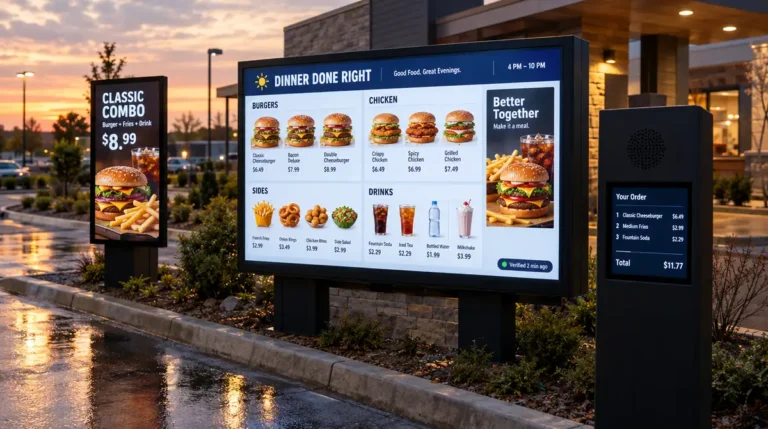
Customer-facing tech belongs in the same section: the POS, the payment reader and the screen customers order from. Outdoor digital menu boards for food trucks draw on the generator, need a vibration-proof mount and add a monthly software line, so the operations plan should name the hardware, the power budget and who updates prices.
Permits deserve their own table with each fee and lead time. The U.S. Chamber of Commerce Foundation’s Food Truck Nation study counted an average of 45 government-mandated procedures taking 37 business days and $28,276 in permits, fees and compliance to start and run a truck for a year across 20 cities. Boston and San Francisco required 32 procedures just to start a truck; Denver required 10. That average equals 19% to 71% of the truck’s own price, so in a high-cost city compliance can cost nearly as much as a budget vehicle. Most health departments base mobile unit rules on the FDA Food Code, and trucks with propane cooking also need fire department approval.
⚠️ Prepping at home to skip commissary fees does not work: most health departments require food trucks to prep, store food and dump wastewater at a licensed commissary, and a plan without a signed commissary agreement fails the permit review.
Food Truck Marketing Plan
The marketing plan explains how customers find a business with no fixed address: the weekly location schedule, social media, local directories, event and catering outreach, and what customers see at the window. Signage works at the point of sale — 80% of adults have seen digital signs in stores in the past month, and 70% of them made an unplanned purchase because of it, according to display-industry analyst Lyle Bunn. Give the menu board, photos and wrap their own line items instead of folding them into “branding”.
Management Team
List owners, ownership stakes, who holds food handler and food manager certificates, the headcount per shift and what happens when the owner is sick. Write down the partner exit terms now; the grind of service strains even close partnerships.
Food Truck Financial Plan and Projections
The financial plan holds food truck startup costs, a 12-month cash flow, a year-one profit and loss statement and break-even. Build revenue bottom-up: service days × orders per day × average ticket. Use benchmarks to sanity-check the result, not to set it:
| Benchmark | Value | Source |
|---|---|---|
| Average food truck revenue, 2024 | $346,000 | Restaurant HQ |
| Receipts per employer mobile food establishment | ≈ $342,000 | U.S. Census Bureau data, our calculation |
| Food and beverage cost | 25–35% of revenue | Industry cost breakdowns |
| Net profit margin | about 6% on average; 6–15% for well-run trucks | UpMenu, industry reports |
The two revenue figures, from different sources, land within 2% of each other, so $340,000–$350,000 is a reasonable reference point for a staffed truck. At a 6.2% margin, $346,000 in revenue leaves about $21,500 in net profit — which is why the owner’s draw must be its own line.
Funding Request
In a food truck start up business plan, this section states the amount, the use of funds and the repayment source. The SBA Microloan program lends up to $50,000 through nonprofit intermediaries, and lenders typically ask for the business plan, financial projections, a commissary agreement and health permits. The average microloan is about $13,000, which covers only 9–33% of a $40,000–$150,000 truck, so the plan has to show where the rest comes from: savings, equipment financing secured by the truck, or a bank loan.
⚠️ One SBA microloan rarely pays for a whole truck: the program caps loans at $50,000 and the average is near $13,000, so a plan built on a single microloan usually has a funding gap a lender will spot.
Food Truck Business Plan Template (Free Fill-In Outline)
This free food truck business plan template lists all nine sections with what to write in each and a sample line, so you can copy it into Word, Google Docs or a printable PDF and replace every number with your own quotes.
The table doubles as a food truck business plan outline: use it as a business plan template for food truck owners at any stage, or print it as a printable food truck business plan template and fill it in by hand. A food truck business plan template free of charge gives you structure, not a plan. The section order is standard, so there’s no value in inventing it, but every template ships with placeholder financials — and those are the pages a lender reads most carefully.
| Section | What to fill in | Sample line |
|---|---|---|
| Executive summary | Concept, area, model, funding ask, 3 key numbers | “Taco truck for weekday office lunches; $129,700 to launch; break-even at 38 orders a day.” |
| Company description | Legal structure, truck vs. trailer, name and concept | “Single-member LLC operating one 18-ft step van.” |
| Market analysis | Stops, foot traffic, competing trucks, customer segments | “Four office parks, 2 breweries, 3 competing trucks within a mile.” |
| Menu and pricing | Items, prices, food cost % | “7 items, $9–$16, average food cost 30%.” |
| Operations plan | Equipment, commissary, permits, daily workflow, customer-facing tech | “Commissary at $800/month; sunlight-readable window display; POS with price sync.” |
| Marketing plan | Weekly schedule, social, events, catering, signage | “Schedule posted every Sunday; 2 catering bookings a month.” |
| Management team | Owners, certificates, staffing per shift | “Owner plus 1 employee; both hold food handler cards.” |
| Financial plan | Startup costs, 12-month cash flow, P&L, break-even | “Fixed costs $7,400/month; contribution $9.29 per order.” |
| Funding request | Amount, use of funds, repayment | “$60,000 equipment loan secured by the truck.” |
For the company description row, pick the name early, because it ends up on the wrap, the permits and the LLC filing. If you work in Word, paste the table into a blank food truck business plan template Word file; keep the numbers in a food truck business plan Excel sheet or Google Sheets so one changed assumption — orders per day, ticket, food cost — flows through every statement. In the operations row, price the window display from real quotes: digital menu board costs split into hardware, software and installation, and a truck usually needs one or two screens, not a full restaurant setup.
⚠️ A free template is not a finished plan: its placeholder numbers have never been priced for your city, so copying them into a loan application is the fastest way to get it rejected.
Food Truck Business Plan Sample: A Worked Example
This food truck business plan sample models a fictional taco truck in a mid-size U.S. metro: $129,700 to launch, $20,475 in a stabilized month, a 30% food cost and 38 orders a day to break even before the owner takes a draw.
Treat this food truck business plan example as a starting point, not a quote: replace each line with prices from your own suppliers, commissary and city. Most sample food truck business plan PDF files online skip the owner’s wage; like any honest food truck sample business plan, this one doesn’t.
Food truck startup cost breakdown
| Line item | Cost |
|---|---|
| Used step van and kitchen build-out | $68,000 |
| Cooking and refrigeration equipment | $14,000 |
| Generator (inverter) | $4,000 |
| POS hardware | $800 |
| Sunlight-readable window display (2,500+ nits) | $4,400 |
| Wrap and exterior graphics | $3,000 |
| Permits, plan review and first-year licenses | $3,500 |
| Insurance, first year | $4,800 |
| Opening inventory and smallwares | $3,500 |
| Launch marketing | $1,500 |
| Working capital reserve (3 months of fixed costs) | $22,200 |
| Total | $129,700 |
A stabilized month
The truck serves 65 orders a day at a $15 average ticket over 21 service days: 1,365 orders and $20,475 in revenue.
| Line | Amount |
|---|---|
| Revenue | $20,475 |
| Food and packaging (30%) | $6,143 |
| Card processing (2.7%) | $553 |
| Fuel and propane | $1,092 |
| Fixed costs (loan $900, commissary $800, insurance $400, permits $250, maintenance $400, marketing and software $450, one employee $4,200) | $7,400 |
| Profit before owner’s draw | $5,288 |
| Owner’s draw | $3,500 |
| Net profit | $1,788 (8.7%) |
The 8.7% net margin sits inside the 6–15% band reported for well-run trucks.
Break-even in three lines
- Contribution per order: $15.00 ticket − $4.50 food − $0.41 card fee − $0.80 fuel = $9.29.
- Break-even before the owner’s draw: $7,400 ÷ $9.29 = 797 orders a month, or 38 a day.
- Break-even including a $3,500 owner’s draw: $10,900 ÷ $9.29 = 1,173 orders a month, or 56 a day.
The gap between 38 and 56 orders a day is the difference between a truck that survives and a truck that pays its owner. The way seasons affect the food truck industry tightens it further: if winter volume drops to 60% of a stabilized month, the truck clears only about $200 before the owner’s draw, which is why the plan carries a three-month reserve. Catering fills slow months without adding street service days, and a catering menu packages your street items for private events.
Niche Examples: BBQ, Coffee, and Vegan Food Truck Plans
The same nine sections work for every concept; these food truck business plan examples show where each niche changes the numbers.
- BBQ food truck business plan: a smoker adds equipment cost and long cook times, so the plan should show batch sizes, holding times and how sold-out items come off the menu mid-service.
- Coffee food truck business plan: a lower average ticket means the break-even order count runs far higher than for a meal truck, so morning routes near offices and campuses carry the model.
- Vegan concept: ingredient costs can run higher, and the market analysis has to prove local demand street by street instead of assuming it.
Why a Digital Menu Belongs in Your Plan
A digital menu at the service window belongs in the operations and financial sections of your plan because a sunlight-readable screen raises the average ticket, shortens perceived waits and lets you change menus and prices between locations in minutes.
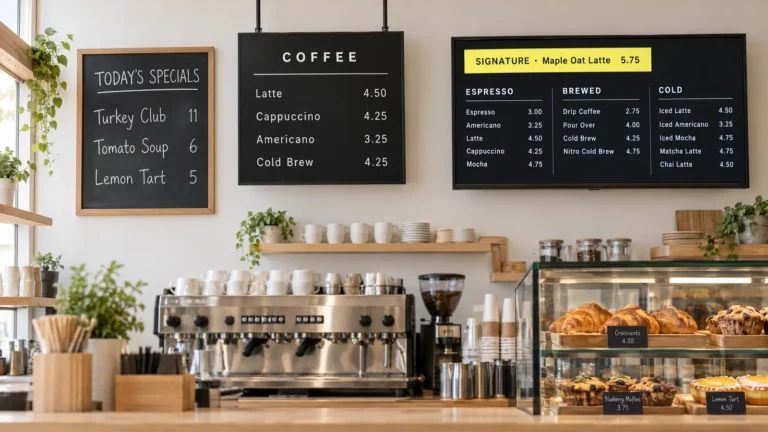
The sample above budgets $4,400 for an outdoor screen, and the reason is simple. The menu is the last thing a customer reads before ordering, and on a truck it doubles as the storefront. That’s why more operators budget for an outdoor display as a line item instead of treating a printed board as a one-time branding cost. A printed board can’t change between a breakfast stop and a brewery, and a consumer TV can’t be read in the midday sun.
Visibility From the Curb
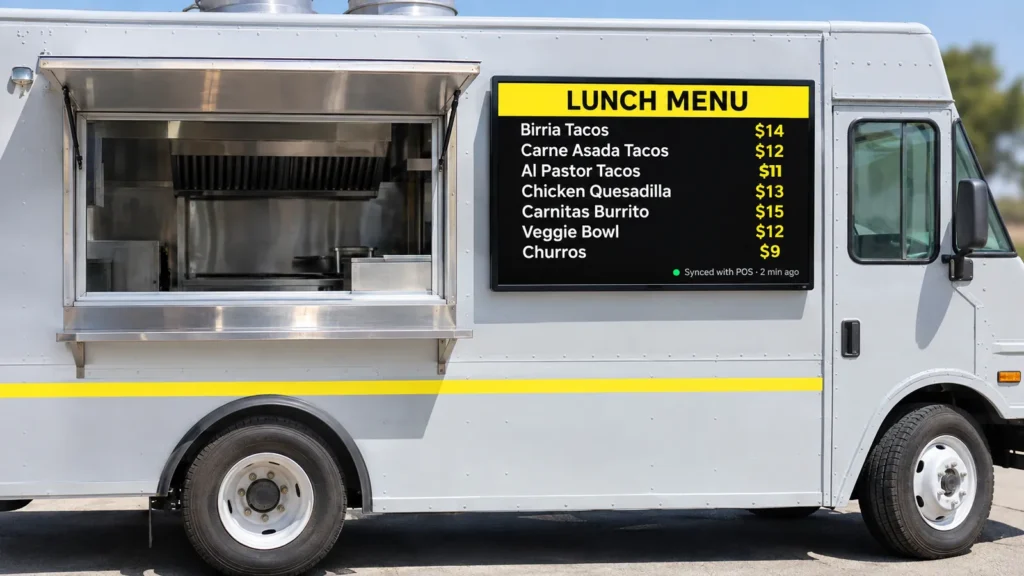
Brightness decides whether a screen works outdoors. A standard office monitor delivers 200–300 nits and a smartphone 600–1,000 nits; a screen in direct sunlight needs at least 2,500 nits. In other words, an ordinary TV at 300–500 nits is five to eight times too dim for a west-facing service window. Budget an outdoor-rated, weatherproof display, and plan the mount so it survives road vibration.
⚠️ A regular indoor TV is not an outdoor display: at 300–500 nits it washes out in direct sun, while outdoor-rated displays start around 2,500 nits.
A Bigger Average Ticket
Restaurant studies put the average sales lift after a switch to digital menus at 3–5%, according to a Networld Media Group ROI study, and McDonald’s reported a 3–5% higher average ticket in its U.S. locations. Conservative tests come in lower: WAND measured a 2% lift at a single store. Item-level results can be larger — Orlando’s Market saw appetizer sales rise 11% and ice cream sundae sales 9%, and Taco John’s saw sales up 12% seven months into a digital menu test.
Applied to a truck, the 3–5% range on $346,000 in revenue adds $10,380 to $17,300 in sales a year. At a 30% food cost that is roughly $7,300 to $12,100 in gross profit before card fees — 34% to 56% on top of the $21,500 net profit an average truck keeps.
Shorter Perceived Waits at the Window
Customers overestimate the time they spend in line by about 36%, and digital screens reduce perceived wait time by up to 35%, according to research summarized by Digital Signage Today. Those two numbers almost cancel out: with a moving screen to read, the line feels about as long as it really is. Tasty’s Fresh Burgers recorded a 35% drop in perceived wait time and a 37% increase in sales of promoted items after it moved its menu and promos onto screens.
Instant Menu and Price Changes Between Locations
A food truck business model that moves between a lunch route, an evening event and a catering job needs three menus and sometimes three price lists. A digital board switches them on a schedule or in a few taps, keeps each menu near the seven-item sweet spot and removes the reprint cost every time a supplier raises a price. When the screen pulls prices from your POS, the board and the register can’t disagree.
Decker, screen software from Alpha Intec, Inc., a Delaware corporation, connects the menu to Toast, Square and Clover, so POS digital signage updates prices and sold-out items on the screen automatically. Decker Player keeps the last menu on screen if the truck loses its connection.
How to Budget the Window Display in Your Financial Plan
Put the screen in startup costs and the software in monthly fixed costs. An outdoor 2,500-nit, IP65-rated display lists at around $4,400. Against $7,300–$12,100 a year in extra gross profit, that pays back in about 4 to 7 months — faster than the 9–18 months reported for restaurant chains, because a truck needs one or two screens, not a system for every location.
| Line item | Where it goes in the plan | Example amount |
|---|---|---|
| Outdoor display (2,500+ nits) | Startup costs | ≈ $4,400 |
| Screen menu software | Monthly fixed costs | $0 on Decker’s Starter plan for one screen; paid plans from $8 per screen/month |
| POS price sync and daypart menus | Monthly fixed costs | Decker Professional plan, $12 per screen/month |
| Expected sales lift | Revenue assumptions | 3–5% (use 2% in a conservative case) |
As of Decker’s pricing update on 10/26/2026, one screen stays free on the Starter plan with no credit card, and paid plans start at $8 per screen/month before sales tax.
When a Digital Menu Doesn’t Pay Off
A screen is not the right line item for every truck. Leave it out of the plan, or push it to year two, if one of these conditions applies:
- You work fewer than 8 service days a month. At $100,000 a year in revenue, a 3–5% lift is $3,000–$5,000 in sales, so a $4,400 outdoor display takes well over a year to pay back from gross profit.
- Your menu has four items or fewer and never changes. A printed board does the same job when there are no dayparts, specials or price changes to push.
- You can’t afford a screen of 2,500 nits or more and you serve in direct sun. A dim indoor TV reads worse than vinyl, so it costs sales instead of adding them.
- Your truck has no stable power during service. The screen runs off the same generator as the fryer; without spare capacity, budget the generator upgrade first.
Ready to put a sunlight-readable menu on your truck? Build route-based menus, sync prices from Toast, Square or Clover, and update every board from your phone. See digital menu boards for food trucks →
Mistakes That Get Plans Rejected
Most rejected food truck business plans share four defects: revenue worked backward from a target, permit costs without evidence, no owner’s wage and no slow-season plan — each one easy for a lender to spot and easy for you to fix before you apply.
- Revenue backed into from a goal. Build revenue from orders × ticket, then check that one window can physically serve that many orders in the lunch hour.
- No permit evidence. Attach application receipts, fees and lead times; in capped-permit cities this is the biggest execution risk in the plan. In the order for starting a food truck, the health department call comes before the truck purchase, so the plan should already show plan-review fees and dates.
- No owner’s wage. A truck showing 25% profit while the owner works 60 unpaid hours a week isn’t profitable — the wage is hidden in the profit line.
- No slow season. Show winter months at their real volume and carry a cash reserve that covers them, instead of projecting the summer peak for all 12 months.
- A bloated menu. More than about seven items per category slows the line and raises waste.
⚠️ “60% of food trucks fail in the first year” does not hold up in federal data: the Bureau of Labor Statistics shows 20.4% of all new U.S. businesses close within their first year, and an analysis of the same data puts the first-year closure rate in accommodation and food services at 14.7% — about a quarter of the popular claim.
Build the plan on that real baseline. About 49% of new businesses are still open after five years, so the plan’s job is not to promise survival but to show how the truck gets through year one.
Questions and Answers
1 How long should the plan be?
Most food truck business plans run 10–25 pages plus appendices, and the average business plan lands at about 15–20 pages. A tight plan with a real P&L beats a long one padded with industry background.
2 Do I need a business plan to get a food truck loan?
Yes, for a bank or SBA-backed loan. SBA Microloan lenders typically ask for a business plan, financial projections, a commissary agreement and health permits; equipment financing secured by the truck is more lenient.
3 How much money do I need to start a food truck?
The truck alone runs about $40,000–$150,000. Our worked sample needs $129,700 including a $22,200 working capital reserve; a trailer build or a leased truck can start lower.
4 Are food trucks profitable in 2026?
Many are, on thin margins. The average truck nets about 6%, and well-run trucks reach 6–15%. Industry revenue is expected to dip 1.1% in 2026 as tariffs raise costs, so price your menu with that pressure in mind.
5 What should be included in a business plan for a food truck?
Nine sections: executive summary, company description, market analysis, menu and pricing, operations, marketing, management, financial plan and funding request — plus appendices with your menu, permits, insurance and supplier quotes.
6 Can I use a free template?
Yes, for structure. Replace every placeholder number with quotes from your own suppliers, commissary and city before anyone else reads it.
7 Can I download the plan as a PDF?
You can turn this guide into one: copy the template table and the worked sample into Word or Google Docs and export it. A food truck business plan sample PDF is useful as a format reference, but a lender needs your own numbers, not a downloaded example.
8 Is $50,000 enough to start a food truck business?
Sometimes, with a used trailer, a leased truck or a small build-out. It leaves little room for permits, insurance and a cash reserve, so model a three-month reserve before you commit.
9 What is the most profitable food truck model?
The one with repeat demand and a short menu: weekday lunch routes plus catering usually beat pure festival schedules because bookings and regulars are predictable. Your own break-even math decides it.
10 Should the plan include a digital menu at the window?
If you change menus between locations or serve more than 8 days a month, yes. Put the screen in startup costs, the software in monthly costs and a 2–5% sales lift in your revenue assumptions.
11 Can ChatGPT write a business plan for me?
An AI tool can draft the structure and wording, but it can’t price your menu, quote your commissary or know your city’s permit fees. The numbers have to come from your own research.
12 What is the biggest problem food trucks face?
Fixed costs that keep running on slow days: commissary, insurance, the truck payment and permits. That’s why the plan should show break-even orders per day and a slow-season reserve.
Sources
- U.S. Bureau of Labor Statistics: Food trucks drive fast employment growth in mobile food services
- IBISWorld: Food Trucks in the US industry analysis
- U.S. Chamber of Commerce Foundation: Food Truck Nation report
- U.S. Small Business Administration: Microloans
- WAND: What's the ROI of digital menu technology