Digital signage costs $1,500 to $300,000 per project — here is what sets your price


Digital signage cost runs from about $1,500 for a one-to-three-screen indoor setup to $300,000 or more for a video wall or roadside LED structure. The display eats 40–60% of the budget; installation, power work, permits and software add another 20–40% on top.
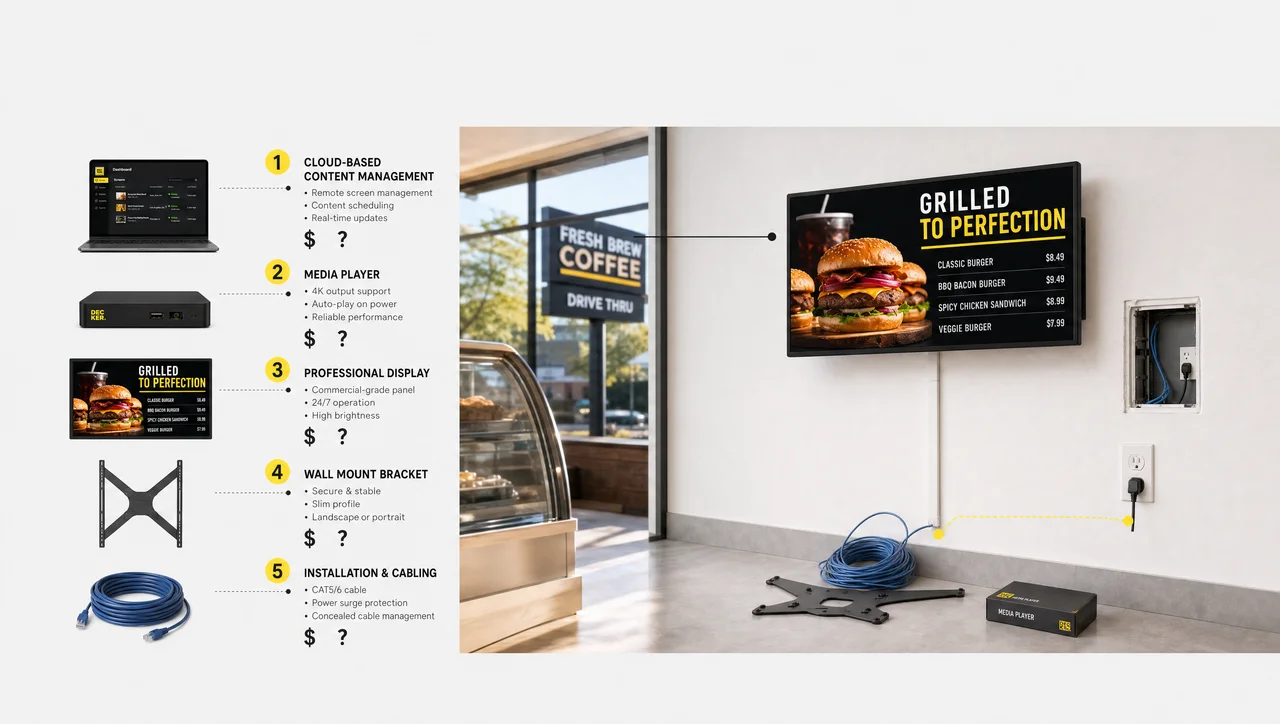
That spread is not vendor mystery. It is five separate purchases stacked into one invoice — screen, player, mounting and wiring, software, and everything that repeats every year afterwards.
Buyers who price only the screen are the ones who get surprised in week three. Demand is not the problem — a FedEx Office survey found roughly 76% of US shoppers had entered a store because of its signage. Measurement is: in the State of Digital Signage 2026 survey of 515 operators, 76.5% do not track the return on screens they already own, and only 6.2% use a concrete method.
This guide breaks each line down with current US market numbers, then gives you a way to build your own estimate before you ask anyone for a quote.
Digital signage cost in 2026: price ranges at a glance
Digital signage costs between $1,500 and $300,000 per project in the US, and the gap comes from four variables: screen count, indoor versus outdoor placement, colour capability, and whether the sign goes onto an existing structure or a new one.
Here is where the market actually sits in 2026:
| Tier | Typical range | What you get |
|---|---|---|
| Single indoor screen, installed | $800 – $2,000 | Commercial display, player, mount, basic wall install |
| Small indoor setup (1–3 screens) | $1,500 – $4,000 | Hardware, mounts, install, plus a monthly software fee |
| Entry outdoor LED sign | $3,800 – $5,000 | Basic single-sided board, single or limited colour |
| Retrofit or replacement | $1,500 – $10,000 | New LED panel into an existing cabinet or monument base |
| Mid-range full-colour outdoor | $6,500 – $35,000 | Full-colour display, mounting structure, permits, power |
| Full-service package | $10,000 – $30,000 | Consultation, install, training, software bundled |
| Multi-screen rollout (4–20) | $10,000 – $35,000 | Networked screens across one or several sites |
| Large-format and billboard | $30,000 – $300,000+ | Video walls, monument builds, roadside LED structures |
Two numbers do most of the planning work. The display absorbs 40–60% of the total, so once you know the screen, you know roughly half the project.
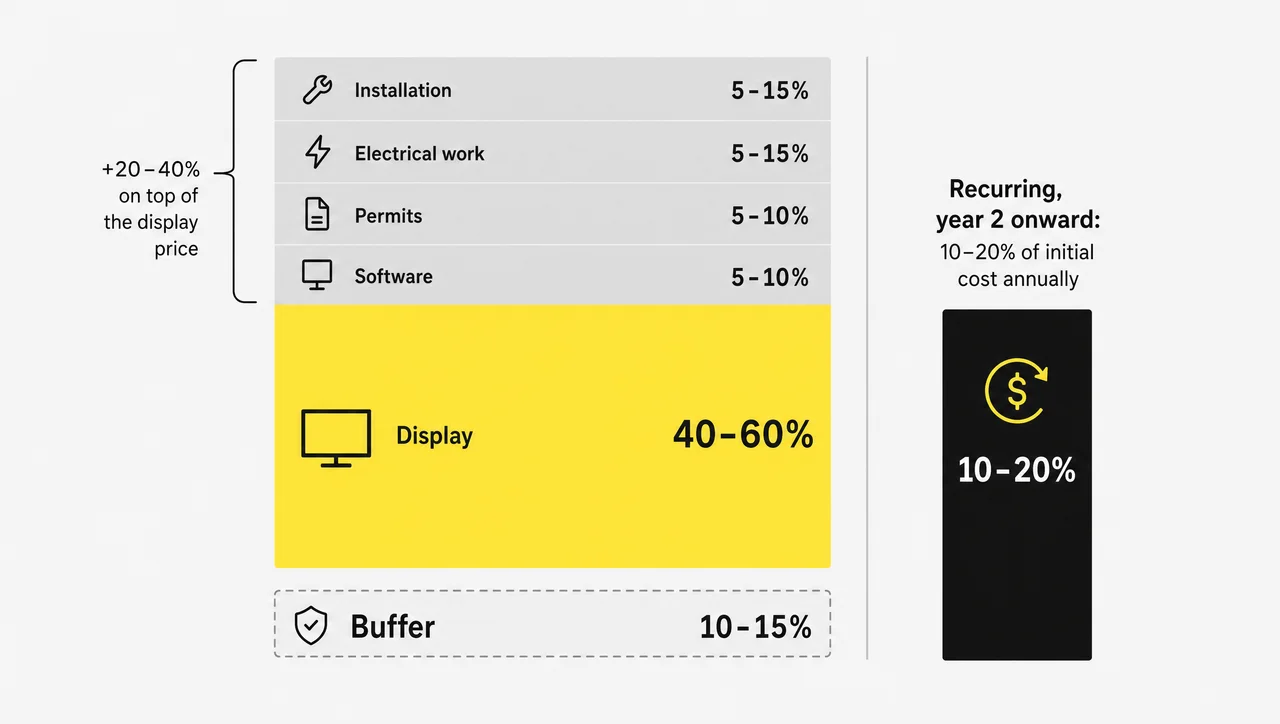
Everything around the display — mounting labour, electrical runs, permits, first-year software — typically adds 20–40% on top of the screen price, not 5%. A small shop can start near $2,000; a corporate network can pass $100,000 without leaving the ordinary.
For scale context, the Ernst & Young study commissioned by the International Sign Association put the US sign and visual communications industry at $37.5 billion in economic impact with over 200,000 workers, and digital is the segment taking share from print.
Digital signage display price: what the screen itself costs
The digital signage display price ranges from about $400 for an entry 43-inch commercial panel to $200,000 for a large outdoor LED structure, and screen class matters more than diagonal size.
Current US pricing by category:
- Entry commercial panels (24–43-inch): $320 – $760
- Standard commercial panels (55-inch): $900 – $2,200
- High-spec 55-inch, 500+ nits or touch: $2,200 – $2,800
- Typical per-screen range across the market: $300 – $3,000 once brightness and duty rating vary
- High-brightness and outdoor-rated panels: $2,000 – $10,000
- Large LED boards and billboards: $10,000 – $200,000+
Older price guides still quote $298 for a 43-inch commercial panel. The panels behind that figure are discontinued or replaced, and the floor for a new commercial 43-inch is closer to $400.
Retail listings show the outdoor end plainly. A custom outdoor LED sign starts around $4,028, while a double-sided 25″ × 50″ board with a five-year warranty lists near $69,240 before dealer discounting — roughly $34,620 after. Small wall-mounted signs sit at the other end, $200 to $1,000, with a single wall sign often quoted near $700.
Six things move the number before you pick a model: budget ceiling, diagonal and format, brand and warranty length, where the screen physically hangs, weather exposure, and the resolution of the content you plan to run.
That last one is easy to skip and expensive to fix. If you are running high-resolution images and video, check the RAM and processing headroom of the panel or player — cheap hardware with a short warranty is money spent twice. Modern digital signage technology spans plug-and-play sticks and cloud-connected networks, and the two are not priced anywhere near each other.
Expect three to four years of service life as a floor, and five to seven from a quality commercial panel that is cleaned and ventilated properly.
Commercial displays vs consumer TVs: what the price gap buys
A consumer smart TV starts around $100 and a commercial display of the same diagonal can reach $2,500. The difference is not picture quality — it is duty rating and warranty.
Commercial panels are built for continuous operation and carry longer coverage. Consumer sets are rated for a few hours of daily use and warrantied accordingly, which is why a basic 32-inch LCD at roughly $500 looks like a bargain and often is not.
Consumer hardware can still work, but only when the platform is built for it — our guide to picking a tv for digital signage covers which sets survive a signage duty cycle.
⚠️ “A TV is a TV” is not true for signage: consumer sets are rated for roughly 4–8 hours of daily viewing, while signage runs 12–16 hours. A $400 TV replaced twice in three years costs more than a $1,000 commercial panel with a three-year warranty.
How much is a monitor you can actually use for signage?
Shoppers searching for monitor prices land on a different market entirely. Consumer monitors in US retail run roughly $199 to $1,100, with most work-grade models clustering near $230–$400.
Those panels are built for a desk at arm’s length, not a lobby at 20 feet. Brightness is typically half what a commercial signage panel delivers, and there is no continuous-operation rating.
A monitor works as a signage screen in exactly one scenario: a low-traffic internal display running a few hours a day, where replacement is cheap and downtime costs nothing.
Recommended commercial displays and current prices
Named models make the range concrete:
| Model | Size | Resolution | Price | Notable |
|---|---|---|---|---|
| Samsung QB24C | 24″ | UHD, 250 nits | $319.99 | Smallest commercial class, for shelf edge and counters |
| ViewSonic CDE4302 | 43″ | 1920×1080, 350 nits | $399 – $467 | DLED backlight, USB media player, flicker-free with blue light filter, RS232 and HDMI-CEC, 16/7 rating |
| Samsung QM43C | 43″ | 4K UHD, 500 nits | $728.99 | Brightness for daylight-facing indoor positions |
| ViewSonic CDE4330 | 43″ | 4K UHD | $759 | Current replacement for the CDE4302 |
| Samsung QB55R-B | 55″ | 4K UHD, 143 W | $724 – $1,250 | System-on-chip with embedded player, Wi-Fi and Bluetooth, UHD upscaling, 3-year warranty |
| Samsung QM55R-B | 55″ | 4K UHD | $1,244.76 | Non-glare panel, UHD upscaling |
| Samsung QH55R | 55″ | 4K UHD | $2,191 | Upper commercial tier |
| Samsung QM55R-T | 55″ | 4K UHD, touch | $2,795 | Capacitive touch, embedded player, all-in-one |
Commercial panels move 20–30% between dealers on the same SKU, so treat these as a band rather than a sticker.
Two things this table settles. The QB55R carries an embedded player, which removes a whole line item from the quote — worth $150–$600 depending on what you would otherwise buy. And the ViewSonic CDE4302 shows what a 16/7 duty rating with a flicker-free backlight costs when staff look at the screen for a full shift: about $400, not $300 and not $1,000.
What display specs to compare between two quotes
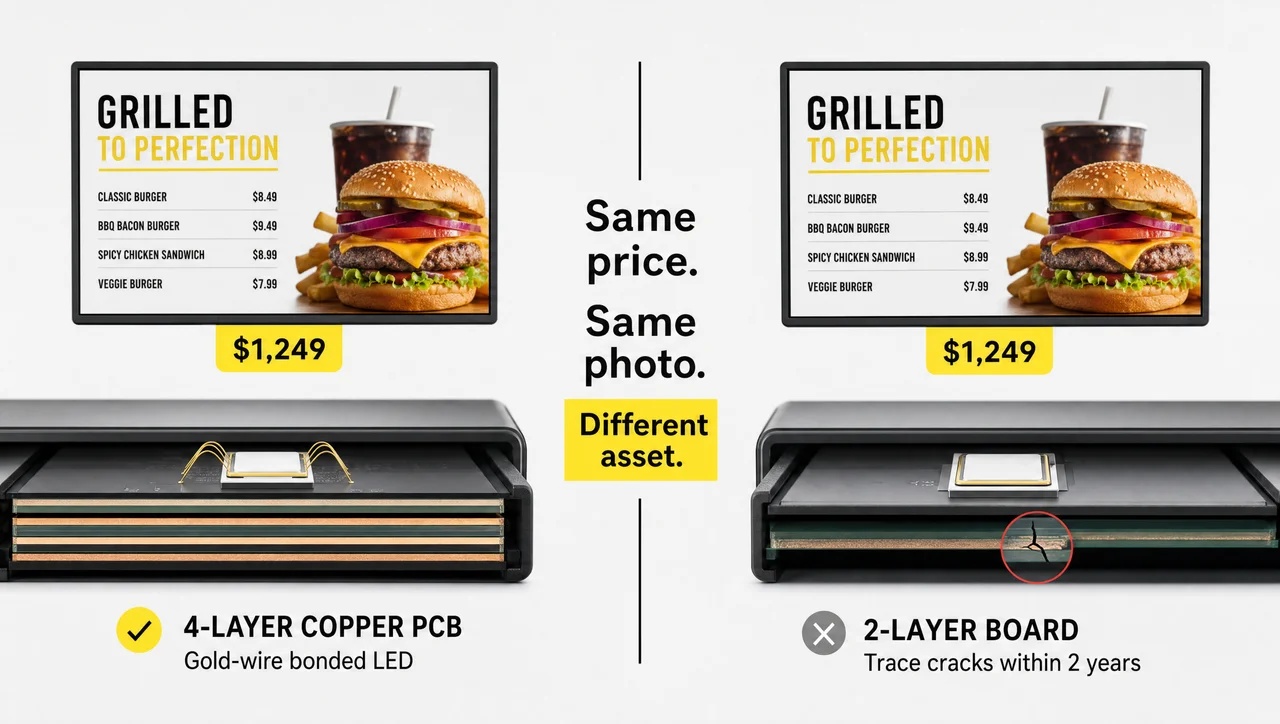
Two quotes at the same price can hide very different hardware. The markers worth checking:
- PCB construction. Four-layer copper boards with gold-wire bonded LEDs versus two-layer boards that develop trace cracks inside two years.
- Pixel pitch. Tighter pitch means higher resolution and higher cost per square foot. It also sets the minimum viewing distance.
- Module count. A 2ft × 6ft display uses fewer modules than a 4ft × 10ft one, which is most of why the bigger board costs more.
- Cabinet and serviceability. Whether modules swap from the front, and whether the controller is a standard part or proprietary.
- Communication hardware. Wi-Fi, LTE modem or CAT5 — often quoted separately, sometimes not quoted at all.
Full-colour vs single-colour: a 30–60% premium
Full-colour LED displays mix red, green and blue diodes to render millions of colours. Single-colour boards use one diode colour, usually red or amber.
Full-colour displays cost 30% to 60% more than a comparable single-colour sign, and that premium buys images, logos and video: scripture graphics for a church, team logos for a school, food photography for a restaurant.
It is not automatic. A business that only runs scrolling text — hours, service changes, a phone number — gets the job done on a single-colour board for meaningfully less.
Media players, mounts and cabling: the digital signs cost quotes leave out
A media player and mounting hardware add $80 to $1,000 per screen to digital signs cost, and both get left out of first-draft quotes more often than any other component.
Player pricing splits into two distinct markets:
- Consumer streaming sticks: $30 – $40, with the common model at $35
- Android media boxes: $60 – $80
- Commercial-grade players: $150 – $600
- Whole-market range including bundled options: $0 – $500
- Embedded system-on-chip players: $0 additional, built into the display
Mounting and cabling run $50 – $200 for a straightforward indoor wall mount, and $100 – $400 per screen once you add enclosures, outdoor-rated cable and weather sealing. A Wi-Fi router or network switch belongs in the same line.
Pick the software before the player, not the other way round. The operating system your platform supports determines which hardware is eligible, and a cheap stick running the wrong OS is a full re-buy. If your platform is Android-based, an inexpensive stick is usually the right answer.
One structural note: sticks and embedded players report nothing back. If a screen freezes on a black frame at 11am, nobody finds out until a customer mentions it. Purpose-built verification hardware monitors screen and player independently and restarts both remotely, which turns player choice into an uptime decision rather than a $39 decision.
Signage cost of installation, electrical work and permits
Installation, power infrastructure and permitting add $400 to $17,000 to signage cost depending on whether the sign goes indoors or into the ground outside. This is a one-time block — once done, it does not recur — but it is where quotes diverge most.
Installation by scenario:
| Scenario | Typical cost |
|---|---|
| Small indoor screen | $130 – $500 |
| Basic per-screen install | $200 – $500 |
| Standard professional install | $200 – $1,000 per screen |
| Large wall-mounted display | $500 – $2,000+ |
| Multi-screen indoor rollout | $2,000 – $10,000 |
| Outdoor structure, pole or monument | $1,000 – $10,000+ |
Some installers bill by hour rather than by screen — around $295 for the first hour and $195 for each hour after — which is worth asking about when your site has awkward access. Mounting height, wiring through walls and network configuration are the three variables that move the figure.
Older wiring and unusual architecture push it up. For multi-site rollouts, add project management and on-site technicians as separate lines. And a bad install is not just slow: incorrect mounting can physically damage the hardware.
Electrical work is the line buyers forget. New lines, upgraded circuits, trenched conduit and disconnects run $1,500 to $5,000 and up on outdoor projects, and $500 to $5,000+ across the market as a whole.
The variable is distance. If the electrical panel sits 200 feet from where the sign goes, trenching alone can outweigh the mounting labour. Outdoor signs also need weather-rated components and dedicated circuits, which is not a place to economise.
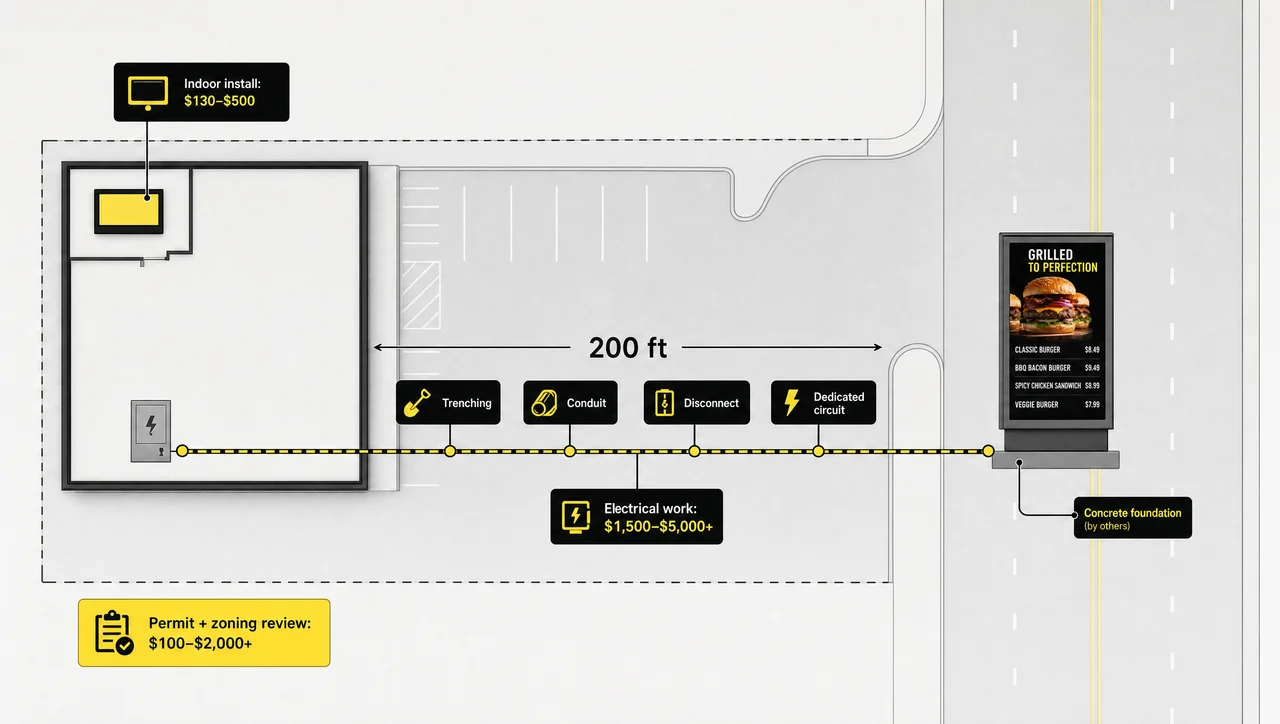
Permits and zoning add $100 to $2,000+ in city fees, engineering drawings and inspections. The Federal Highway Administration’s MUTCD standards govern signage near public roads, and many municipalities model their commercial sign codes on the same framework.
That is why the same sign costs different amounts in different cities — permit schedules, inspection requirements and contractor rates are all local. Check power availability and sign code before you sign a quote, not after the cabinet is fabricated.
Digital signage software pricing: subscriptions vs licences
Digital signage software pricing runs from free to over $120 per screen per month, and it is the only component with two genuinely different billing models rather than one range.
Across 515 operators surveyed for the State of Digital Signage 2026 report, 56.1% pay $11–20 per screen per month, 20.0% pay $21–50, 9.1% pay $5–10, and only 1.6% pay above $50. Published rates across major platforms span $7 to $45 per screen per month.
Full market spread:
- Free tiers: $0, typically capped at 1–3 screens
- Entry paid plans: $3 – $10 per screen per month
- Common cloud plans: $11 – $20 per screen per month, where the majority of operators sit
- Annual billing: $99 – $300 per screen per year
- Premium tiers: up to $100 – $120 per screen per month
- Enterprise plans: from $1,000 per month for large networks
- Perpetual licence: $500 – $3,000 one-time, plus maintenance
- Licence fees across the market: $0 – $1,000 depending on model
Decker sits inside that band: a free forever plan for a single screen with no card required, $8 per screen/month at the entry paid tier, $12 with POS price synchronisation and proof-of-play reporting, and $16 with SSO, audit logs and menu-to-sales attribution. Annual billing saves 15%, against a market norm of 10–20% for annual terms, and verification hardware adds $7 per screen/month.
⚠️ “Free forever, no limits” is not the whole offer: free plans on this market generally stop at one to three screens and strip scheduling, multi-zone layouts or monitoring. The paid tier starts at screen four, which is exactly where most real deployments begin.
Software rarely breaks a budget — on a five-screen setup it is often under 5% of year-one spend. What it decides is labour. A platform that needs someone to walk to each screen with a USB stick costs a staff hour per change; one that publishes remotely costs nothing after setup.
The functional floor worth insisting on: remote publishing, scheduling, support for images, video and HTML, screen zoning, user roles, and per-screen status reporting. Good digital signs software also needs a support team that answers quickly, because the first month is when questions cluster.
A monthly plan before an annual contract is a reasonable way to find out whether your team will actually use it. A 30-day trial across several screens tells you more than a feature list does.
Digital sign costs that repeat: content, energy and maintenance
Recurring digital sign costs land between $340 and $1,000 per screen per year once you count content production, electricity and service. These numbers separate purchase price from ownership cost.
Content production
- Freelance design: $15 – $25 per hour
- Basic templates or static layouts: $50 – $200 each
- Custom animation or video: $300 – $1,000+ per piece
Frequency decides the model. Occasional updates suit freelance hours; constant updates justify an in-house designer, or more cheaply, a template library inside the platform. A professional designer is genuinely necessary only when signage is your core media channel.
Businesses underestimate this line more than any other, usually by budgeting hardware and assuming content is free. Template editors that handle images, HTML and video cut it close to zero for routine changes — a restaurant swapping a menu item, an office posting an event banner.
There is a third option that removes the line entirely: generating layouts from data you already maintain. When a menu is bound to the POS, a price change in the till regenerates the board image on its own. That is the mechanism behind the Burger Shop deployment in Downtown LA, where update time dropped from days to minutes across four screens.
Energy
Consumption depends on size, resolution, LED density and hours of operation. A 32-inch or 43-inch LCD drawing 200 watts, running 16 hours a day, uses about 1,170 kWh a year. At the US commercial average of 13.4 cents per kWh that is roughly $157. In California at 25.75 cents the same screen costs over $300.
Modern outdoor LED panels draw as little as 230 W/m², but scale changes the arithmetic — a 60 m² board running 10 hours daily costs roughly $20 a day. Newer models are meaningfully more efficient than the generation they replace, which is where operational savings actually come from.
| Setup | Draw | Hours/day | Annual electricity |
|---|---|---|---|
| 43″ indoor LCD | 200 W | 16 | ~$157 |
| Typical indoor screen | — | 12–16 | $140 – $250 depending on state rate |
| Large indoor or high-brightness | — | 16 | $100 – $500 |
| Per display, monthly | — | 12–16 | $5 – $20 |
| 60 m² outdoor LED board | 230 W/m² | 10 | ~$7,300 |
Maintenance, support and warranty
Budget $100 – $300 per screen per year for maintenance, and the same again for a technical support contract. A useful planning rule: annual maintenance runs 10–20% of the initial installation cost.
Replacement modules, software updates, connectivity fees, cleaning and occasional service all sit here. Most buyers forget the category entirely and discover it in year two.
Warranty terms move the five-year total more than purchase price does. A five-year limited warranty covering defective parts, in-factory labour, LED panels, power supplies and control boards is a materially different asset from one year on the same cabinet.
Third-party communication devices — Wi-Fi bridges, LTE modems — usually carry their own one-year coverage regardless of the sign warranty. Read both before comparing totals.
One-time vs recurring: how digital signage pricing splits
Digital signage pricing separates cleanly into what you pay once and what you pay forever. Mixing the two is the most common budgeting error.
| One-time | Recurring |
|---|---|
| Display hardware | Software subscription or licence maintenance |
| Media players | Content creation and updates |
| Mounts, enclosures, cabling | Maintenance, repairs and replacement modules |
| Installation labour | Electricity |
| Electrical work | Connectivity (Wi-Fi, LTE data) |
| Permits and inspections | Technical support contract |
Installation belongs strictly on the left. Electricity belongs strictly on the right. A perpetual licence is the only item that lands on both sides.
Outdoor digital signage cost vs indoor: electronic signs prices by placement
Outdoor digital signage cost runs $10,000 to $100,000 versus $5,000 to $10,000 indoors, and the gap is engineering, not size.
- Indoor electronic signs: $5,000 – $10,000 for a lobby wall, sanctuary display or retail screen set
- Outdoor signs: $10,000 – $100,000, with most commercial installations landing in the $10,000 – $80,000 band
- Interactive and touch displays: $15,000 – $30,000
Electronic signs prices climb outdoors because of four requirements indoor units do not have — and electronic signs cost more to run afterwards for the same reasons: sealed weatherproof housing, brightness legible in direct sun, active cooling, and weather-rated electrical supply.
A larger screen indoors costs more than a smaller one. The same screen moved outside costs multiples more. Indoor installs are simply simpler.
Interactive displays sit in their own band because the value is engagement rather than visibility — the touch layer, the processing behind it and the more complex mounting all price in. Video walls and multi-screen configurations add processing load on top of panel cost, so the multiplier is never just the number of screens.
Installed 2026 prices by outdoor configuration, which is how manufacturers actually quote:
| Configuration | Active display area | Typical pitch | Installed price |
|---|---|---|---|
| Reader board 3×1 | 9.5ft × 3.2ft | P8 or P10 | $8,000 – $13,000 |
| Standard business sign 3×2 | 9.5ft × 6.3ft | P6.67 or P8 | $12,000 – $18,000 |
| Church or school marquee 4×2 | 12.6ft × 6.3ft | P6.67 or P8 | $16,000 – $24,000 |
| High-traffic roadside 5×3 | 15.75ft × 9.5ft | P8 or P10 | $22,000 – $35,000 |
One multiplier is missing from most quotes until you ask: a double-sided sign costs 60–80% more than the same sign single-sided. On a $16,000 marquee that is $10,000–$13,000 you did not budget, and it is the single largest avoidable surprise in outdoor projects.
Digital sign prices by industry: schools, churches, restaurants and retail
Digital sign prices vary by sector because of three things — viewing distance, message complexity and local sign code — not because vendors charge schools differently from restaurants.
| Segment | Typical range | Main cost driver |
|---|---|---|
| Retail, indoor | $5,000 – $10,000 | Screen count and layout complexity |
| Schools | $2,000 – $30,000 per campus, ~$16,000 typical | Road speed and required letter height |
| Churches | $5,000 – $25,000 | Roadside visibility, structure type |
| Restaurants | $6,500 – $25,000 | Full-colour requirement, mounting style |
| Business, outdoor | $10,000 – $50,000 | Structure, permits, brightness |
| Corporate networks | $30,000 – $100,000+ | Screen count, integrations, central management |
The phrase electric message board usually describes the cheapest end of this table: a single-colour LED board running scrolling text, which starts around $5,000 installed and does the job when the message is words rather than pictures.
Hotels, medical clinics and corporate offices sit between the retail and network rows, priced by screen count rather than by structure.
How much is a digital sign for a school?
A small single-panel LED board for daily announcements starts near $5,000. A full-colour monument sign with a large display area reaches $35,000 or more, and the per-campus band across the market sits between $2,000 and $30,000.
Schools choose between three constructions, and the choice is usually decided by what is already standing on the property rather than by budget:
- Retrofit — a new LED panel into the existing sign structure. Cheapest entry.
- Standalone LED board — new board, simple mounting, no masonry.
- Full monument sign — new base, new cabinet, full permit and foundation work.
Size follows an industry rule rather than taste: one inch of letter height for every 10 feet of viewing distance. A campus on a 45 mph road may need legibility from 300+ feet, which forces letter height up, display size up, and cost up with them.
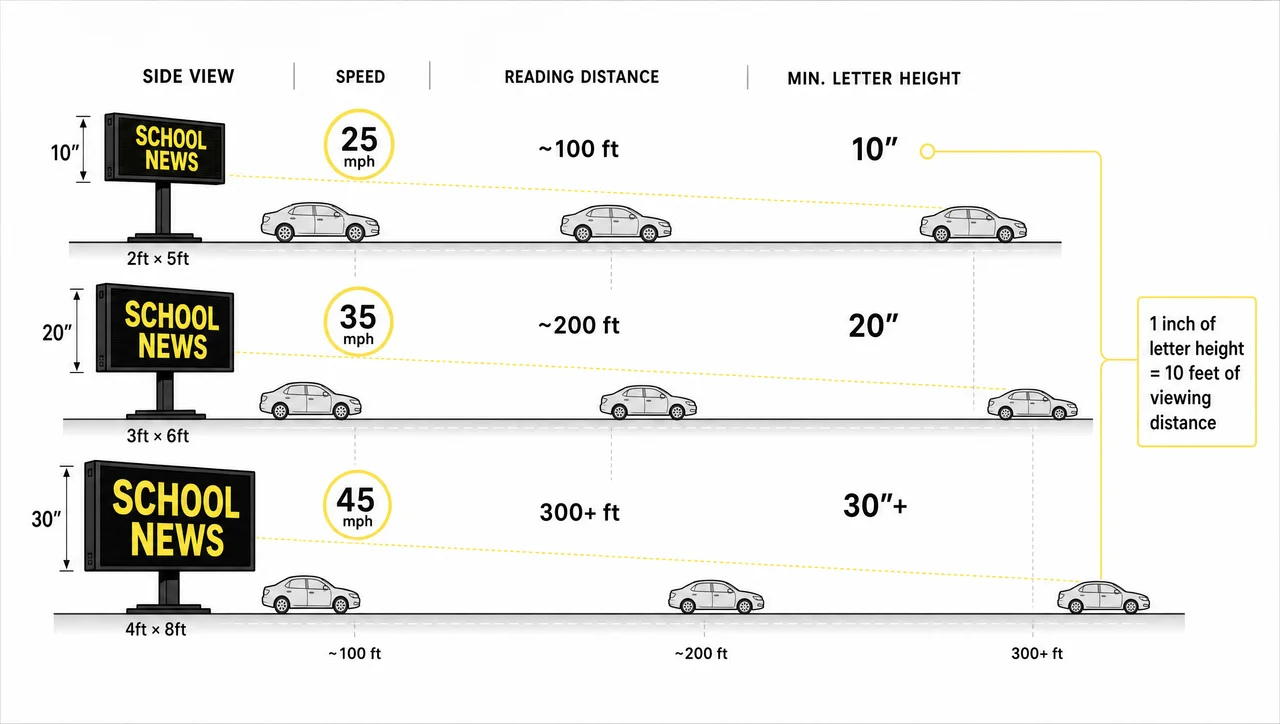
| Road speed | Viewing distance needed | Minimum letter height | Practical display size |
|---|---|---|---|
| 25 mph | ~100 ft | 10″ | 2ft × 5ft |
| 35 mph | ~200 ft | 20″ | 3ft × 6ft |
| 45 mph+ | 300+ ft | 30″+ | 4ft × 8ft or larger |
Larger boards cost more because they need more LED modules, bigger cabinets and stronger mounting structures. A school on a quiet 25 mph street reads fine from a smaller and cheaper display.
How much is a digital sign for a church?
Text-only LED boards start around $5,000. Full-colour church displays run $7,000 to $25,000 depending on size and resolution. Most outdoor church signs sit at the low end of the general outdoor range rather than the middle.
Roadside position drives the number. A church at a busy intersection needs legibility from further out, which raises display size, structural requirements and installation labour together.
Budget separately for software access, electricity, cleaning and replacement modules. Churches are the segment most likely to fund the purchase and forget the running cost. Indoor LED walls for a lobby or sanctuary are priced against the indoor table above, not this one.
How much does a digital sign cost for a restaurant?
A mid-range full-colour display for a restaurant lands between $6,500 and $25,000 depending on size and mounting. Four mounting scenarios price differently: roadside, wall-mounted, pole-mounted, or integrated into an existing structure.
Full colour is not optional here in the way it is for a school. A restaurant competing with a row of storefronts needs to show food, daily specials and limited-time offers, and text cannot do that.
Indoors, the same logic applies to menu screens: the display earns its cost through daypart switching and promotion changes rather than through the panel itself. Compare restaurant quotes on total installed cost — hardware, installation, software, permits, power and maintenance in one figure.
Digital signage prices by project scale
Component pricing tells you what things cost. Project pricing tells you what you will actually write a cheque for.
| Scale | Screens | Hardware | Software | Installation | Average total |
|---|---|---|---|---|---|
| Small setup | 1–3 | $600 – $2,000 | $10 – $50/mo | $300 – $800 per screen | $1,500 – $4,000 |
| Medium rollout | 4–20 | $5,000 – $25,000 | $50 – $500/mo | $2,000 – $10,000 | $10,000 – $35,000 |
| Large or outdoor | 20+ | $20,000 – $200,000+ | $1,000+/mo | $5,000 – $50,000 | $30,000 – $300,000+ |
Small setups suit cafés, boutiques and single offices. Medium rollouts show up in retail chains, hotels and medical clinics — the scale where centralised management stops being a convenience and becomes the only workable option.
Large installations cover video walls, transport hubs, stadiums and roadside LED. They carry two costs the smaller tiers do not: structural supports quoted separately from installation, and enterprise plans that finally make software a visible line. A complete digital signage solution at this scale is priced per deployment rather than per screen.
The same picture appears in market data from a different angle. Small businesses commonly report spending $1,000 to $5,000. Initial per-screen setup lands at $680 to $3,400+, or $400 to $2,500 upfront with $8 to $30 monthly software. A basic multi-screen deployment often starts around $4,700, and a single screen at $2,000 to $4,000 is a common quote.
Cost of digital signs by component: the summary
The cost of digital signs in one table, for copying into a budget request:
| Cost component | Typical range | What drives the price up |
|---|---|---|
| Display, indoor commercial | $320 – $2,800 per screen | Diagonal, brightness, duty rating, brand |
| LED display and cabinet, outdoor | $3,800 – $50,000+ | Size, resolution, full colour, double-sided |
| Media player | $0 – $600 | Consumer stick vs commercial player vs embedded |
| Mounts, enclosures, cabling | $50 – $400 per screen | Outdoor enclosure, mounting height, cable grade |
| Installation, indoor | $130 – $2,000 | Wall type, height, cable routing |
| Installation, outdoor | $1,000 – $10,000+ | Foundation, pole height, site access |
| Electrical and power work | $500 – $5,000+ | Distance from panel, trenching, circuit upgrades |
| Permits and zoning | $100 – $2,000+ | City fees, engineering drawings, inspections |
| Software | $0 – $120 per screen/mo, or $500 – $3,000 one-time | Screen count, feature tier, billing model |
| Software and connectivity, outdoor sign | $0 – $500/year | Cloud platform, LTE modem, scheduling |
| Content creation | $15 – $25/hr; $50 – $1,000+ per asset | Update frequency, animation, video |
| Electricity | $140 – $250/yr indoor; $5 – $20/mo per display | Size, resolution, hours, LED density, state rate |
| Maintenance and support | $100 – $300 per screen/yr; 10–20% of initial cost | Warranty length, indoor vs outdoor, screen count |
One caveat on reading it: the display row covers the component only. A project total sits well above that row for outdoor work, because the four rows underneath it are where outdoor money goes.
How to calculate your own digital sign cost
How much does digital signage cost at your specific site? Most calculators ask for a screen count and return a number with no working shown. Here is the arithmetic behind them, so you can run it yourself before any vendor sees your budget.
Indoor, per screen. Display + player + mount + install = base cost. Add software × 12 months × screens. Add 10–20% of the base for annual maintenance.
Worked example: a 55-inch commercial panel at $1,200, a $300 commercial player, a $120 mount and a $500 install gives $2,120 up front, plus roughly $360 a year in software and $250 in maintenance.
Outdoor, per sign. Outdoor pricing is driven by display area, so the useful unit is cost per square foot. Take cabinet dimensions, multiply by the per-square-foot rate for your pixel pitch, then add mounting structure, electrical run, permits and shipping.
A 4ft × 8ft full-colour board is 32 square feet. What that costs depends almost entirely on pitch:
| Pixel pitch | Minimum viewing distance | Installed cost per sq ft |
|---|---|---|
| P4 – P8, outdoor | 13 – 26 ft | $400 – $900 |
| P3 – P4, coarse indoor | 10 – 13 ft | $500 – $900 |
| P2.5 | ~8 ft | $900 – $1,600 |
| P1.5 – P1.9, fine pitch | 5 – 6 ft | $1,500 – $2,500 |
| P0.9 – P1.2, micro pitch | 3 – 4 ft | $2,500 – $4,000+ |
Moving one step tighter typically adds 25–50%. Moving several steps multiplies: P4 carries roughly six times the pixel count of P10, and the price follows. Two quotes for the same physical dimensions can differ threefold on pitch alone, which is the most common source of confusion in outdoor comparison. Hardware alone for a 32 sq ft outdoor panel lands at $6,400–$19,200 before installation.
Five-year view. Initial project cost + (annual software × 5) + (annual maintenance × 5) + (annual electricity × 5) + one player replacement. Players age faster than screens, so budget one refresh inside the display’s life.
Run those three and you will know within about 15% what a vendor should quote. The remaining variance is site conditions — old wiring, difficult access, unusual permit requirements — which nobody prices from a desk.
Hidden costs and the buffer: why digital signs prices grow after signing
Permits, electrical upgrades and custom mounts push digital signs prices 10–15% above a budget that looked complete, which is why experienced buyers hold a buffer instead of a contingency conversation.
The recurring surprises:
- Connectivity. Each screen needs data. Wi-Fi may not reach; LTE means a modem and a data plan.
- Provisioning. Configuring the network, enrolling devices and setting up content management takes technical hours before anything displays.
- Integrations. POS systems, sensors and live data feeds each need programming beyond standard setup.
- Custom mounts. Non-standard walls, ceilings and structures rarely take an off-the-shelf bracket.
- Staff training. Somebody has to learn the platform, and that time is real.
Ask installers for quotes that separate equipment, labour and recurring charges into three blocks. A single total tells you nothing you can negotiate; three blocks tell you where the money is and which part you could scope differently.
Skipping any of these categories does not remove the cost. It moves it into month two, when the budget is already approved.
How to compare digital signage suppliers and read a quote
A complete digital signage quote covers display, cabinet, control system, software licence, mounting hardware, shipping and installation — and the most common source of buyer frustration is a quote that looks cheap until the missing pieces get added.
Digital sign pricing structures differ more than the totals suggest. Some suppliers include training and warranty; others bill both separately. Communication hardware — Wi-Fi bridge, LTE modem, CAT5 run — is frequently absent from a base quote entirely.
Four pricing red flags:
- Missing line items. Anything you cannot see, you will pay for later.
- Unusually low pricing. It almost always means installation or permits are excluded.
- No product specifications. A quote without pixel pitch, panel construction and warranty terms is not comparable to anything.
- A vendor who will not explain the proposal in detail. Detailed answers signal transparency; vague ones signal risk.
Hidden commissions inflate quotes too. Some resellers add margin to a manufacturer’s sign without disclosing it, which is why a direct relationship usually produces both better pricing and a single point of contact for warranty, training and support.
Ask for a written breakdown of six lines: display cost, installation cost, electrical cost, permit cost, software cost, warranty terms. Ask who handles permits, who pays for repairs after year one, and whether the supplier subcontracts or pays third-party commissions.
A supplier who cannot produce a line-item breakdown either does not know their own costs or does not want you to see them.
Then gather at least three quotes, insist recurring fees are stated, and compare lifetime cost rather than installation price. Two criteria beyond price are worth weighting: display service life and how far the platform scales when you add screens.
Tell suppliers your actual goal — cutting menu update time, improving in-store engagement, reducing print runs — because that usually produces a cheaper recommendation than a spec list does.
When digital signage is not worth the cost
The honest version of a pricing guide includes the cases where the answer is no. Five of them:
- Under 4 hours of daily foot traffic past the screen. At a $2,000 installed cost and 100 viewers a day, cost per thousand impressions is worse than a printed poster replaced quarterly.
- Content that changes less than twice a year. A permanent menu or fixed price list costs $50–$200 to print once. The digital equivalent costs $2,000 up front plus $500 a year to show the same static image.
- One screen with nobody responsible for it. The most common cause of poor return is not price — it is a single display nobody updates. Without a named content owner, the screen becomes an expensive clock.
- Outdoor placement with the panel over 150 feet away and no trenching budget. Trenching adds $1,500–$5,000, which can exceed the sign’s own price on a small board.
- A site where local code caps brightness or size below your visibility requirement. Confirm the code first. A sign that is legal but unreadable from the road is a total loss, not a compromise.
⚠️ “Digital always beats print on cost” is not true across the board: digital wins when content changes often. Below roughly two content changes a year, printed signage is cheaper across a five-year horizon even before electricity.
Signage pricing on payment terms: financing, five-year ownership and return
Financing spreads a digital sign across budget cycles instead of requiring the full amount up front, which is why schools, churches and small businesses use it most.
Many manufacturers arrange financing through third-party lenders, and the US Small Business Administration publishes guidance on planning capital purchases. Five questions before signing: interest rate, payment term, total repayment amount, early payoff rules, and which services are included in the financed price.
One principle protects you: financing must not change what is in the project. If the cash quote covers installation, software and warranty, the financed version covers the same three. Compare the financed total against the cash price to see what spreading payments actually costs.
On ownership, evaluate over five years rather than at purchase. Signage depreciates like any other technology, and knowing the depreciation curve is what makes replacement and upgrade budgeting possible instead of reactive.
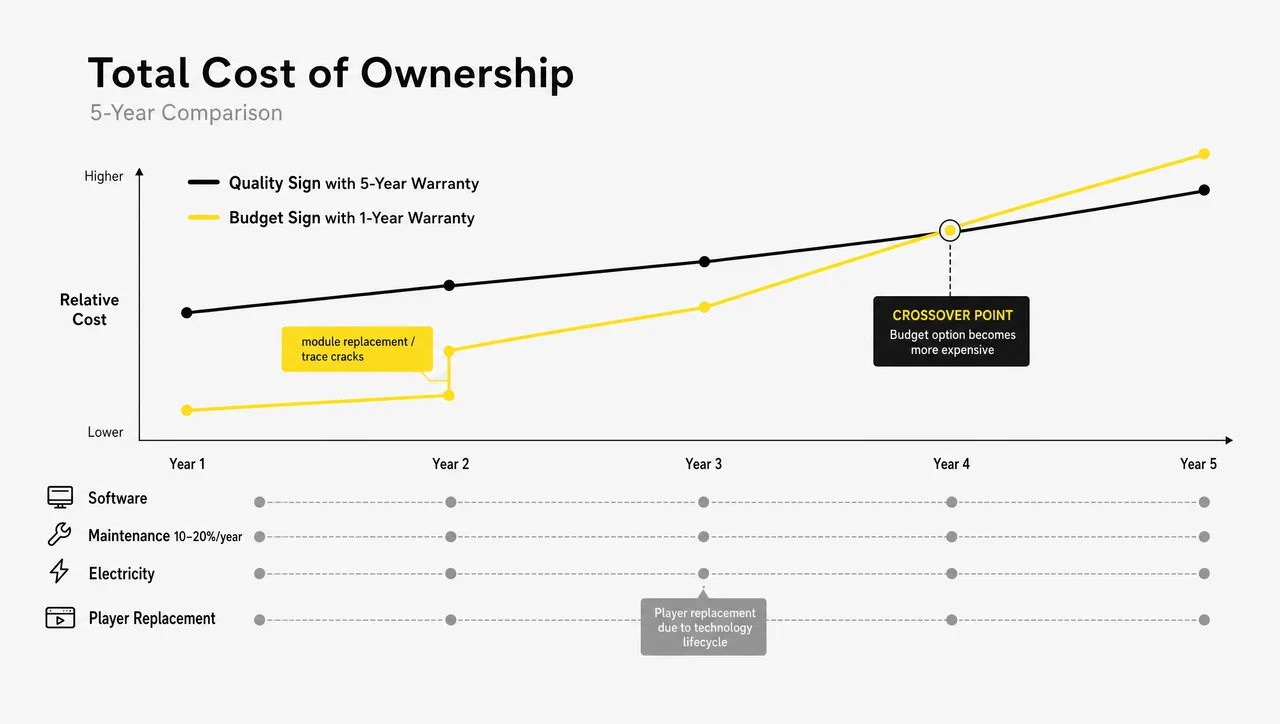
Quality displays last five to seven years with proper care; players need replacing sooner as platform requirements move. A cheaper sign with one year of coverage can easily cost more across five years than a better sign with five.
⚠️ “The cheapest quote is the cheapest sign” is not reliable: two boards at identical prices differ on PCB construction and warranty length, and the one with two-layer boards can start failing modules inside two years. Compare five-year totals, not invoice totals.
Return shows up in flexibility rather than in the screen. Promotions go live the same hour, content shifts by daypart, print runs disappear, and cloud management means none of it requires being on site.
Most buyers never find out whether it worked. In the 515-operator State of Digital Signage 2026 survey, 76.5% measure no return at all and 17.7% go on impressions alone, leaving 6.2% using any concrete method. That is the real risk in this budget — not overpaying for a panel, but never learning whether the panel earned anything.
Track three metrics to avoid joining them: sales uplift on promoted items, dwell time in the area the screen serves, and staff hours saved on updates. For networks, add a fourth — screen uptime, measured per location rather than assumed, because a display that was dark for six hours returned nothing that day.
Modest improvements usually outweigh the recurring fees, and screens generally draw more footfall than static boards.
Questions and Answers
1 How much does a digital sign cost in total?
Between about $3,800 for a basic single-sided outdoor LED board and $100,000+ for a large double-sided monument configuration. Indoor setups of one to three screens land at $1,500–$4,000. The variables are display size, resolution, colour capability, mounting type and installation complexity.
2 What are the factors that affect digital signage costs most?
Five: display size, pixel pitch, colour capability, installation method and local regulations. Larger signs need more LED modules and stronger structures. Tighter pixel pitch costs more per square foot. Outdoor placement adds weatherproofing, electrical work and permits that indoor placement does not.
3 What is the average price for a single digital signage screen in the USA?
$800 to $2,000 installed for a commercial-grade screen with a media player and mount. That figure includes installation labour, which is what makes it more useful than a screen-only price.
4 Are there monthly fees for digital signage?
Yes. Most operators pay $11–$20 per screen per month, with a fifth of the market at $21–$50 and entry plans from $7. Annual billing at $99–$300 per screen per year is common and usually discounts 10–20%. Free tiers exist but cap screen count and features.
5 How much is a monitor for digital signage use?
Consumer monitors run $199–$1,100 and are built for desk viewing a few hours a day. A commercial 43-inch signage panel starts near $400 and is rated for 16/7 operation with matching warranty. For anything running 12+ hours daily, the commercial panel is cheaper per year of service.
6 Can you install digital signage yourself?
For a single indoor screen, yes. For multi-screen or outdoor projects, no — incorrect mounting or wiring can damage hardware outright, which erases the labour saving several times over. Outdoor installations also need permits and inspections a DIY install will not clear.
7 What ongoing maintenance does a digital sign need?
Software updates, occasional module replacement, cleaning and technical support. Plan on 10–20% of the initial installation cost annually, or $100–$300 per screen per year for maintenance plus a similar amount for a support contract.
8 How does digital signage reduce operational costs?
Through energy efficiency and eliminated printing. A 43-inch LCD at 200 watts running 16 hours daily on $0.12/kWh costs about $140 a year, and newer outdoor LED panels draw as little as 230 W/m². The larger saving is reprints that no longer happen and staff hours no longer spent swapping posters.
9 How can I lower the total cost of digital signage?
Start with fewer screens and scale, choose energy-efficient panels, use platform templates instead of commissioned design, and pick software that cuts management time rather than the cheapest licence. Buying direct rather than through a reseller removes an undisclosed margin layer.
10 How long do digital signage systems last?
Quality commercial displays last five to seven years with proper care; hardware in general delivers three to four years minimum. Media players need replacing sooner than screens as software requirements advance, so budget one player refresh inside each display’s service life.
11 Do outdoor screens need special equipment?
Yes. Weatherproof sealed housing, high-brightness panels and active cooling are all mandatory, along with weather-rated electrical components and dedicated circuits. Those requirements — not physical size — are why outdoor installations cost several times an indoor equivalent.
12 Is there a cost per square foot for digital signs?
For outdoor LED, yes, and it is the most reliable way to compare quotes. Installed rates in 2026 run $400–$900 per square foot for coarse outdoor pitch (P4–P8) and climb to $2,500–$4,000+ for micro pitch under P1.2. Multiply cabinet area by the rate for your pitch, then add structure, electrical, permits and shipping separately.